Thought Leadership · Prestige Gastronomy · Starred Alsace · Biometrics · Wellness · 2026
The table has become an instrument of health as much as a place of pleasure. Alsace, France's most starred region per capita, is the most accomplished demonstration of this.
34 Michelin stars
Alsace 2026 — including 6 in Strasbourg · 1 green star (NYD Breitenbach) · Sommellerie Prize (Table du Gourmet, Riquewihr)
6 tables in Strasbourg
1741 · Au Crocodile · De:ja · Les Funambules · Umami · Les Plaisirs Gourmands — all maintained in Michelin 2026
Biometrics + table
The most advanced wellness stays integrate biometric assessment and real-time nutritional recommendations into the gastronomic experience
There is a moment when eating ceases to be an ordinary act and becomes something else — an experience engaging all five senses simultaneously, summoning memory, structuring cultural identity and, in the most achieved expressions, reconfiguring the physiological state of the person eating. This is the moment prestige gastronomy seeks to reach — not at every bite, but in the construction of a meal as sensory and emotional architecture.
The UHNWI wellness-first clientele of 2026 no longer visits a starred table solely for standing or hedonistic pleasure — they do so also because they know that what they eat, how it is cooked, with what ingredients and in what state of attention, directly impacts their cognitive and physiological performance in the hours that follow. Alsace, with its 34 Michelin-starred restaurants — the densest of any French region relative to population — and its incomparably rich agricultural terroir, is one of the territories where this convergence is most authentically lived.
Strasbourg's starred gastronomy in 2026: updated map
The 2026 Michelin Guide confirms the solidity of Strasbourg's gastronomic scene. The city retains six starred establishments — a remarkable stability in a vintage where Alsace obtained no new stars but confirmed the coherence of its existing fabric.
Au Crocodile (rue de l'Outre) is the reference institution, founded in 1801, today led by chef Franck Pelux. The house of classic French grand cuisine in Strasbourg — service, cellar, consistency — at a level recent establishments struggle to match. 1741 (facing the Palais Rohan) is the table of precision: Jérémy Page, trained under Joël Robuchon, marries noble and peasant products with what Gault&Millau 2026 describes as "rare precision." The closest to the Parisian palace format. De:ja (David Degoursy and Jeanne Satori) carries engaged, natural, near-narrative Nordic cuisine — what Gault&Millau describes as "a thousand leagues from what one expects of an Alsatian table, yet profoundly anchored in the terroir." The most coherent with regenerative gastronomy values: organic/biodynamic products, militantly respected seasons, preparations that reveal matter rather than transform it. Les Funambules (chef Guillaume Besson, rue Geiler) offers high-level gastronomy with a biodynamic and natural wine cellar coordinated by sommelier Camille Cullard, trained at Auberge de l'Ill and Alchémille. Umami has been exploring the fifth flavour dimension for over fifteen years on rue des Dentelles. Les Plaisirs Gourmands (Guillaume Scheer) is the quietest of the six, appreciated by insiders for its consistency.
Beyond Strasbourg: Alsace's great tables within 60km
The Auberge de l'Ill in Illhaeusern (Haeberlin family, three stars for decades) remains Alsatian gastronomy's absolute reference — classical cuisine, a setting of rare beauty on the Ill river, service precision that has not aged. JY'S in Colmar (Jean-Yves Schillinger, two stars) best translates Alsatian gastronomic modernity — creative, precise, with a remarkable wine list. The Table du Gourmet in Riquewihr, whose sommelier Anne Humbrecht just received the 2026 Michelin Sommellerie Prize, merits a detour for its cellar and vineyard-anchored cuisine. In the committed and regenerative register, NYD - 48° Nord (Julien Schaffhauser, Breitenbach), recently awarded a 2026 Michelin Green Star, is the Alsatian table whose philosophy most coherently aligns with sustainable gastronomy values: ultra-local sourcing, named partner producers, militant seasonality.
Gastronomy as total sensory experience: beyond the meal
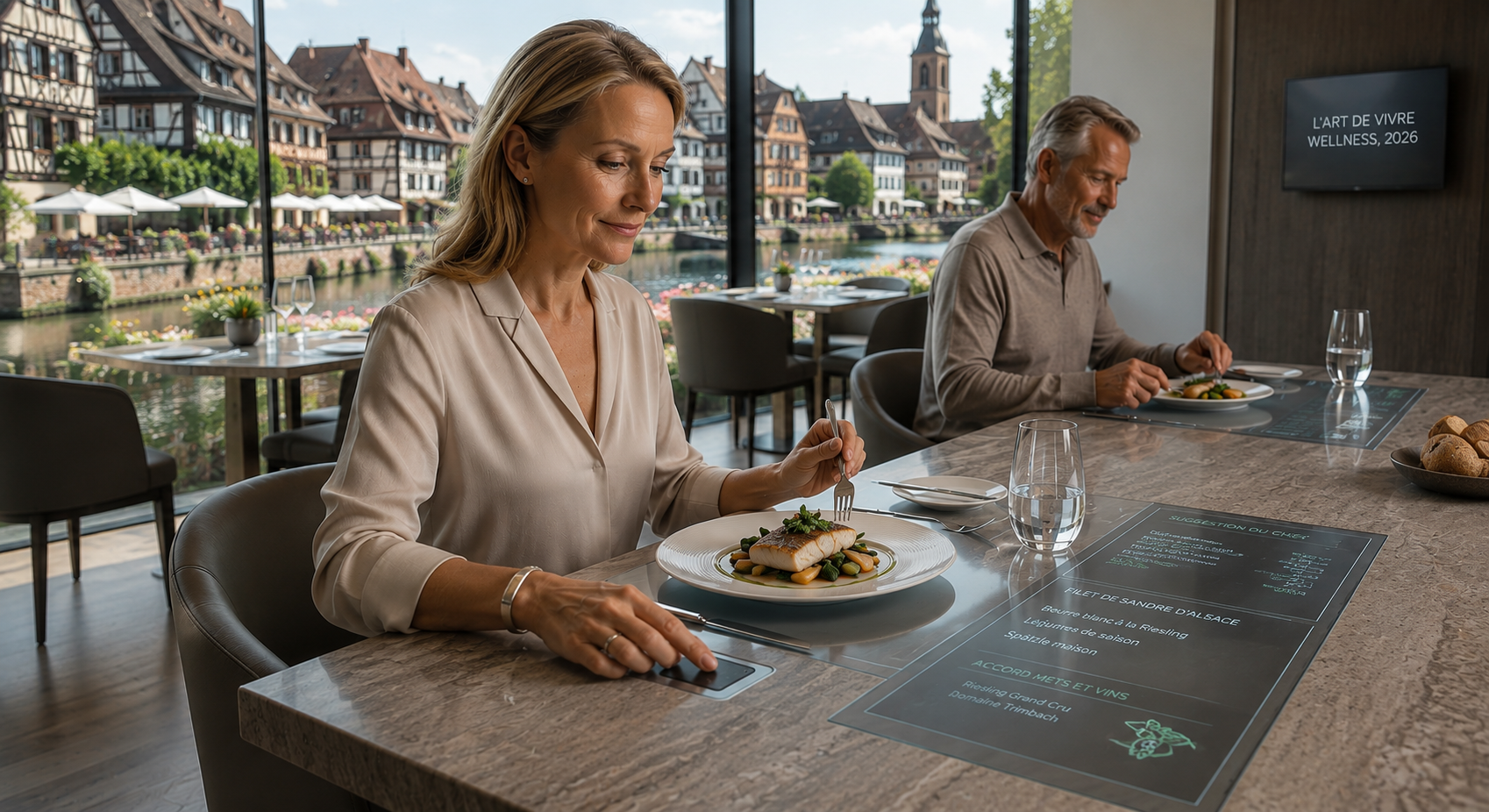
The most advanced luxury gastronomic establishments have begun integrating gastronomy into comprehensive wellness programmes with biometric assessments: before the meal, an express biomarker analysis (real-time blood glucose via subcutaneous sensor, HRV via wearable, sometimes inflammatory or hormonal markers from a recent blood panel) allows the establishment's chef or nutritionist to make real-time recommendations — adapting portions, orienting toward certain dishes, adjusting macronutrient concentration. This model is already operational in several Swiss and Austrian high-end wellness clinics. In Alsace, formal integration is not yet common, but Adopte une Conciergerie can compose this type of programme by coordinating a functional medicine practitioner with a high-level Alsatian chef — an offer we are developing for 2026-2027.
For UHNWI wellness-first clients, the tension between gastronomic pleasure and nutritional rigour dissolves when the chef is expert enough to create experiences satisfying both dimensions simultaneously. Alsatian new-generation chefs — De:ja, NYD, Les Funambules — work precisely in this direction: biodynamic sourcing, gentle cooking preserving micronutrients, high-quality plant propositions, artisan fermentations with documented digestive benefits, natural biodynamic wines limiting chemical inputs.
Gastronomy as cultural and identity transmission
Alsatian gastronomy is not only a palate pleasure — it is one of the densest forms of cultural transmission any French region offers its visitors: four centuries of Franco-German encounters in the plate, peasant land culture that has resisted standardisation, preservation techniques (choucroute, confits, Beewecka, Kougelhopf) that are ingenious responses to a specific terroir, and a viticultural tradition whose great aged wines — Riesling, Gewurztraminer, Pinot Gris — are among France's most complex and least internationally known.
Winstubs — Alsatian character brasseries serving choucroute, baeckeoffe and flammekueche in century-old wood settings — are cultural experiences as much as gastronomic ones. Chez Yvonne, Au Pont du Corbeau, Zum Strissel: these three addresses are the most consistent and best-kept. We integrate them systematically into gastronomic programmes alongside starred tables. Gastronomic markets — the Broglie market on Wednesday and Saturday mornings, the organic market — are terroir entries we organise as guided programmes: a market morning with a chef or producer, followed by an Alsatian cooking lesson, is one of our most popular gastronomic experiences.