Branded residences — prestige co-ownerships operated under a luxury hotel brand, from Four Seasons to Bulgari, Aman, Rosewood and Mandarin Oriental — represent Europe's most dynamic real estate segment of the decade. After saturating Paris, London, Monaco and Geneva, these projects are seeking new territories in European second-tier cities with strong heritage and institutional anchors. Strasbourg ticks several boxes on this checklist. But is it ready to host such a project? And what would it change for the Alsatian prestige property market? A forward-looking analysis.
Thought Leadership · Branded Residences · Grand Est · Strasbourg · Prospective 2026–2030
Europe's most dynamic real estate segment is seeking new territories. Strasbourg — European capital and double UNESCO listing — is on the map.
+170% in 10 years
Growth in the number of branded residences in Europe over the 2015–2025 decade
+25–35%
Average value premium of a branded residence over a comparable non-branded property
Vienna · Prague · Porto
Three European second-tier cities where branded residences have opened or been announced since 2022
Ten years ago, raising the question of a branded residence in Strasbourg would have seemed presumptuous. Four Seasons Residences, Bulgari Hotels & Residences, Aman and Rosewood Residences were then the preserve of world capitals — Paris, London, New York, Dubai, Hong Kong. The geography of these projects was that of concentrated wealth, mass UHNWI tourist flows, property markets where ten thousand euros per square metre was the floor.
In 2026, that geography has changed. Driven by strongly growing global demand for "lifestyle" real estate — buyers who no longer want merely an apartment but a service, an identity, an integrated service network — the branded residences segment has expanded to cities that nobody would have predicted in pipelines five years ago. Vienna has its Rosewood Residences in development. Prague has seen luxury operator interest in its extraordinary heritage stock. Porto welcomed Aman and Six Senses projects. Bordeaux saw its first branded residence project announced. The front line of this segment has moved.
Is Strasbourg on this front line? The honest answer is: not yet, but closer than one might think.
What branded residences are — and why they change the markets they enter
A branded residence, in its purest form, is a residential co-ownership whose units are sold to private owners and managed — wholly or partly — under a luxury hotel operator's brand. The owner acquires their apartment or suite, benefits from hotel services (24/7 concierge, room service, spa, security, rental management during absences), and can choose to place their property in a brand-managed rental programme when not in occupation.
The model is powerful for several reasons. For the buyer: they purchase not only a property but a service promise and membership in a community of peers. For the hotel brand: residences represent recurring revenue (management fees, rental commissions) without hotel construction capital costs. For the local property market: a branded residence arrival creates a new price floor for the district, appreciates neighbouring properties and anchors a lasting prestige image. Market studies converge on an average value premium of 25–35% for a branded residence versus a comparable non-branded property. In Vienna, Rosewood Residences' first units were commercialised at prices 40% above the Viennese market's previous records.
Branded residence location criteria: Strasbourg through this lens
Solvent local and international demand. Strasbourg's local wealth base — established Alsatian families, regional business leaders, senior European civil servants — is limited in volume. Its real strength on this criterion is proximity to Swiss and German wealth pools: Basel 45 minutes, Zurich two hours, Freiburg im Breisgau 45 minutes, Frankfurt two hours thirty. For a Swiss or southern German buyer, a Strasbourg branded residence is a European heritage asset minutes from home, at a price with no comparison to Geneva or Munich. This buyer profile is exactly what branded residence operators target in European "second-tier" markets.
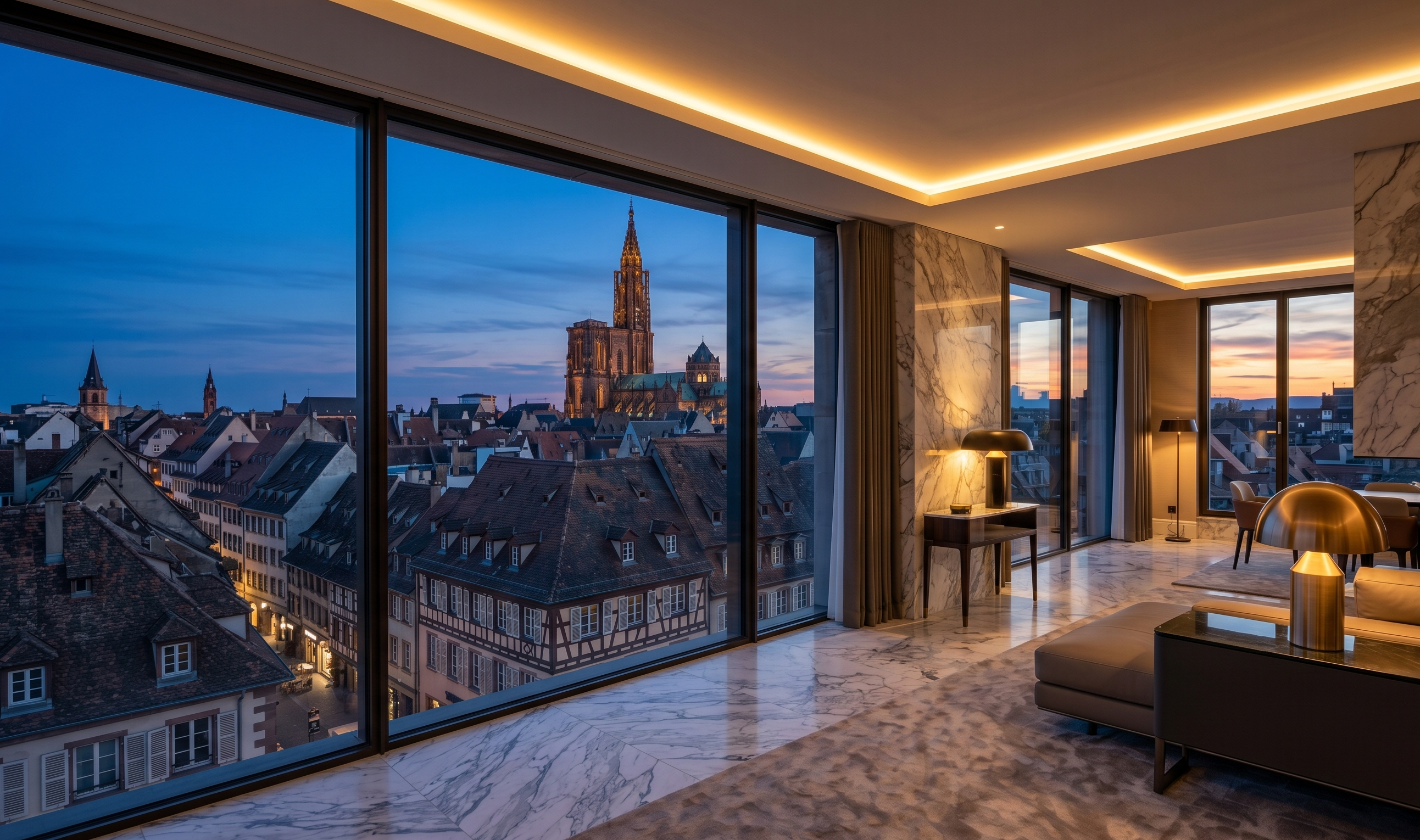
Urban and heritage fabric quality. Strasbourg is among France's best cities outside Paris: UNESCO-listed Grande Île since 1988, UNESCO-listed Neustadt since 2017, the Orangerie Park, the Ill riverbanks of Petite France, Cathedral views from the piano nobile floors of certain Wilhelminian buildings. The architectural quality of Strasbourg's building stock has no equivalent in comparable French cities.
Quality tourism demand. Strasbourg — European institutions, Christmas Market (2–3 million visitors), Music Festival, growing international tourism recognition — meets this criterion. The RevPAR of Strasbourg's best accommodation is among France's highest outside Paris in December.
Premium-location land availability. Strasbourg's most constraining criterion. The Grande Île and Neustadt are protected by UNESCO and heritage regulations, limiting heavy transformation and excluding large new construction. Potential opportunities: a large Wilhelminian building in the Orangerie or Contades transformed entirely (the Rosewood Vienna model), a former private mansion reconversion, or a Wacken district operation (less regulated, but less symbolically charged).
Premium services ecosystem. Strasbourg has the starred restaurants and gastronomy. It lacks luxury retail (no equivalent of the rue du Faubourg Saint-Honoré) and its airport, while useful, is not an intercontinental hub. These gaps are surmountable — many branded residences in comparable cities have succeeded with less dense service ecosystems — but they represent a relative handicap.
Instructive European precedents: lessons from Vienna, Porto and Prague
Vienna is the most relevant precedent. European institutional capital (UN, OPEC, OSCE), UNESCO heritage city, prestige property market historically undervalued relative to its fundamentals: the parallel with Strasbourg is striking. The Rosewood Residences Vienna project, announced in 2023 in a historic Ring palace, received exceptional uptake — first units sold at prices establishing new records for the city. Buyers? Mainly non-residents: Germans, Swiss, Middle Easterners and a growing proportion of Asians viewing Vienna as a European "safe haven." This buyer profile is directly transposable to Strasbourg.
Porto illustrates branded residences' capacity to transform a market: before the Aman and Six Senses project announcements in the historic centre, Porto was perceived as a rising tourist market but not yet a standalone prestige property market. The announcements changed perception — first for international buyers, then for the local market. Within two years, Porto's premium segment underwent spectacular revaluation. The mechanism is repeatable.
Prague is most instructive for its demand composition similarities with Strasbourg: strong proportion of Western European buyers seeking a pied-à-terre in an exceptionally heritage-rich city at accessible prices. Branded projects under negotiation in Prague explicitly target this profile — with international (German, Swiss, British, American) clientele representing most of the absorption potential. Strasbourg, with its Swiss and German proximity, is in a similar position.
Realistic scenarios for Strasbourg at 2028–2032 horizon
Scenario 1 — The independent precursor (most likely, 2026–2028). A local or regional developer, without an international hotel brand, launches a premium residence project with integrated concierge services — a "branded residence" in functional terms without the international label. This scenario is most probable near-term as it does not depend on international brand negotiation timelines. It creates a precedent, establishes a new price reference, and attracts international operators' attention. This is precisely the path several European markets followed before a major brand arrived.
Scenario 2 — Existing hotel conversion (2027–2030). A major Strasbourg hotel raises funds by selling a portion of its rooms and suites as privately owned residences under hotel management. This "partial conversion" model is one of the most common branded residence forms outside major capitals. It requires no new construction, respects heritage constraints, and allows the hotel operator to secure financing while creating an owner community. A realistic scenario in this timeframe.
Scenario 3 — A major brand implantation (2029–2032 at earliest). A first-tier international operator — Four Seasons, Rosewood, Bulgari, Aman — announces a Strasbourg project, probably in a transformed heritage building in the Orangerie or Neustadt. This scenario is the least imminent but not unrealistic if two conditions converge: Strasbourg's international visibility continues on its current trajectory, and a local developer with an exceptional heritage asset approaches these operators. The latter is as much a human as an economic variable.
What this means for current owners and investors
If a branded project materialises in the Orangerie or historic Neustadt, the market effects will be mechanical and documented by all international precedents: district price revaluation, new reference price floor, inflow of international buyers who had not previously had Strasbourg on their radar. Owners who will have bought before such an announcement — in premium districts, in quality buildings, at today's prices still below their fundamental value — will benefit from a significant windfall effect. The question is not "whether" this type of project will arrive in Strasbourg — the fundamentals trajectory is too favourable. The question is "when." At Adopte une Conciergerie, we work with investor clients on identifying the heritage assets that best exhibit pre-branded residence characteristics — Orangerie/Contades/Neustadt location, Wilhelminian or Haussmann architectural quality, service-residence transformation potential — and acquiring them before the international narrative catches up with the territory's reality.
Five questions on branded residences in Strasbourg
Can a branded residence be established in a listed or heritage-protected building in Strasbourg?
Yes, but with real constraints. The reference model is the transformation of an existing heritage building — Wilhelminian building, former hotel, private mansion — into residences with services, without deep structural modification. This model respects Heritage Architect (ABF) constraints and UNESCO and ZPPAUP rules, provided interior interventions preserve classified elements (parquet floors, fireplaces, facades, stairwells). Rosewood Vienna and several London projects have demonstrated that the most regulatory-constrained buildings are often the most attractive for a branded residence — precisely because their rarity and character are the primary selling arguments.
What would the price per square metre of a branded residence in Strasbourg be?
In the hypothesis of a first-tier branded project (Rosewood, Four Seasons) in a premium heritage building in the Neustadt or Orangerie, commercialisation prices would probably range from €12,000 to €18,000/m² — two to three times current Strasbourg prestige market prices. These levels are not calculated from the existing local market value but from the brand's perceived value, integrated services and target clientele profile (non-resident Swiss, German, international buyers). The Viennese precedent confirms these orders of magnitude: Rosewood Residences Vienna commercialised at levels 40% above previously achieved Viennese record prices.
What type of buyer would a Strasbourg branded residence target?
Primarily non-residents. The dominant profile: Swiss buyers (Basel, Zurich, Geneva) seeking a European heritage asset less than two hours from home, at a price representing 30–50% of what they would pay for a comparable Swiss property; German Baden-Württemberg and Bavarian buyers with Alsatian heritage sensitivity; Parisian buyers seeking a prestige pied-à-terre outside Paris in a city to which they have an attachment; and international buyers — American, Middle Eastern, Asian — beginning to include Strasbourg in their searches for European heritage assets outside major capitals.
How is Adopte une Conciergerie positioned to accompany this type of acquisition?
Our positioning on Strasbourg branded residences rests on three elements: our knowledge of the Strasbourg off-market — the heritage buildings that could be the subject of a branded transformation are often in the hands of established Alsatian families or local institutional owners we know; our network of developers and institutional investors active in the Grand-Est market, first informed of projects in development before public communication; and our capacity to accompany international buyers — Swiss, German, American, Czech — in understanding a local market whose subtleties (ABF regulation, co-ownerships in protected sectors, LMNP tax regime) require the expertise our Grand-Est anchor provides.
What are the risks of this scenario?
Three principal risks deserve honest naming. First, timing risk: the window between "pre-branded market" and "branded project arrival" may be longer than anticipated — five to ten years rather than three to five. Buyers entering this thesis must do so with a long horizon and solid fundamentals case, not solely the branded scenario. Second, regulatory risk: UNESCO and ABF constraints could limit branded projects to areas outside protected perimeters (Wacken, peripheral districts), significantly reducing the heritage and symbolic interest of the project. Third, macroeconomic risk: a reversal of the European luxury property market, recession or geopolitical crisis could push back branded residence operator expansion timelines. These risks justify a fundamentals-based approach to the Strasbourg market rather than pure speculation on the branded scenario.
Strasbourg is not yet a branded city. But in 2026 it possesses more of the required characteristics than it did five years ago — and more than will be needed in five years for the question to cease being prospective. The real question for a serious investor is not whether Strasbourg will one day have its Four Seasons or Rosewood. It is whether they want to be a property owner there before or after the announcement.
Strasbourg · Branded Residences · Grand Est · Four Seasons · Rosewood · Bulgari · Prospective · May 2026
Adopte une Conciergerie — First Private Luxury Concierge of Grand-Est · Paris · French Riviera · Prague Presence