Alsace Wine Route in UHNWI mode: 3-day private itinerary (domains closed to the public)
April 22, 202613 min read
The Alsace Wine Route, seen from inside the most confidential areas. Our private 3-day itinerary: visits closed to the public, vertical tastings, meetings with cellar chefs, and insider gastronomic addresses.
The Alsace Wine Route stretches over one hundred and seven villages, between Marlenheim in the north and Thann in the south. For the majority of visitors, it translates into a day of open cellars, standardized tastings, direct purchases. For our clients, it's something else: a private itinerary through the great terroirs, with access closed to the public, vertical tastings supervised by the cellar chefs, intimate meetings with the leading winegrowers. Here is the typical 3-day itinerary that we put together.
Why this route exists
Wine-growing Alsace is a paradoxical territory. On the one hand, it is among the top wine tourism destinations in France. On the other hand, its largest areas work far from the media gaze, without a mass commercial strategy. The most notable of them — Zind-Humbrecht, Trimbach, Hugel & Fils, Weinbach, Josmeyer, Léon Beyer, Marcel Deiss, Domaine Ostertag — rarely welcome the general public. Some do not receive at all, unless recommended. It’s their right: they work the vineyard, not the shop.
Our house, rooted in Alsace since 2020, maintains direct relationships with these areas. Not commercial partnerships: human ties, based on several years of joint work. When we ask Olivier Humbrecht or Jean-Frédéric Hugel for a slot for a quality client, they respond. The following is the itinerary that we put together for UHNWI families who want to discover wine-growing Alsace at the level where it deserves to be discovered.
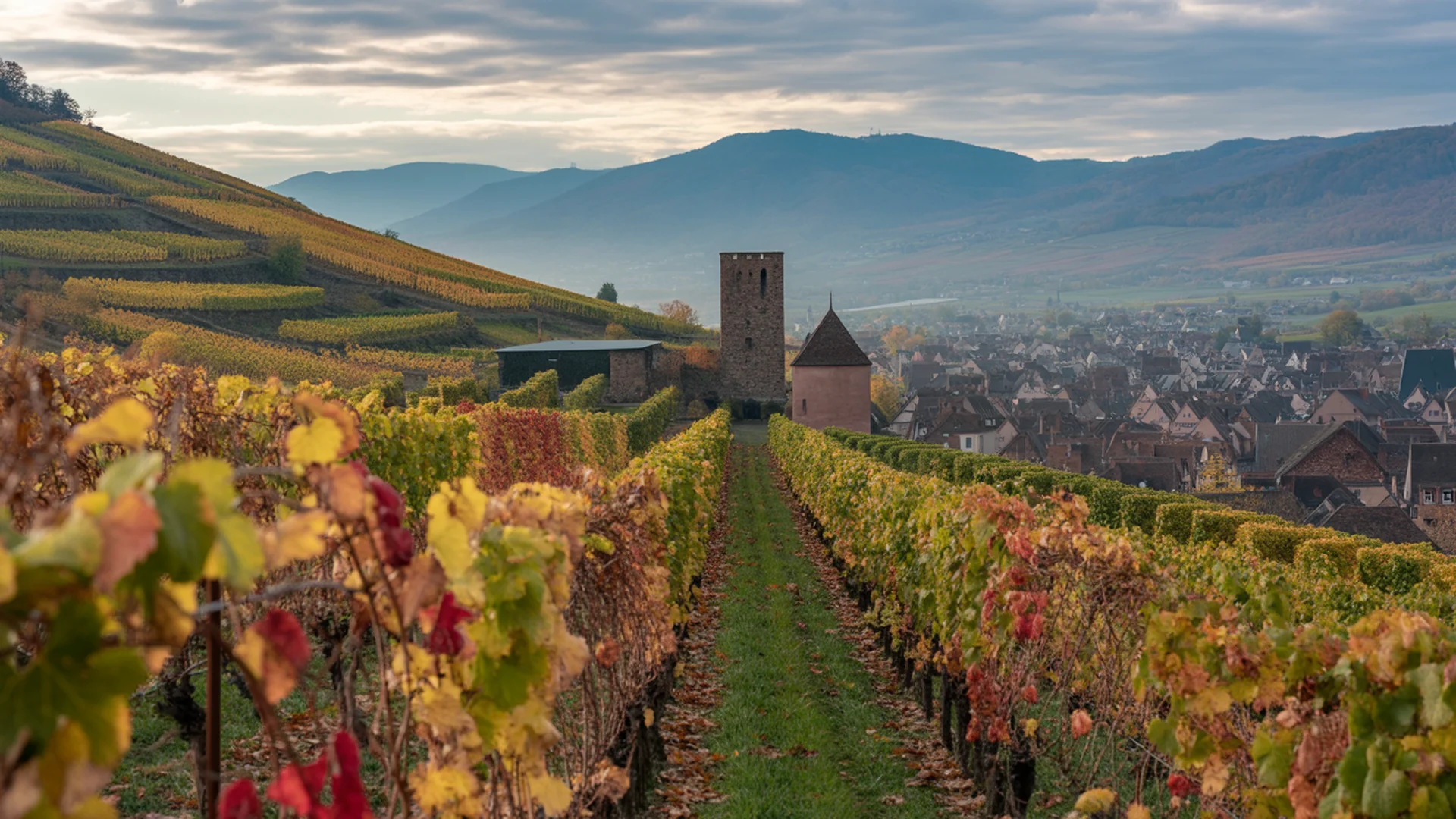
The terraces of the Grand Cru Schlossberg above Kaysersberg — 80 hectares, first recognized Grand Cru in Alsace in 1975, two-color granite.
Day 1 — Turckheim, Colmar, Kientzheim
Morning: Domaine Zind-Humbrecht, Turckheim
Starting point: Turckheim, fortified village in the Vosges, 3 km west of Colmar. The Domaine Zind-Humbrecht, founded in 1959 by the merger of the Zind and Humbrecht houses, is today run by Olivier Humbrecht, the first Frenchman to have won the title of Master of Wine. The estate covers 41 hectares spread over ten terroirs, including the legendary Grands Crus Rangen de Thann (with Clos Saint-Urbain), Hengst, Brand, Goldert, Clos Windsbuhl, and Clos Jebsal.
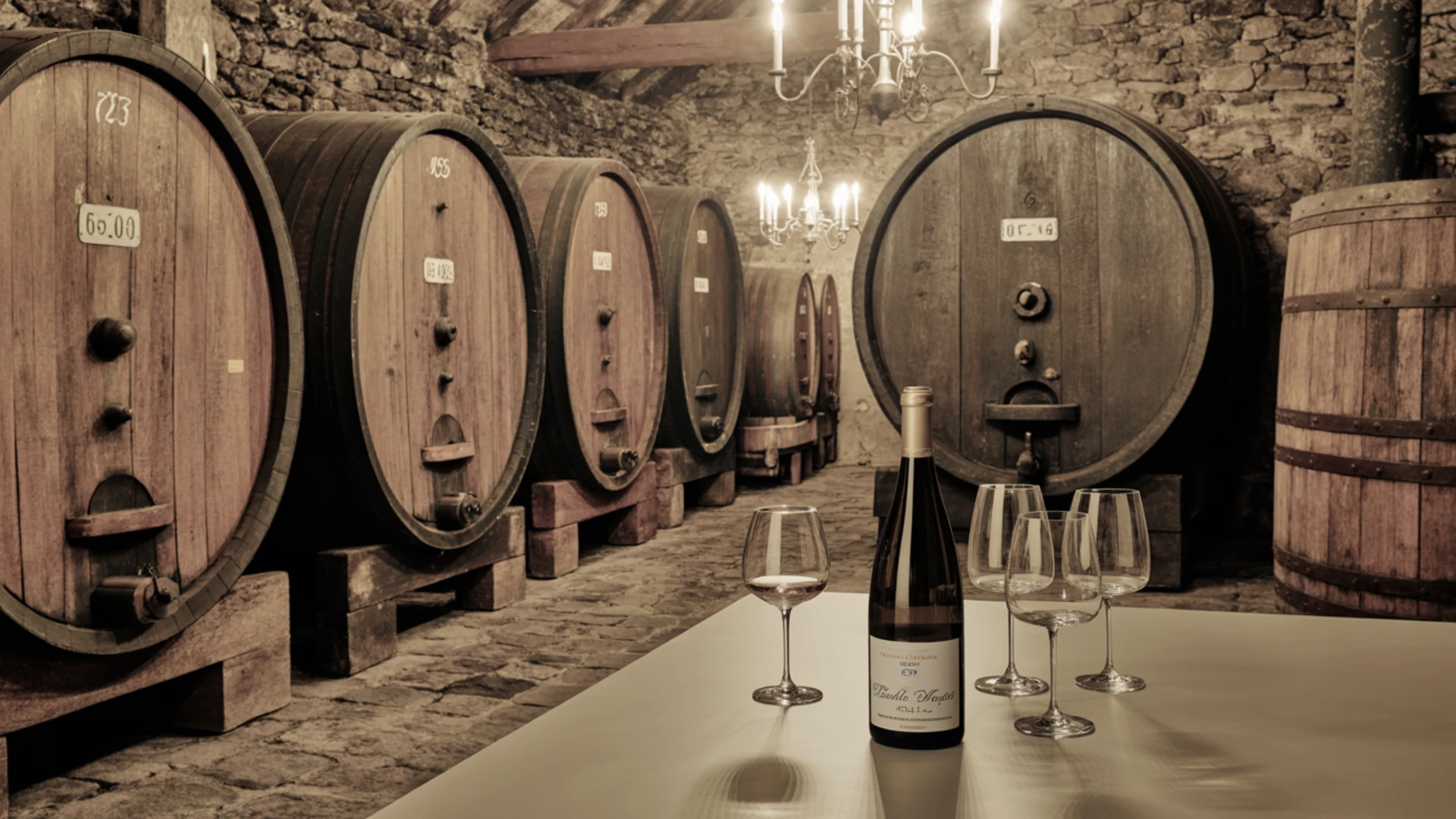
The visit lasts two to three hours. It begins with a tour of the vineyards - if the weather permits, in a 4x4 on the volcanic slopes of the Rangen de Thann, one of the steepest terroirs in Europe. Then private tasting in the historic cellars of Turckheim: ten to fifteen vintages, including Grands Crus in true vertical tastings (three to five vintages per terroir, to understand the evolution). All the wines are produced biodynamically, with low yield viticulture (30 to 40 hl/ha) and long aging on the lees.
Rare point: Olivier Humbrecht or his daughter Marguerite personally welcome the visitors we introduce to them. It's not a business routine: it's a family-to-family exchange. Exchanges can shift towards biodynamics, geology, gastronomy, European viticulture. As always in these cases, we do not learn what is written in books: we learn what is transmitted in the vineyards.
Lunch: La Table du Gourmet, Riquewihr
Twenty minutes to the north, in Riquewihr (a medieval village ranked among the most beautiful in France), we stop for lunch at Jean-Luc Brendel's Table du Gourmet, a Michelin star, Mediterranean and Alsatian cuisine reinterpreted with rare precision. The room overlooks the paved Grand’Rue. Our on-site concierge reserves the most discreet table, based on your privacy request.
Afternoon: Hugel & Fils, Riquewihr
Still in Riquewihr, rue de la Première Armée, the Maison Hugel & Fils is one of the oldest Alsatian estates - 12 generations, founded in 1639. The house specializes in single-plot vintages ("Jubilee Riesling", "Schoelhammer Riesling" from the Grand Cru Schoenenbourg), but also in Late Harvests and Grain Selection Nobles, where she is among the best in the world.
The Hugel visit is reserved for professionals and recommended amateurs. It takes place in the medieval cellars under the main house, where centuries-old tuns rest (the largest, the Sainte Catherine, dates from 1715). Tasting with Marc-André or Jean-Frédéric Hugel: Pinot Noir Grossi, Riesling Grand Cru Schoenenbourg, Late Harvest Gewurztraminer. For customers who wish to purchase annual allowances, the house opens a direct channel that we facilitate.
Evening: Hotel La Clef des Champs, Kientzheim
Night at the Chateau d'Isenbourg, in Rouffach (20 minutes from Colmar), or at the Hotel Les Haras in Strasbourg if you prefer the city. For a version closer to the vineyards, we recommend the Villa René Lalique in Wingen-sur-Moder, relay & castles, two Michelin stars, in the former home of the artist of the Lalique crystal factory.
Day 2 — Ribeauvillé, Kaysersberg, Bergheim
Morning: Maison Trimbach, Ribeauvillé
Ribeauvillé, dominated by three ruined medieval castles, is home to the 13-generation Maison Trimbach, founded in 1626. Trimbach produces two of the greatest Rieslings in the world: the “Cuvée Frédéric Emile” vintage, and the legendary “Clos Sainte-Hune”, from a 1.67 hectare plot on the Grand Cru Rosacker. Clos Sainte-Hune is considered by many oenologists to be the greatest French dry white wine, in any region.
The Trimbach tasting is a school: the heir Pierre Trimbach or his brother Jean welcome us in the historic tasting room, above the cellars. Half a dozen vintages of Cuvée Frédéric Emile (2005, 2010, 2015, 2020 if available), then two or three older Clos Sainte-Hune (the 1995 remains unforgettable for those lucky enough to taste it). The Trimbach style – dry minerality, chalky precision, telluric length – defines the “classic Riesling” school which has made Alsace’s international reputation.
Lunch: JY'S, Colmar
Return to Colmar for lunch at Jean-Yves Schillinger at JY'S, one Michelin star. Franco-Alsatian cuisine with an Asian outlook, in a contemporary decor, facing Little Venice. Excellent precision/pleasure ratio.
Afternoon: Domaine Weinbach, Kaysersberg
Kaysersberg, a former imperial stronghold and birthplace of Albert Schweitzer, hosts the Domaine Weinbach in the Clos des Capucins, a former monastic property bought in the 19th century by the Faller family. The estate is today managed by Catherine Faller and her sons Eddy and Theo. It is a reference area for the Gewurztraminers and Rieslings of the Grand Cru Schlossberg, and for the Riesling Cuvée Sainte Catherine.
The house — still a restored residence of a noble monastic family — is breathtakingly charming: stone heart, oratory chapel, enclosed garden. The tasting is done at the table, not standing. Catherine Faller tells the story of the transformation of the estate after 1979, the conversion to biodynamics undertaken in 1998, and the work on the old grape varieties. The Sainte-Catherine 2005, 2010, 2015 are served vertically: the evolution of a grand cru under biodynamics can be read from an vintage to another.
Late afternoon: Domaine Marcel Deiss, Bergheim
Last stop of the day in Bergheim, at Marcel Deiss, a contemporary figure in Alsace who rewrote the standard: Jean-Michel Deiss was one of the first Alsatian winegrowers to elevate the terroir above the vineyard, producing extraordinary plot blends. The exceptional vintages — Altenberg de Bergheim, Mambourg, Burg, Rotenberg — are part of a break with the variety-based dogma of the region. All vineyards are Demeter biodynamic.
Evening: Michelin-starred dinner at Chambard, Kaysersberg
Dinner at Olivier Nasti at the Table d'Olivier Nasti at Chambard, two Michelin stars. Nasti is a chef specializing in game and truffles, in a very high-level contemporary Alsatian setting. For a more relaxed version, the Winstub du Chambard offers more affordable traditional Alsatian cuisine in the same establishment.
Have a project in mind?
Our experts are ready to create a bespoke experience for you.
Eguisheim, a circular fortified village from the 12th century, is the cradle of the Maison Léon Beyer, 14 generations old, founded in 1580. It is one of the oldest houses in Alsace and, with Trimbach, the most institutional. His style: dry, very elegant wines, with uncompromising precision. Its Grands Crus Pfersigberg and Eichberg are references.
Patriarch Marc Beyer receives us in the so-called “royal families” room, where each of the European sovereigns of the 19th and 20th centuries signed the guestbook. A way to understand what “historic house” means in Alsace — it is not a slogan, it is a rare transgenerational continuity.
Lunch: Caveau d’Eguisheim or vineyard picnic
Two options. The first, traditional: the Caveau d'Eguisheim, intimate Alsatian cuisine, duck confit with quetches, tarte flambée. The second, which we recommend to customers who cherish moments outside the program: a picnic in the middle of the Pfersigberg vineyards, with a basket composed by the Maison de la Truffe in Colmar (terrine, cheeses, bread, seasonal fruits) and a cellar chosen on site. Logistics (tables, chairs, service) are provided by our team.
Afternoon: Domaine Josmeyer, Wintzenheim
Wintzenheim, neighboring Colmar, is home to the Domaine Josmeyer, run by Céline Meyer and her sister Isabelle since the death of their father Jean Meyer. A biodynamic estate since 2000 (Demeter), it produces Grand Cru Hengst and Brand Rieslings of remarkable clarity and elegance. It is one of the producers most esteemed by international sommelier professionals.
Late afternoon: Unterlinden Museum in Colmar
Before returning, a private visit to the Unterlinden Museum, in the ancient Dominican cloisters in the center of Colmar. The highlight: the Isenheim Altarpiece by Matthias Grünewald (1512-1516), one of the most moving works of the German Renaissance. We organize a visit outside opening hours, with a museum curator to accompany the reading of the panels.
Evening: Return
Return to Colmar-Bale-Mulhouse airport (50 minutes) or to Strasbourg (45 minutes) for connection. For a continuation, we recommend a fourth day in Strasbourg (Municipaux Baths, cathedral, starred dinner) or a diversion to the Vosges (castles, walks in the forest).
Practical dimension of the itinerary
Transport: car with discreet driver, German or English depending on preference. Driver knowing the shortcuts between wine villages, essential to avoid wasting time on the roadWines too touristy.
Accommodation: 2 nights in relay & castles (Villa René Lalique in Wingen-sur-Moder, Chateau d'Isenbourg in Rouffach, or Hostellerie du Cerf in Marlenheim).
Access to the estates: visits supervised by cellar managers, vertical tastings, access to collection vintages. Coordination with the houses requires 6 to 8 weeks of anticipation.
Gastronomy: three to five starred lunches/dinners reserved as a priority, with confidential tables.
Acquisitions: if the customer wishes to purchase allocations (often 6 to 24 bottles per house), we coordinate with the estates and deliver to the residence or professional cellar.
Budget: tailor-made coordination fees in addition to services (accommodation, catering, transport, purchases). Confidential quote after interview.
For whom?
This route is aimed at three profiles. Firstly, enlightened amateurs who already know Alsace and want to go beyond tasting tourism. Secondly, international UHNWIs (Americans, Asians, Middle Easterners) who are discovering Alsace for the first time and immediately want the highest level. Third, wine collectors who wish to meet producers ahead of significant acquisitions.
In all cases, the requirement is the same: the quality of access, the confidentiality of the moments, the precision of the information transmitted. This is what our house brings to this itinerary.
Wine-growing Alsace reveals its depth to those who know how to look at it. The historic estates have written a relationship between man and the vine which has few equivalents in Europe. Entering their cellars, their gardens, their tables is access to a civilization that still lives. Our job, in Alsace as elsewhere, is to open doors that a simple visitor will never find.
Frequently asked questions
Are the areas mentioned open to the public?
Most do not receive the general public or very punctually. Hugel & Son and Trimbach have occasional tasting rooms. Zind-Humbrecht, Weinbach, Beyer, Josmeyer, Deiss receive almost exclusively on professional recommendation. Our house has had direct relationships with these areas for several years, which allows us to organize access specifically for our clients.
How long does it take to organize this itinerary?
Six to eight weeks of anticipation are necessary to obtain slots for Michelin-starred areas and reserve gourmet tables. During the harvest period (September-October), the anticipation must be extended to two to three months. Outside of the period, a period of three weeks may be sufficient with a little flexibility in the areas visited.
What is the most favorable season?
May-June for rising vines and long days. September-October for the harvest, spectacular but very busy with the estates. Winter (November to March) paradoxically offers a higher quality of exchange: the winegrowers have more time, the light on the snow-covered vines is magnificent, the cellars remain active. Our choice for a first stay: early May or late November.
Can we buy bottles directly from the estates?
Yes, with limitation. Houses like Zind-Humbrecht, Trimbach, Hugel and Weinbach practice allocation: each client obtains a number of bottles determined by vintage, based on their history with the estate. A first purchase may be limited. With the seniority of the relationship and by nThrough our intermediary, significant allocations can be obtained for serious collectors.
Is Le Clos Sainte-Hune accessible?
Rarely. Trimbach markets around 8,000 bottles of Clos Sainte-Hune per year, for a global market. Old vintages ($antes from 2010) are practically impossible to find except in private sales by insiders. For a client who wants to build a vertical, we coordinate with Trimbach directly and with specialized partner traders.
How many guests can participate in this itinerary?
Optimal: 2 to 6 people. Private wine tastings are designed for a small group. Beyond 8, intimacy with the winegrowers erodes. For a larger group (birthday, event), we can organize an equivalent program but adapted to the format, with tastings in small successive groups.
Can this itinerary be integrated into a longer stay in France?
Yes. The sequences that we build regularly: Alsace-Champagne (3 days Alsace, 2 days Champagne), Alsace-Burgundy (3 days Alsace, 4 days Burgundy), Alsace-Switzerland (3 days Alsace, 4 days Saint-Moritz or Geneva). Transition logistics (car with driver or helicopter) are orchestrated by our company.
Do the cellar managers speak English?
Most, yes. Olivier Humbrecht is bilingual. Pierre and Jean Trimbach speak English. Jean-Frédéric Hugel speaks English. Catherine Faller speaks English. Marc Beyer speaks English. For tastings with a translator (German, Italian, Japanese, Mandarin), we provide a translator specialized in oenology on request. The quality of the translator is decisive for this type of meeting.
Alsatian entrepreneur, Alexandre founded Adopte Une Conciergerie with one conviction: true luxury is reclaimed time. He personally leads the most sensitive missions and writes a monthly editorial sharing his vision of exceptional concierge service.