In 2026, data from Knight Frank and specialist analysts from the art and luxury markets confirm what savvy collectors have long known: an Hermès Birkin in the right colors and leathers is not a handbag. It is a heritage asset whose value trajectory, over two decades, has regularly surpassed that of traditional stock markets. The Pink Shocking in porosus crocodile. Electric Blue in Togo. Chartreuse Green in Mysore goatskin. Each tells a story of absolute scarcity — and that scarcity comes at a rising price.
-
Alternative Assets · Heritage · Hermès Birkin · 2026
When the bag becomes an asset — and what it says about the luxury market in 2026.
+700%
Hermès share performance over 10 years (CAC 40, best performance)
14% / year
Birkin average return over 35 years according to Baghunter — vs. 8.65% S&P 500
€248 billion
Hermès market capitalization — first in the CAC 40 in April 2025
There are objects that are the subject of an informal consensus among the world's great fortunes, passed down from generation to generation, never written in any prospectus and yet as solid as the most reliable heritage advice: Hermès Birkins in rare colors are a store of value. Not a speculation. Not a fashion. A store of value — like a gold coin, like a well-located building, like a vineyard classified Grand Cru — whose fundamental characteristic is that demand structurally exceeds supply, and that this situation will not change.
In 2026, this conviction is reinforced by data which deserve to be read carefully, and with the nuances they require. Analysts at Knight Frank, which publishes the Luxury Investment Index each year in its annual global wealth report, have documented the outperformance of luxury bags as an asset class over the past two decades. The Baghunter study, which analyzed the performance of the secondary market for Birkins over thirty-five years, concluded at an average annual return of around 14% — compared to 8.65% for the S&P 500 over the same period. This figure should be read with caution — the Birkin market has neither the liquidity nor the transparency of a stock market — but it says something real about the value dynamics of these objects.
Why the Shocking Rose — and not just any Birkin
Not all Birkins are equal. There are common Birkins - the black in togo leather, the gold in clemence leather, the etoupe in clemence leather - which constitute what specialists call the "stable core" of the market. These models have decent liquidity, constant demand, and regular appreciation. They constitute the basis of a luxury leather goods portfolio.
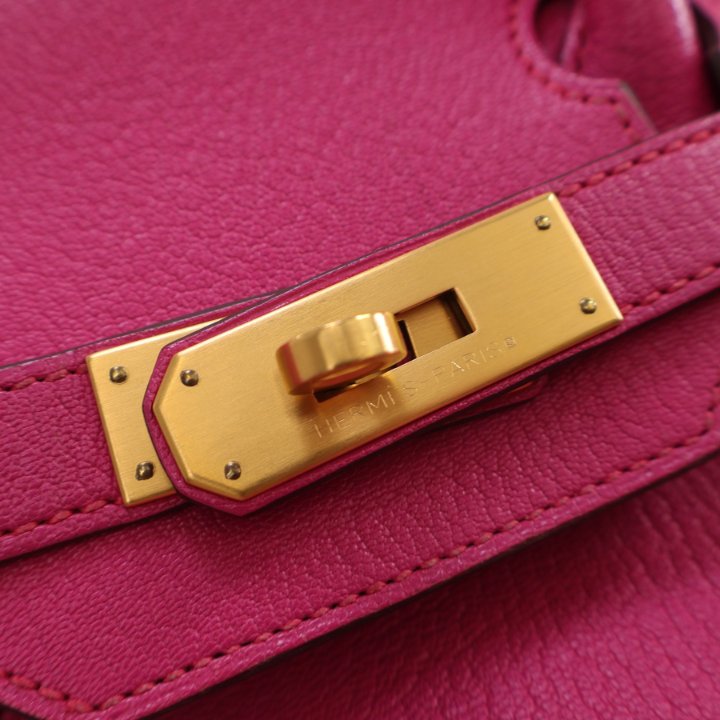
And then there are the rare colors. Shocking Rose – this pink of almost unreal intensity, a signature for decades of the most desirable Birkins – does not leave the house's workshops at predictable intervals. He appears, disappears, reappears according to logics that the house does not make public. When a Rose Shocking in porosus crocodile with gold hardware — known as “full gold hardware” — is put up for auction at Christie's, Sotheby's or Artcurial, it systematically generates results above estimates. Not because the bidders are irrational, but because iThey know that the next Rose Shocking in crocodile is not in next month's catalog. It will arrive when it arrives.
The same logic applies to exotic leathers — crocodile porosus niloticus, alligator mississippiensis, salvator lizard, ostrich — whose production is subject to strict CITES regulations which limit volumes in a restrictive and sustainable manner. A Birkin 25 in Shocking Rose porosus crocodile with palladium hardware is a piece of which the number of copies in global circulation is less than a few dozen. This is what the Anglo-Saxons call a “trophy asset” — an asset whose value is based on its irreplaceability in a universe that values precisely the things that money alone cannot buy.
The paradox of the bag you can't buy
One of the most fascinating dimensions of the Birkin's asset dynamics is precisely the mechanism that makes its value so difficult to reproduce: one cannot simply decide to buy a Shocking Rose Birkin in crocodile from Hermès. You can't point at the model in a window, put down your credit card, and walk away with it. This is not how Hermès works.
The house practices an extremely sophisticated customer relationship management policy: iconic bags are offered to customers following a purchase history established over time, according to a logic of relational reciprocity rather than pure commerce. "Develop a customer relationship with your local Hermès store. Buy more accessible accessories first to demonstrate your brand loyalty." This process — which collectors sometimes refer to as the “Hermès game” — can take months or years before a first bag is offered. And the rarest pieces, in the most desirable colors, are never offered for simple ordering. They are presented, occasionally, to customers whose profile corresponds to the image that the house wants to associate with these pieces.
This restriction of access is not a constraint — it is the mechanism for producing value. A bag that everyone can buy today loses value tomorrow. A bag that very few people can obtain, even with the necessary means, is structurally deflationary in its cost of access and inflationary in its resale value.
The alternative asset in a UHNWI wealth strategy
For wealth managers advising UHNWI clients — those wealthy individuals with more than $30 million in net assets — the question is no longer whether luxury alternative assets deserve a place in a portfolio. It is to determine what place, in what proportion, and with what selection criteria.
The Birkin has alternative asset characteristics that set it apart from most other collectibles. Its demand is global and culturally stable — a piece desirable in Paris is also desirable in New York, Dubai, Shanghai and Tokyo. Its value is relatively disconnected from stock market cycles — the 2008 collapse did not collapse the secondary market for Birkins. Its storage and maintenance costs are low compared to real estate or a large work of art. And its liquidity, while limited compared to a financial asset, is much greater than that of real estate — a rare Birkin can be auctioned and sold within weeks.
These characteristics explain why institutions like Knight Frank treat it as a separate asset class in their annual analysis of UHNWI portfolios. For a sophisticated wealth investor, owning one or more rare-colored Birkins is less a consumption decision than an allocation decision — a way of holding value in a form that providesan immediate pleasure of use and a prospect of long-term added value.
For clients of Adopts a Conciergerie which articulate complex heritage strategies - prestigious real estate in Grand Est, Alsatian wine estates, luxury movable assets - this dimension of assets alternatives is an integral part of the thinking that we support with our wealth management advisor partners.
Eight questions on the Birkin as a heritage asset in 2026
Is it really true that a Birkin brings in more than the stock market in the long term?
The honest answer is: it is true for certain models, in certain conditions, and with important nuances. The often cited Baghunter study calculated an average annual return of around 14% for Birkins over thirty-five years, compared to 8.65% for the S&P 500 over the same period. Knight Frank has also documented the outperformance of luxury bags in its Luxury Investment Index. These figures are real but should be read with caution: they relate to the most desirable models in the rarest colors, not the entire market. A well-maintained black Birkin in togo appreciates regularly, but not at 14% per year. A Rose Shocking in size 25 porosus crocodile can perform exceptionally well at auction. The comparison with the stock market is attractive but imperfect: the Birkin market has neither the liquidity nor the transparency of a stock market, and transaction costs on the secondary market are significant.
Which Birkin colors and sizes are the best assets in 2026?
Specialists distinguish two main categories. Stable values: black, gold, etoupe, fawn, in classic togo or clemence leathers, in sizes 25, 30 and 35. These models are the most liquid and constitute the basis of a portfolio of collectible leather goods. They appreciate regularly and resell without difficulty on leading secondary markets — Vestiaire Collective, The Real Real, Christie's, Sotheby's, Artcurial. Top assets: rare colors — Shocking Pink, Electric Blue, Chartreuse Green, Mimosa Yellow — in exotic leathers — crocodile porosus, alligator mississippiensis, ostrich, lizard — in size 25 or 30, with 18-carat gold or palladium hardware. These pieces are rare at the time of primary purchase and can realize significant multiples of their purchase price at auction, over a period of five to ten years.
How can a UHNWI investor access a rare Birkin at Hermès?
Access to a Birkin at Hermès — and even more so to a model in a rare color or in exotic leather — requires building a customer relationship with a reference boutique. Hermès practices a sophisticated customer relations policy: iconic bags are offered to customers following a purchase history established over time. Experts recommend starting with purchases in other categories — silk, perfume, accessories, jewelry — to establish a strong customer profile. For UHNWIs whose time is scarce and whose networks are limited in specific boutiques, there are specialized intermediaries — luxury leather goods advisors, luxury personal shoppers — who can facilitate access. For secondary market acquisition, major auction houses like Christie's and Artcurial, as well as certified platforms like Vestiaire Collective, are reliable channels providedhave the bag authenticated by an independent expert before any purchase.
What are the risks to be aware of before investing in a Birkin?
Four main risks deserve to be clearly identified. Firstly, the risk of counterfeiting: the secondary market for Birkins is flooded with fakes, sometimes of extremely high quality. An independent expert is essential before any purchase on the secondary market. Then the liquidity risk: a Birkin is not as liquid as a stock — selling it takes time, involves significant commission costs (10-25% depending on the channel), and depends on current demand. The risk of physical condition: a Birkin that is damaged, deformed or whose leather has been poorly treated can lose a very significant part of its value. Storage and maintenance are performance factors. And finally the fashion risk: if certain models – the black Birkin, the gold Kelly – are timeless, other colors can undergo cycles of desirability. The rarest colors can be the most volatile both up and down.
How will the secondary market for Birkins work in practice in 2026?
The secondary market for Birkins is structured around several complementary channels. Auctions — Christie's, Sotheby's, Artcurial, Bonhams — constitute the most transparent and well-documented segment. The sales results are public, which makes it possible to follow the evolution of prices by model and color. Seller commission fees are typically 10-15%. Certified platforms — Vestiaire Collective, The Real Real, Rebag — offer broader accessibility, shorter sales times, but prices generally lower than auction results for rare pieces. Private collector networks — via specialized brokers — allow confidential transactions without significant commission fees, but require an established network. In 2026, benchmark prices for a standard togo leather Birkin 25 are between 12,000 and 18,000 euros on the secondary market, with exotic leather models ranging from 30,000 to over 150,000 euros depending on color and size.
Is the Birkin reserved for women as an investor? Is male engagement growing?
The demographics of active Birkin buyers have evolved significantly. If women historically constitute the majority of boutique customers, male buyers represent a growing share of acquisitions in a heritage and collection logic - not necessarily for use. In major auctions, a significant proportion of the most valuable lots are acquired by men, often with the aim of collecting or alternative investment. Family offices and wealth managers who include Hermès bags in their clients' portfolios do so regardless of the beneficiaries' gender. The asset has no gender — it has value.
What difference in value is there between a “So Black” Birkin and a Shocking Rose Birkin?
These two models perfectly illustrate the two ends of the value spectrum. The “So Black” Birkin — entirely black, togo or box leather, black lacquered hardware — is a piece of absolute aesthetic consistency whose rarity is documented: it is only produced over very short periods and in tiny quantities. On the secondary market, examples in good condition sell for between 25,000 and 40,000 euros depending on size and condition. The standard leather Birkin Rose Shocking is in a similar range for togo models, but can reach levels from 80,000 to 150000 euros in size 25 porosus crocodile, with palladium fittings, in excellent condition, during major international auctions. Color, leather, hardware, size and condition are the five variables that determine the value of a collectible Birkin. Of these five variables, it is the combination of rare color and exotic leather that creates the most significant value premiums.
How does Adopte une Conciergerie support its clients in their alternative luxury asset strategies?
Our support for alternative luxury assets — including collectible leather goods — is part of a global heritage vision. We are not leather goods brokers. We are wealth advisors who understand that for some of our UHNWI clients, a complete portfolio includes prestigious real estate in Grand Est, wine estates in Alsace, and exceptional movable assets of which certain collector's bags are part. We can direct our clients to specialized experts — luxury leather goods advisors, auction experts, certified personal shoppers — who complete our network on these specific subjects. And we can, as part of global heritage support, coordinate the reflection between these different assets and the real estate and tax dimensions that we manage directly.
A Shocking Rose Birkin in porosus crocodile is not a handbag you buy. It's an asset that you get — when the moment, the relationship and the room coincide. And this rare coincidence is precisely what makes it valuable.
Alternative Assets · Heritage · Hermès Birkin · Luxury · 2026
Adopt a Conciergerie — First Luxury Private Conciergerie in the Grand-Est
Sources: Knight Frank Luxury Investment Index · Baghunter Study (35-year analysis) · Finance Héros · U&Moi · Café de la Bourse · BFM Bourse · Christie's · Artcurial
This article is for informational purposes. It does not constitute investment advice. Past performance is no guarantee of future performance.