The Grand Est, conceived as an administrative entity in 2016, is in reality the juxtaposition of three historical regions: Alsace, Lorraine, Champagne-Ardenne. Three territories, three personalities, three prestige economies. This guide rereads them from a single angle: that of a private concierge which accompanies, from Strasbourg, the families and leaders of the region.
The Grand Est is not a periphery
Many Parisian concierge houses have never set foot in Reims. Many believe that Strasbourg is an administrative city. Many do not have the slightest idea of the UHNWI ecosystem of Nancy, Metz or Sundgau. This is a mistake. The Great East concentrates:
- One of the largest European concentrations of dynastic capital (the great Champagne houses: Moet & Chandon, Krug, Ruinart, Pol Roger, Bollinger, Deutz, Louis Roederer, Taittinger, Billecart-Salmon, Veuve Clicquot).
- An important industrial area (steel, automobiles, chemicals, textiles) with many historic families still active in Mulhouse, Strasbourg, Metz, Nancy.
- A diplomatic and European economy in Strasbourg (European Parliament, Council of Europe, European Court of Human Rights), which attracts a demanding international population.
- A proximity to the border which makes the region a transit hub for wealthy Swiss, German and Luxembourgish people.
Each of these families has very specific needs: management of residences, orchestration of confidential events in wine châteaux, professional and private travel between the six major cities, relations with European public authorities, philanthropic support (cultural patronage, support for academic institutions). Our house has been present in the East since 2020, rooted in Strasbourg, and covers these six major cities in direct operations.
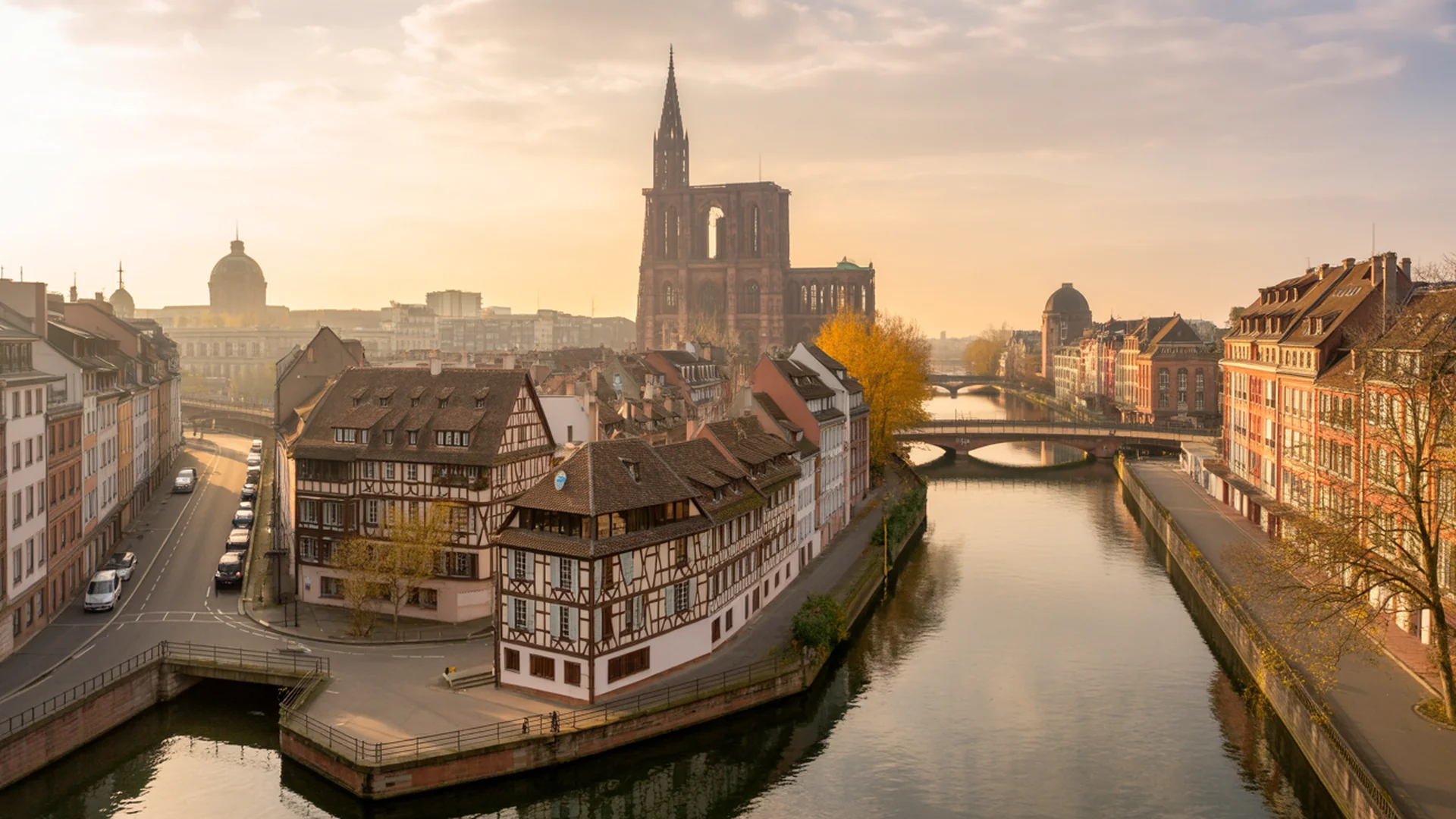
Strasbourg — the center of gravity
Strasbourg is not only the regional capital: it is the European capital (seat of Parliament), a dual UNESCO heritage city (Grande Île and Neustadt), and a leading economic hub. The high-end clientele is divided between three populations:
- Local entrepreneurial families (agri-food, technology, construction) and their children, often trained abroad and returned to manage family SMEs.
- Senior European executives from the Parliament and the Council, who live in Strasbourg as a second home during the monthly sessions.
- Passing customers: diplomats, parliamentarians, wealthy people from Northern Europe who stay for the weekend.
The addresses that count: the Hôtel Les Haras, the Hôtel Léonor, the Villa René Lalique (twenty minutes towards Wingen-sur-Moder) for high-end stays. As for gastronomy, Au Crocodile, 1741, Buerehiesel and Umami. For a confidential dinner, La Casserole or Aux Six Pins. And for well-being, the Strasbourg Municipal Baths, the uses of which we have detailed in another dedicated article.
What our house orchestrates in Strasbourg
Continuous management of permanent and secondary residences, star reservations even during parliamentary sessions, private access to the European Parliament and institutions, private visits to the Cathedral and the Museume Œuvre Notre-Dame, private evenings in the historic winstubs, organization of dinners in private courtyards of Petite France, transfers between Entzheim airport and the city center, and tailor-made weekend programs combining architecture, gastronomy and well-being.
Reims and Champagne — the dynastic economy
Reims is one of the most important centers of family capital in France. The dozens of Champagne houses, most of which are still in family hands, constitute a clientele with very high standards. Family celebrations – birthdays, weddings, baptisms – take place in the cellars of houses, in historic castles (Château de Reims, Château de la Villeneuve), in restored Cistercian abbeys, or in private estates inaccessible to the public.
Oenology there is cultural, not commercial. The local Reméens know their vintages like the people of Bordeaux know their vintages: perfectly, and with a form of discretion that is sometimes disconcerting for the foreign visitor. Tourist tours (visits to Pommery, Taittinger, Veuve Clicquot cellars) are distinct from the private tours that we organize for our clients — vertical tastings of rare vintages, meetings with cellar chefs, dinners at the owner's table.
Target services in Champagne
- Private tastings organized in houses which never receive the public (particularly in the Côte des Blancs and the Montagne de Reims).
- Access to the medieval cellars of Reims Cathedral for confidential dinners (up to 20 seats, upon authorization).
- Stay in a private wine château (Château de Sacy, Château de Pierry, Château d'Avize) with full service.
- Organization of weddings and receptions in lower Champagne (Ay, Epernay, Avize).
- Acquisition of rare bottles and collector’s cases from direct sellers.
Metz and Nancy — the Duchy of Lorraine, contemporary reality
Metz and Nancy are the two historic cities of Lorraine. Metz, predominantly German during the second half of the 19th century, has preserved impressive architecture - the imperial quarter, the monumental train station by Kröger, Saint-Étienne Cathedral with its stained glass windows by Chagall. The Centre Pompidou-Metz, opened in 2010, today makes it a leading cultural destination. Nancy, historic capital of the Duchy of Lorraine, embodies the School of Nancy and Art Nouveau (Émile Gallé, Louis Majorelle, Victor Prouvé, Daum).
The high-end clientele is less visible than in Champagne, but present. Several Lorraine industrial families (glass, crystal, steel) maintain historic residences in and around these towns. The cultural ecosystem (museums, Musée de l'École de Nancy, Center Pompidou-Metz, Palais de la Cour de Justice de Metz) offers a density that it is valuable to know how to orchestrate.
Target services in Metz and Nancy
- Private tours of the Center Pompidou-Metz outside opening hours.
- Access to the still active workshops of Daum, Baccarat (45 minutes), Cristalleries de Saint-Louis for custom orders.
- Stays at the Maison Carrée de Vezelise or at the Domaine de la Mauldine (private castle-hotels).
- Michelin-starred dinner at the Magasin aux Vivres in Metz, at the Table du Bon Roi Stanislas in Nancy, or at the Restaurant Michel Husser.
- Wedding in the park of Château de Fléville, Renaissance castle rents for confidential events.
Colmar and Mulhouse — intimate Alsace
Colmar, with its extraordinarily preserved medieval heart, is the gatewaynatural beauty of the Alsace Wine Route. The villas of the great winegrowers are discreet, there are numerous quality winstubs (JY's, by Jean-Yves Schillinger, remains the starred reference). Mulhouse, more austere, less visited, is home to the most important industrial heritage in Alsace (Cité du Train, Automobile Museum, École Nationale Supérieure de Chimie de Mulhouse), and industrial families of textiles and chemistry still present.