An exceptional property hosts an average of forty to sixty travellers per year. Each rotation is a critical sanitary moment — and, since France's ANRS MIE opened an Emerging hantavirus cell on 7 May 2026 in response to the MV Hondius outbreak, a subject on which public attention has just risen a notch. This article details the protocols we concretely apply at Adopte une Conciergerie to guarantee impeccable hygiene between every stay, prevent rodent infestations carrying zoonotic diseases (hantavirus, leptospirosis, salmonellosis) and intervene curatively when necessary — in line with the official recommendations of the US CDC, the French ANRS MIE, the Institut Pasteur Hantavirus National Reference Centre, and our own field experience on isolated chalets, villas with outbuildings, and long-vacant second homes.
Sanitary Note · Sources ANRS MIE · CDC · WHO · Institut Pasteur · Updated May 2026
The detail that distinguishes an ultra-luxury concierge: sanitary hygiene thought of as a protocol, not as a cleaning.
7 May 2026
ANRS MIE opens a level-1 Emerging hantavirus cell
19 FR cases
Recent confirmed infections in France Jan-Mar 2026 (CNR Hantavirus / Pasteur)
0 vaccine
No specific treatment or vaccine available — prevention remains the only answer
There are two ways to manage the hygiene of an exceptional property between two stays. The first is to entrust a "departure cleaning" to an external team, glance over and reopen for the next guests. This is the market's dominant approach, and it is precisely what we refuse to do. The second is to apply a written, traceable, systematic sanitary protocol designed to meet the real requirements of a UHNWI clientele and the biological risks documented by health authorities. This is what we have done since the very first property we managed.
This article details why this rigour matters, what it concretely covers, and how recent news — notably France's ANRS Emerging Infectious Diseases agency opening a level-1 Emerging hantavirus cell on 7 May 2026, in response to the WHO-reported outbreak aboard the MV Hondius — has reinforced the importance of preventive and curative protocols in the premium private concierge profession.
Why hygiene between stays has become a subject in its own right
On the mainstream market, a traveller finding a hair on the pillow leaves an average rating. On the premium market, the same traveller — often paying ten times more per night — leaves the property within the hour, demands a full refund, and leaves a detailed comment that durably weighs on positioning. There is no tolerance. Impeccable hygiene is not a differentiating advantage: it is a condition of entry.
Added to this is a health risk professional concierges can no longer ignore. Exceptional properties are often isolated (altitude chalets, forest-edge villas, second homes) and frequently vacant for weeks at a time. These two characteristics — isolation and prolonged vacancy — are precisely the factors that favour the installation of wild rodents, recognised by health authorities as vectors of several zoonotic diseases including leptospirosis, salmonellosis, and hantaviruses. ANRS MIE's reference page, updated 12 May 2026, is explicit: "prevention of infection essentially consists in limiting contact with rodents and their excretions. This requires avoiding, in at-risk areas, handling wood, cleaning long-vacant premises, any activity that puts dust or earth into suspension". For a concierge, this sentence is an operational roadmap.
The 2026 hantavirus context: what to know, without alarmism
Hantaviruses form a family of zoonotic viruses present on all continents, transmitted primarily by wild rodents (rats, voles, field mice) through their urine, faeces and saliva. According to ANRS MIE and the WHO, more than twenty viral species pathogenic to humans have been identified. Transmission occurs essentially through inhalation of contaminated aerosols from the excreta of asymptomatically infected rodents — exactly the type of aerosols a broom or classic vacuum cleaner can generate in an unprepared premises.
Two syndromes may result depending on viral species and geographic zone: haemorrhagic fever with renal syndrome (lethality 0.4 to 10%, predominant in Europe and Asia), or severe cardiopulmonary syndrome (lethality 30 to 60%, predominant on the American continent). No specific treatment or vaccine is available on an international scale. Prevention is therefore the only effective answer.
In France, the Institut Pasteur's CNR Hantavirus (National Reference Centre) recorded 19 confirmed cases of recent infection between January and March 2026, within the observed monthly average. Globally, the WHO estimates between 10,000 and 100,000 annual cases, mainly in Asia and Europe. On 3 May 2026, the WHO alerted on an outbreak aboard the Dutch cruise ship MV Hondius, prompting ANRS MIE to open a level-1 Emerging cell on 7 May 2026 to structure scientific monitoring.
The takeaway is not anxiogenic, it is operational: hantavirus circulation is stable in France, but avoidance rests entirely on simple, rigorous gestures during cleaning of long-vacant premises and rodent management. This is exactly the work of a serious concierge.
Preventive protocols: preventing rodent installation
The best curative intervention is the one you never have to make. Our preventive approach, aligned with CDC and ANRS MIE recommendations, rests on five pillars we apply on each managed property.
1. Building sealing. Mice can pass through any gap larger than 6 millimetres (CDC), rats through any passage larger than 12 millimetres. When taking on a new property, we conduct a complete sealing audit: building exterior, network penetration points (water, electricity, gas, ventilation), technical ducts, door and window seals, vents, chimneys, attics. All weak points are sealed with stainless steel wool, fine hardware cloth, or appropriate caulking products, in line with CDC recommendations. Steel wool alone is not sufficient: we systematically double it with caulk or mortar to prevent rodents from moving it.
2. Surroundings management. American health authorities (CDC, Washington State Department of Health) recommend keeping building surroundings clear of any potential rodent shelter. Concretely: trimmed vegetation, grass cut short near the building, removal of leaf and debris piles, firewood stored at minimum 30 centimetres off the ground and at distance from the building, removal of brush and stone piles within several metres around the home. For Vosges chalets, Provençal villas or forest-edge properties, this surroundings maintenance discipline is as important as sealing.
3. Attractant control. No food item should remain accessible in a vacant property. Our between-stay closure protocol provides for: complete refrigerator emptying, placement under hermetic metal or thick glass containers of all non-perishable items (rice, pasta, cereals, biscuits), thorough kitchen cleaning to eliminate any organic trace, verification of emptied and cleaned bins, control of compost bins and pantry cupboards. Pet kibble, sometimes forgotten under the sink or in a garage, is one of the most powerful attractants identified by health services.
4. Early detection. At each control visit (which we perform monthly on vacant properties, more frequently in at-risk seasons), we conduct systematic inspection of sensitive points: attics, cellars, garages, outbuildings, under-sink, behind appliances, inside lower cupboards. We look for indices documented by veterinary and health services: droppings (variable shape and size by species), gnawing marks on packaging or wooden elements, nests of shredded fibres (paper, insulation, fabric), greasy traces along baseboards (repeated passage marking), nocturnal sounds reported by previous travellers. Any trace, even light, triggers intervention.
5. Preventive deterrence. On structurally at-risk properties (isolation, forest or rural environment, multiple outbuildings), we set up permanent monitoring: capture traps without toxic bait placed in likely passage zones, regular control, visit contract with a licensed professional (3D: Disinfection, Rat Removal, Insect Removal) Certibiocide-certified, intervening on trigger or quarterly preventive visit.
Curative protocols: if presence is detected, what to do — and what absolutely not to do
If a rodent presence is detected, whether droppings, nests or a dead animal, the CDC and ANRS MIE protocol is unambiguous. What absolutely must not be done: sweep, dry-vacuum, or blow the area. These gestures put potentially virus-containing dust particles into suspension in the air, and constitute the main documented mode of human contamination. No domestic vacuum cleaner, even with HEPA filter, eliminates this risk for directly contaminated dust.
The protocol we apply, strictly aligned with CDC recommendations published in January 2025:
Step 1 — Prior airing, 30 minutes minimum. Open all doors and windows of the concerned premises for at least 30 minutes before any intervention. Leave the premises during this time. This cross-ventilation significantly reduces airborne viral load.
Step 2 — Personal protective equipment. Impermeable gloves (rubber, latex, vinyl or nitrile), unvented protective goggles, and for heavy infestation, N95-type HEPA filtration respirator or half-mask with cartridge (CDC recommendation). Our teams are equipped with this material on all at-risk properties.
Step 3 — Disinfectant solution preparation. Bleach diluted to 10% — that is 1 part bleach to 9 parts water (CDC recommendation, Institut Pasteur, ANRS MIE). Prepared extemporaneously, never stored. Possible alternative: a disinfectant registered as virucidal. 10% bleach solution remains the reference for its documented efficacy on hantaviruses, modest cost and traceability.
Step 4 — Application and contact time. Generous spraying of the solution on droppings, urine, nests, dead animals, and any contaminated surface. Minimum contact time: 5 minutes per CDC, up to 15 minutes per some American university extensions to guarantee inactivation. During this time, touch nothing.
Step 5 — Wiping with disposable paper towels. Pickup using disposable paper towels. Deposit in a closed plastic bag. Double bagging. Disposal as infectious waste in line with local channels.
Step 6 — Complete surface disinfection. All hard surfaces (floors, countertops, cupboards, shelves) are then disinfected with 10% bleach solution or virucidal disinfectant. Contaminated porous materials (fabrics, soft toys, bedding) are washed hot (washing machine, hot programme, high-temperature drying or sun exposure — detergent and heat destroy the virus's lipid envelope, per CDC).
Step 7 — PPE removal and final hygiene. Glove decontamination with bleach solution before removal, disposal in the sealed bag, prolonged hand washing with soap and hot water.
Special case — heavy infestation. In case of significant infestation (piles of droppings, multiple nests, several dead animals), intervention is no longer within our scope: we immediately mandate a professional 3D Certibiocide-licensed company, equipped with full PPE (HEPA masks, suits), and we return the property to service only after written sanitation certification.
Hygiene protocols between each stay, in detail
Beyond zoonotic prevention, here is concretely what a rotation between two stays covers in our high-end properties. This checklist is applied and verified at each departure.
Complete linen change. All used linen is entirely changed between each stay, without exception: sheets, pillowcases, duvet covers, blankets if in direct contact, bathrobes, hand and bath towels, kitchen towels, washcloths. High-temperature washing (60 °C minimum for terry and bed linen, per sanitary recommendations on lipid viral envelopes). Flat linen ironing. Dedicated stock per property to never cross linen between properties.
Disinfection of high-frequency contact points. Handles, switches, remote controls, taps, toilet flushes, chair backs, armrests, keyboards, glass surfaces, safe keypads, appliance remotes, home automation touchscreens. 70% alcohol disinfectant or EN 14476-certified virucidal product.
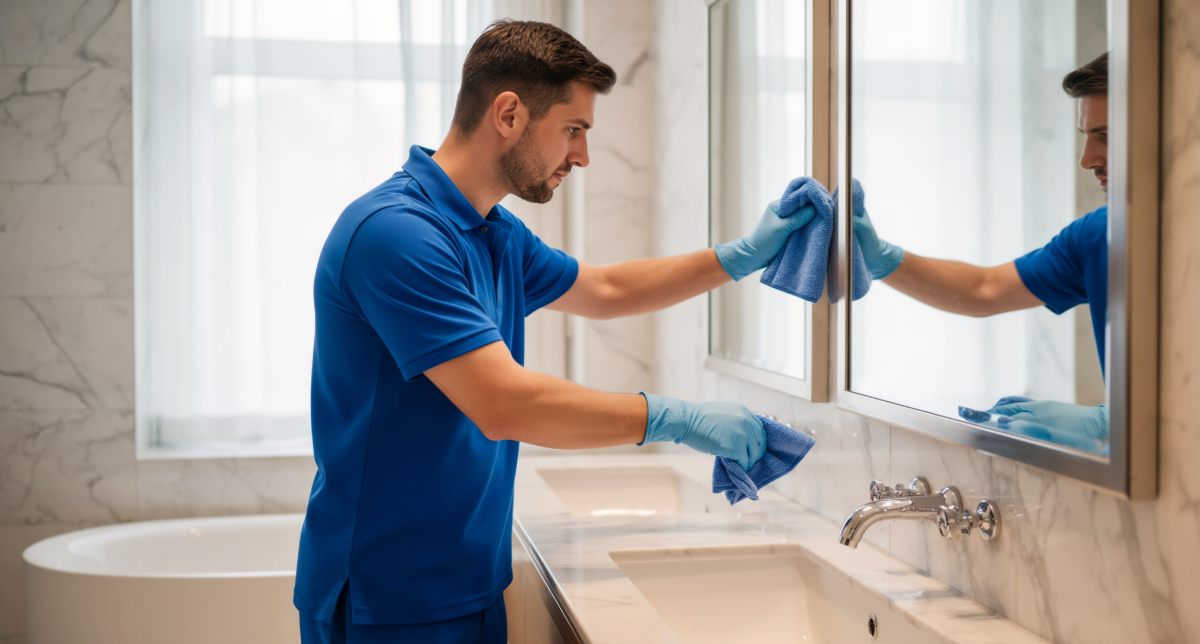
Bathroom and sanitary facilities. Thorough cleaning with virucidal product: toilets (inside and outside, seat, lid, mechanism), sink, shower and bath (panels, floors, joints, taps, regularly descaled showerheads), mirrors, accessories, towel warmer. Visual joint check (mouldy black areas to treat immediately). Removal of cosmetic products left by previous traveller.
Kitchen. Complete degreasing (stovetop, hood, oven, microwave inside and out), inside and outside refrigerator cleaning (shelves and bins removed and washed), countertop disinfection, coffee maker emptying and cleaning, kettle descaling, toaster degreasing. Dishwasher emptied, cleaned, filter rinsed. Sink and siphon disinfected. Individual verification of dishes, glasses and cutlery (systematic dishwasher pass between stays).
Floors and surfaces. Vacuuming of all floors, followed by hard floor washing with disinfectant. Rugs and carpets: HEPA vacuum and, periodically, professional steam cleaning. Glass, mirrors and glazed surfaces: cleaning and disinfection.
Spa, sauna, jacuzzi, pool. Chemical parameter control (free chlorine, pH, bromine, total alkalinity) between each stay. Jacuzzi emptying and complete disinfection protocol cleaning at each rotation. Sauna cabin and wooden bench brushing and cleaning (essential against microbial risk if damp), hammam. Pool filter checked and cleaned.
Air and ventilation. Complete property airing during rotation. Visual check of ventilation outlets, mechanical ventilation filter replacement on schedule, verification of absence of nests in ducts (sensitive subject identified by CDC, recommending professional intervention if ventilation has been colonised). End-of-rotation air freshener diffusion.
Photo control and traceability. Our field team documents each rotation by a time-stamped photo checklist (12 to 18 views depending on properties) constituting a verifiable written trace. This traceability is a contractual commitment to our owners.
The special case of long-vacant properties
ANRS MIE and CDC recommendations are particularly clear on premises closed for several weeks or months: these are high-risk contexts imposing a reinforced protocol. Before any return to service — seasonal reopening of an autumn chalet, return of a Provençal villa after winter, first opening of a second home taken over by a new owner — we systematically apply:
A prior airing of 30 minutes minimum before anyone enters closed volumes (cellar, attic, garage, outbuildings in particular). A complete inspection searching for rodent traces before any cleaning. If presence detected: application of the complete curative protocol described above, or mandate of a 3D professional if infestation is heavy. If no presence detected: complete wet cleaning (no dry sweeping, no vacuum on dusty surfaces) with virucidal product. Ventilation outlets and attics verification. Opening of long-unused pipework (water purge and disinfection).
This seasonal opening discipline is one of the most appreciated services by our second-home owners — precisely because it saves them or their travellers from being the first to enter a volume that has not been managed for several months.
Why 100% human changes everything on hygiene
A premium hygiene checklist is worth only what the person who applies it is worth. This is precisely where the 100% human model changes the nature of the result. Our field teams are stable, internally trained in the sanitary protocols detailed above, equipped with necessary PPE, supervised by an identified referent for each property, and held to a requirement of systematic photographic traceability. No platform, no algorithm, no opportunistic subcontracting can guarantee this execution level over time.
On the ultra-luxury segment, the gap between a correct rotation and an impeccable one is measured in details — a shower joint, the underside of a piece of furniture, the back of a cushion, a machine filter, a cupboard corner. These are precisely the details our team verifies systematically, because it knows your property and knows itself responsible. Adopte une Conciergerie is built for this.
Ten questions on hygiene between stays and sanitary prevention
Why talk about hantaviruses now and not a year ago?
The subject is not new, but current events have put it back at the forefront. On 3 May 2026, the WHO alerted on a hantavirus infection outbreak aboard the Dutch cruise ship MV Hondius. In response, France's ANRS Emerging Infectious Diseases agency opened a level-1 Emerging cell on 7 May 2026 to structure scientific monitoring. This episode reminds us that hantaviruses still circulate, that France recorded 19 confirmed cases of recent infection between January and March 2026 (CNR Hantavirus / Institut Pasteur), and that prevention through rigorous hygiene protocols remains the only effective response since no specific treatment or vaccine is available. Our role as a concierge is to translate this data into concrete operational gestures.
What product to use for disinfection in case of rodent presence?
The international reference is 10% bleach solution, i.e. 1 part bleach to 9 parts water (CDC recommendation, taken up by ANRS MIE and Institut Pasteur's CNR Hantavirus). It must be prepared extemporaneously, never stored in advance. The recommended contact time is at least 5 minutes (CDC), potentially up to 15 minutes per some American university extensions for complete inactivation. An alternative is a registered virucidal disinfectant (EPA-registered in the US, virucidal EN 14476 in Europe), used strictly per manufacturer's instructions. In all cases, never sweep or vacuum before wet disinfection: this is precisely what puts the virus into airborne suspension.
Why must one absolutely not sweep or vacuum a contaminated zone?
Because that is exactly the gesture health authorities identify as the main mode of human contamination. Hantavirus is essentially transmitted through inhalation of contaminated aerosols from rodent excreta (ANRS MIE, WHO). Sweeping or vacuuming over a zone containing dust, droppings or rodent urine puts these particles into airborne suspension. American health authorities (CDC, Department of Health) are categorical: air first for 30 minutes, then humidify the zone with disinfectant solution, let act 5 to 15 minutes, and wipe with disposable paper towels. No domestic vacuum cleaner, even HEPA-equipped, is validated for this type of decontamination as a replacement for wet protocol.
What protective equipment do your teams use on at-risk properties?
In line with CDC recommendations, on structurally at-risk properties (isolation, rural or forest environment, multiple outbuildings), our teams permanently dispose of impermeable gloves (rubber, latex, vinyl or nitrile), unvented protective goggles, and N95 HEPA-filtration respiratory masks. For interventions in case of confirmed infestation or prolonged closure of premises, we use HEPA cartridge half-masks. Above a certain infestation threshold (piles of droppings, multiple nests, dead animals), we immediately mandate a professional 3D Certibiocide-licensed company, equipped with full body suits — this is no longer the concierge's role.
How often must a vacant property be inspected?
Our standard is a minimum monthly visit on vacant properties, with reinforced frequency in at-risk seasons (autumn for rodent entry into hibernation, end of winter for controls before return to service). For altitude chalets, isolated villas and forest-edge second homes, we increase this frequency to a fortnightly visit. Each visit includes systematic inspection of sensitive points (attics, cellars, garages, outbuildings, under-sink, behind appliances, inside lower cupboards) searching for documented indices: droppings, gnawing marks, shredded fibre nests, greasy traces along baseboards. Any trace, even light, triggers immediate intervention.
How to prevent rodents from entering an at-risk property?
Based on CDC recommendations, our sealing protocol combines five actions. First, identify and seal all gaps larger than 6 millimetres (mice) and 12 millimetres (rats) — around network passages, door and window seals, vents, chimneys, technical ducts. Second, use materials rodents cannot gnaw: stainless steel wool doubled with caulk or mortar, fine hardware cloth. Third, clear surroundings over several metres around the building (trimmed vegetation, wood stored 30 cm off ground minimum and at distance). Fourth, remove all food attractants (emptied refrigerator, items in hermetic metal or glass containers, empty and clean bins). Fifth, on structurally at-risk properties, contract with a licensed 3D company for quarterly preventive visits.
How does a premium hygienic rotation unfold between two stays?
Our rotation protocol comprises eight systematic blocks, application documented by time-stamped photo checklist. First, integral linen change (60 °C minimum washing, flat ironing, dedicated stock per property). Second, disinfection of high-frequency contact points (handles, switches, remote controls, taps) with 70% alcohol or EN 14476 virucidal product. Third, thorough bathroom cleaning with virucide. Fourth, complete kitchen degreasing and disinfection. Fifth, floors and surfaces (HEPA vacuuming, disinfectant washing). Sixth, chemical parameter control of spa, sauna, jacuzzi and pool. Seventh, complete airing and ventilation control. Eighth, photo traceability and rotation closure. This discipline is uncompromising, because it is what distinguishes a premium hotel rotation from simple cleaning.
What signs should alert an owner during a property visit?
Five indices documented by veterinary and health services: black or brown droppings, rice-grain shape or larger by species, particularly along baseboards, behind furniture, under the sink, in lower cupboards. Gnawing marks on food packaging, electrical wires, wooden battens or insulation materials. Nests of shredded fibres (paper, insulation, fabric) in attics, cellars, behind appliances. Brownish greasy traces along baseboards or usual passages (repeated passage marking). Nocturnal sounds reported by former travellers or by yourself on a night on site. If you spot any of these signs, do not intervene yourself without protection — contact us or immediately mandate a licensed 3D professional.
Is hantavirus really a risk in France?
Yes, at a moderate and stable level. According to ANRS Emerging Infectious Diseases agency and Institut Pasteur's CNR Hantavirus, 19 confirmed cases of recent infection were recorded in France between January and March 2026, within usual monthly average. In French Guiana, since 2008, eleven cases of Maripa hantavirus pulmonary syndrome have been detected, six of them fatal. At European scale, the main serotype is Puumala (bank vole), majority in central and northern Europe, responsible for the moderate renal form. The message is not alarmist — circulation is known and monitored — but operational: rural and forest zones, isolated properties and long-vacant premises are the contexts where vigilance must be maximal. This is precisely where our protocols apply.
How does Adopte une Conciergerie articulate premium hygiene and sanitary discretion?
Our commitment is dual. On one side, sanitary rigour aligned with reference authorities' recommendations (CDC, ANRS MIE, Institut Pasteur, WHO) — written protocols, trained teams, available PPE, systematic photo traceability. On the other, total discretion in how this rigour expresses itself with traveller and owner: we never dramatise a risk, we never communicate on individual incidents, we rigorously document internally but present a perfect, calm and welcoming property. This dual requirement — operational irreproachability and narrative discretion — is exactly what a UHNWI clientele seeks, tolerating neither sanitary negligence nor commercial alarmism. This is our trade: thinking on your behalf what must be thought, without ever letting it weigh on your experience.
Impeccable hygiene is not one competence among others for an ultra-luxury concierge — it is the invisible foundation on which everything rests. Fresh linen and dressed tables count for little if the sanitary base is neglected. This is why we have made our protocols a written, verifiable discipline, aligned with the best international recommendations, entrusted to stable human teams who know your properties. Hantavirus is not an emergency in our territories — it is a useful reminder. The real luxury, in 2026, is to be able to enter your property or welcome a client without having to ask the question.
Sources: ANRS MIE (12 May 2026) · CDC Hantavirus Prevention (January 2025) · CNR Hantavirus Institut Pasteur · WHO Disease Outbreak News (3 May 2026) · Santé publique France · May 2026
Adopte une Conciergerie — First Private Luxury Concierge of Grand-Est · Paris · French Riviera · Prague Presence