In a palace, in a luxury residence, in an apartment managed by a private concierge, cleanliness is never visible. It is felt. The immaculate linen with a slightly firm touch that barely smells of anything. The floor that makes no sound underfoot. The air in the room that has no odour — neither that of detergent nor that of enclosure. This kind of cleanliness is not improvised. It is the result of a method, a choice of products, and in 2026, increasingly of a conviction: that excellence in hygiene and environmental responsibility are not opposed. They define each other.
There is a way to recognise a truly well-kept place. It is not the magnificence of the décor or the grandeur of the entrance. It is something more discreet, almost imperceptible — and yet absolutely decisive. It is an absence. The absence of dust on a windowsill no one thought to look at. The absence of a streak on the glass by the washbasin. The absence of that slight sourness one sometimes notices in the corridors of establishments that clean without really maintaining.
In exceptional venues — palaces, private residences, master houses, concierge villas — cleanliness is a form of language. It says, without a word, that someone has taken care of everything. That a protocol has been respected to the last gesture. That nothing was left to chance. And in 2026, it says something more: that the products used to achieve this result are known, traced, and chosen for what they do not leave in the air one breathes, on the surfaces one touches, in the water one drinks.
Cleanliness as total sensory experience
A client entering a grand luxury hotel room engages all five senses before even setting down their luggage. They smell — or do not smell, which is even better. They touch the linen, which must have a precise texture, neither too rough nor too soft, fresh without being cold. They see light settle on surfaces without catching. They hear silence — the absence of the sound that an overdue vacuum cleaner sometimes makes in the corridor.
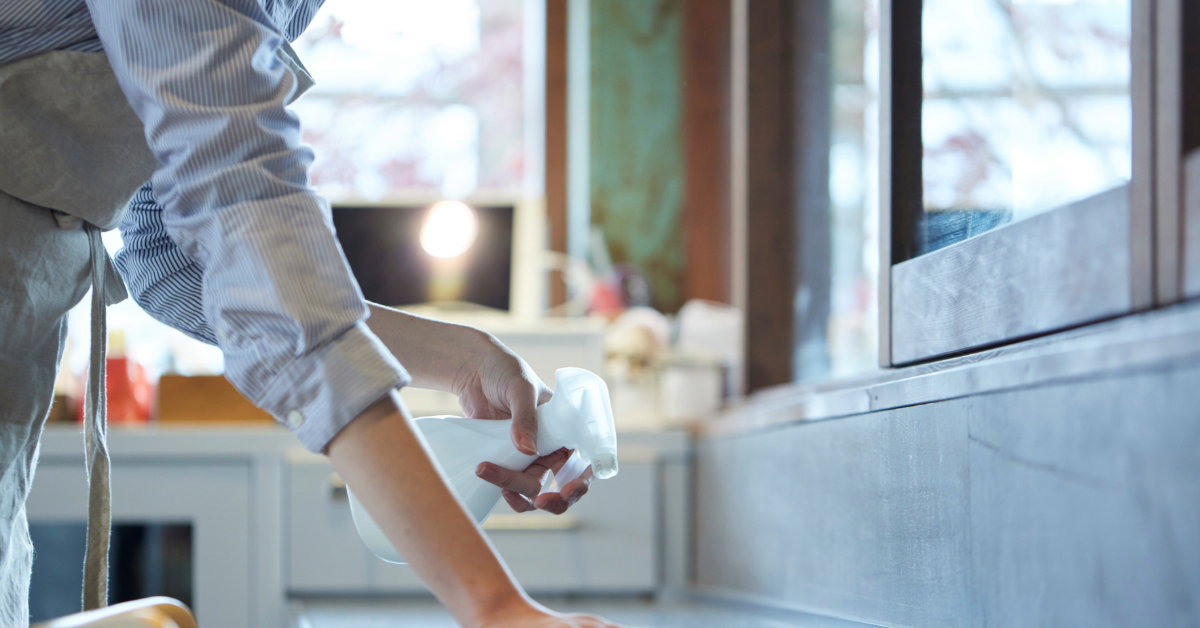
This total sensory experience is the invisible product of hundreds of decisions made in advance. The choice of laundry detergent — without artificial fragrance, or with a natural fragrance (Provence lavender, Vosges cedar). The choice of cloth — high-performance microfibre that cleans with clear water without chemical residue, changed per room without exception. The choice of the multi-surface spray — formulated from plant-based surfactants, without petrochemical solvents, certified EU Ecolabel or Nordic Ecolabel.
Bio-sourced: a word that has changed meaning
Ten years ago, "bio-sourced" in professional maintenance often implied a concession on efficacy. That compromise no longer exists. New-generation bio-sourced formulations — based on plant extracts, natural enzymes, organic acids from fermentation — now achieve microbiological performance equivalent to conventional chemical products, with superior biodegradability and significantly reduced human toxicity.
The Hôtel Fouquet's Barrière became the first Parisian 5-star palace to earn the triple ISO 9001, ISO 14001 and SA 8000 certification — a world first in luxury hotel industry, demonstrating that luxury can lead in sustainable development. The ISO 14001 standard requires documented mastery of all chemical products used, from composition to disposal.
The Hôtel Meurice developed a digital tool for traceability of all its deliveries — to track extra-financial information that conventional accounting systems could not follow: origin, type of agriculture, carbon footprint. What Meurice's CSR manager Marine Deconinck describes as a transparency revolution now applies to cleaning products: it is no longer enough that they be effective — it is necessary to know where each component comes from, how it is produced, and where it ends up.
Traceability: the new standard of excellence
Traceability of cleaning products in luxury venues is no longer a regulatory constraint — it has become a competitive standard of excellence. UHNWI clients are increasingly asking direct questions about products used in their privatised spaces: which detergent for bed linen, which product for kitchen surfaces, which disinfectant for wet areas.
The health dimension. People who suffer from allergies, asthma or chemical hypersensitivity — a growing reality among affluent Western populations — cannot stay in spaces where cleaning products contain volatile organic compounds (VOCs), allergenic synthetic fragrances or chlorine-based disinfectants. A serious private concierge must be able to guarantee documented hypoallergenic protocols for all spaces it manages.
The coherence dimension. A client who has made the choice of organic sourced food, an ethically constructed wardrobe, and a residence renovated with natural materials cannot be satisfied with maintenance carried out with low-grade petrochemical products. Consistency of gesture has become an implicit requirement in contemporary luxury circles.
The transmission dimension. For owners of exceptional residences who welcome their children and grandchildren, the question of what is applied on the surfaces where the youngest play, eat and sleep is a concrete concern. Low-toxicity bio-sourced products are not an ideological preference — they are common-sense parental precaution.
The certifications that count in 2026
The EU Ecolabel for cleaning products guarantees rapid biodegradability, limitation of hazardous substances, demonstrated efficacy and reduced packaging. The Green Key label counts more than 2,400 certified establishments in 2025 — with 35% growth in two years — and has become the international reference for hotel sustainability. ISO 14001 covers the overall environmental management of an establishment, including its procurement policy for cleaning products. HACCP certifications now extend to all microbiologically sensitive areas in luxury establishments.
What Adopte une Conciergerie does
For the exceptional residences and properties that Adopte une Conciergerie manages in Grand-Est and beyond, maintenance excellence is not an option — it is a condition of exercise. We select our cleaning service providers on precise criteria: training in high-end hotel protocols, exclusive use of Ecolabel-certified or equivalent products, documentation of each intervention, and protocols adaptable to owners' specific requirements (hypoallergenic, fragrance-free, VOC-free).
The cleanliness of an exceptional venue goes unnoticed. It is lived. It is the invisible layer beneath which everything else — the architecture, the linen, the view, the silence — can fully express its value. And in a world where clients increasingly read what they cannot see, it has become one of the most discriminating criteria of true luxury.
Sources: L'Écho Touristique (2025) · RSE-Pro.com · Hotel Million · ESG Luxe / Hospitality Trends 2025 · EHL Hospitality Insights · BPI France Big Média (2026)