This week, two apparently unconnected events said the same thing about contemporary luxury: Kering disposed of its via Monte Napoleone building for over a billion euros, and the CJEU ruled in the Goyard-Fauré Le Page case on the right to claim a heritage. An 18th-century building and a date on a bag. Two ways of saying that in luxury, history is the most powerful value — and the most scrutinised.
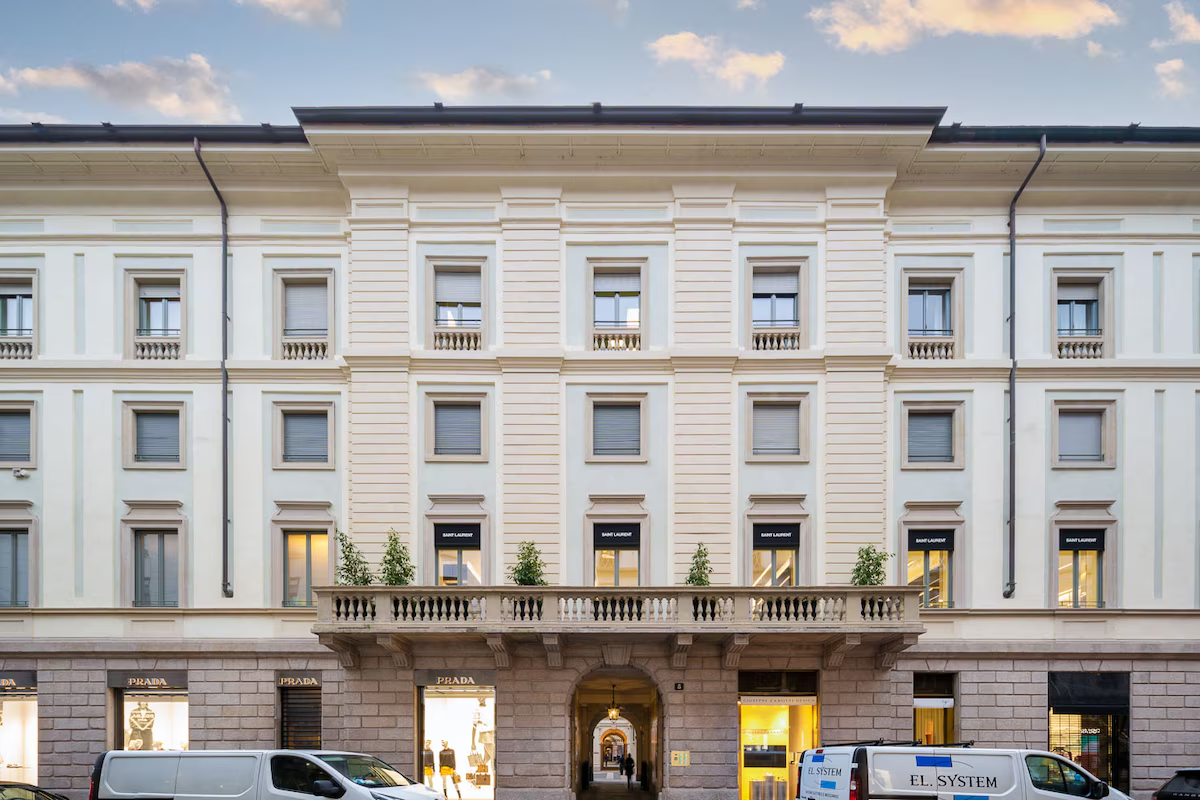
This week, two pieces of news arrived from opposite directions and said exactly the same thing. The first from Milan: Kering finalised the disposal of a majority stake in its building at 8 via Monte Napoleone — an 18th-century edifice at the heart of the Quadrilatero della Moda — to the Qatari group Al Mirqab Group for over one billion euros. The second from Luxembourg: the Court of Justice of the European Union delivered its ruling in the Goyard versus Fauré Le Page case, deciding on a house's right to claim a founding date in its commercial communications.
A building. A date on a bag. Billions on one side, an apparently semantic dispute on the other. And yet both speak to the same thing: in luxury in 2026, heritage is the most powerful asset — and the most complicated to manage.
Kering and via Monte Napoleone: what the sale is really saying
Kering had acquired this building for approximately 1.3 billion euros in April 2024. Eighteen months later, it is ceding 80% to Al Mirqab Group for over a billion, retaining 20% of the jointly held structure. On paper, this is a balance sheet management exercise in a difficult context — the group's net profit was divided by more than ten in 2025, and Luca de Meo, the former Renault chief who arrived in September, is in the midst of restructuring.
But what is really happening is more interesting than the accounting. Kering is not relinquishing just any real estate asset. It is relinquishing — partially — one of the most emblematic corners of the most expensive street in the world. Via Monte Napoleone is the physical temple of European luxury. Having an address there is a status signal that no advertising campaign can reproduce.
This movement fits into a broader dynamic. The great Houses — LVMH with its Parisian flagship buybacks, via Chanel and Kering — have understood for years that prime real estate is not an operational cost. It is an image vector, a heritage asset, and a form of architectural storytelling. Owning the building at 8 via Monte Napoleone says something about permanence and legitimacy — independently of that season's collections.
The Goyard-Fauré Le Page ruling: when storytelling becomes a legal matter
The case has been running since 2012. Goyard — a house founded in 1853 that presents itself as the oldest leather goods house still in operation — contested Fauré Le Page's right to use the mention "Paris 1717" in its communications. The argument: Fauré Le Page, the original royal armourer, ceased activity in 1992 and its company was dissolved. The brand was only bought back and relaunched in 2009. How, then, to claim 1717?
The CJEU delivered on 26 March 2026 a ruling that does not simply settle this dispute between two Parisian leather goods makers. It poses a fundamental question for the entire luxury industry: how far can heritage narrative go without becoming commercial deception? The Court's answer: history is a competitive advantage, but its claim must be provable, continuous and materially grounded.
What this teaches for heritage real estate in Grand-Est
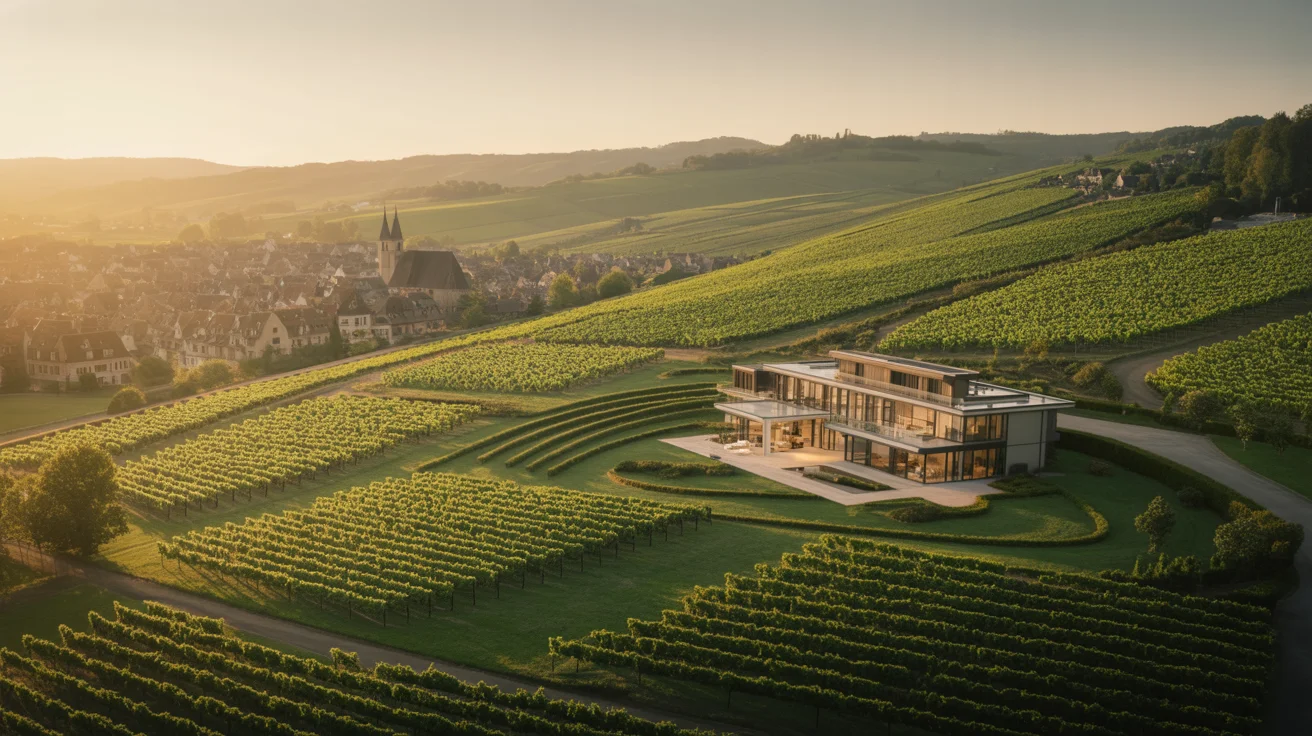
These two news items illuminate each other in the context of what we do at Adopte une Conciergerie. In Grand-Est, we work with properties whose value is precisely patrimonial: châteaux that have crossed centuries, wine estates whose cellars carry the history of the vine in every stone, architect-designed villas whose signature is a piece of regional architectural heritage.
The Kering lesson is clear: prime real estate in a territory of excellence is not an expense — it is an investment in meaning. Owning a château in Moselle or a classified estate on the Wine Route is an inscription into a narrative whose value exceeds the price per square metre.
The Goyard-CJEU lesson is equally clear: this narrative must be true, documented and defensible. Heritage due diligence — verifying a property's origins, its ownership history, the works carried out and their regulatory compliance, the applicable protections — is not only a legal precaution. It is also a way of understanding what you are really buying. And what you can legitimately claim.
How does Adopte une Conciergerie support heritage property acquisition in Grand-Est?
We manage the entire process: off-market property identification via our network of local notaries and family offices, heritage and legal due diligence prior to any viewing, negotiation support, notarial coordination and post-acquisition property management. Our knowledge of Grand-Est allows us to identify properties invisible on public platforms and to understand their real heritage value.
What is heritage due diligence on a character property?
Beyond standard legal checks, heritage due diligence on a château, wine estate or architect villa includes: verification of the property's classification (listed monument, ABF protection zone), audit of works carried out and their compliance with heritage authorisations, assessment of architectural coherence and ownership history, and estimation of renovation constraints associated with the property's protection.
Does a prestige property's storytelling impact its resale value?
Yes, considerably. A château whose history is documented, a wine estate with centuries-long ownership traceability, an architect villa with complete original design archives: these elements constitute a narrative premium that exceeds per-square-metre valuation. The Goyard-CJEU case confirms this at the legal level: patrimonial legitimacy is a protectable value.
How does one access heritage off-market properties in Grand-Est?
Via our exclusive network of notaries, heritage lawyers, family offices and local players who inform us of selling intentions before any public listing. In Grand-Est, high-value heritage properties — châteaux, wine estates, architect villas — are almost systematically transferred off-market, between families or through trusted circles. Adopte une Conciergerie is one of the only players positioned within this network fabric.
Can a Grand-Est heritage property generate income while being preserved?
Yes — and it is one of the most effective strategies for financing the maintenance of a character property. We organise confidential event rentals (private dinners, executive seminars, high-end stays), shoots, and immersive experiences for UHNWI clienteles. These uses are carefully managed to preserve the property's integrity and the owner's confidentiality.
What is the difference between a listed heritage property and an unlisted character property?
A listed historic monument benefits from strict legal protection and significant tax advantages, but imposes constraints on works and use. An unlisted character property offers more flexibility but less protection of its heritage value. Both have their place in a well-constructed portfolio. We support both types of acquisition and manage the specifics of each.
How does property management work for a Grand-Est property when the owner lives elsewhere?
This is one of our core missions. For an owner based in Paris, Geneva or abroad, we are the single point of contact in Grand-Est: managing maintenance providers, supervising works, preparing stays, event rental management during absences, and regular reporting on the property's condition. The owner arrives to find their residence always ready — without having managed any detail remotely.
Is Grand-Est heritage real estate a safe-haven asset in times of uncertainty?
The 2026 data confirms it: rare properties with a strong patrimonial identity structurally resist market cycles better than standardised assets. A classified Alsatian wine estate or a Moselle château does not carry the same risk profile as a new-build apartment in a peripheral area. Its value is anchored in irreplaceability — a quality that the current rationalisation of the market is precisely rewarding.
In luxury as in exceptional real estate, history is not an ornament. It is the foundation. And the finest stories are those that do not need to be invented.
Off-market heritage acquisition Grand-Est · adopteuneconciergerie.fr