Côte d'Azur Ultra-Luxe · UHNWI Guide · Cannes · Saint-Tropez · 2026
Same sea, same sun, same international clientele — but two radically different DNAs. Choosing between Cannes and Saint-Tropez is choosing between two definitions of luxury.
Cannes: palace city
La Croisette, festivals, yachting, luxury shopping, starred gastronomy — urban and spectacular luxury
Saint-Tropez: mythical village
The port, the beaches of Pampelonne, the private villas, the party and the discretion simultaneously — raw Mediterranean luxury
8 palaces in 2026
Hôtel du Cap-Eden-Roc · Cheval Blanc · Carlton · Four Seasons Cap-Ferrat · Maybourne Riviera · and three other benchmarks
There is one question that the most informed clients ask themselves before organizing their summer vacation on the Côte d'Azur: Cannes or Saint-Tropez? The answer is not obvious, and it cannot be reduced to personal preference. It depends on the vacation profile sought, the composition of the group (couple, family, group of friends, combination), the time of the season, the relationship to social life versus retirement, and the way in which we envisage luxury — spectacular or discreet, urban or natural, festivals and galas or beaches and villas.
This distinction is fundamental because these two destinations, barely two hours away by road, represent two philosophies of Mediterranean luxury which do not replace one another – they complement each other. And this is precisely why the smartest itineraries on the Côte d'Azur often combine the two, adding neighboring addresses that allow you to escape both when density becomes too high: Cap d'Antibes, Saint-Jean-Cap-Ferrat, Mougins, Ramatuelle, Gassin, Èze, La Croix-Valmer.
Cannes: spectacular luxury and events
Cannes is a city — not a village, not a transformed fishing port. It has a complete urban infrastructure, its own temporality of events (Cannes Film Festival in May, MIPIM in March, Advertising Lion in June, MIPCOM in October), a Croisette which is one of the most photographed boulevards in the world, and a hotel tradition which dates back to the Belle Époque. For UHNWI visitors, Cannes offers something that Saint-Tropez can't quite give: the feeling of being at the center of a lively international scene.
Cannes luxury is urban, spectacular and social. The Croisette is a walk to take, not to avoid. The palaces line up with uunparalleled density: the Carlton Cannes (Regent), inaugurated in 1911, is the absolute icon — its two domes inspired by the breasts of La Belle Otero, its private white sand beach, its luxury palace suites. The Martinez, Art Deco from the 1930s, is home to La Palme d'Or — the city's two-star Michelin restaurant — and its new 1,400 m² spa. The Majestic Barrière, just opposite the Palais des Festivals, is the palace of Cannes social life — its terraces in the evening look like permanent cocktails. The JW Marriott Cannes and the Five Seas by Inwood complete the premium offering on the Croisette with more contemporary profiles.
For yachts, Cannes is one of the most important marinas in the Mediterranean — the Port of Cannes and Port Canto welcome sailboats and motoryachts of all sizes, with an incomparable service infrastructure (fuel, provisioning, maintenance). Anchorage in front of the Lérins Islands (Sainte-Honorat and Saint-Marguerite, twenty minutes by boat) is one of the most beautiful experiences available in the Cannes region - turquoise water, an island covered in century-old pines, a Cistercian monastery which vinifies one of the rarest wines in France.
Luxury shopping in Cannes is concentrated on rue d'Antibes (premium boutiques, galleries) and the Croisette. Not Paris level, but a coherent and very well maintained offer. The starred gastronomy of Cannes and its immediate surroundings is remarkable: La Palme d'Or (two stars, Martinez hotel), but especially Mougins — the village ten minutes' drive away which concentrates a density of gastronomic restaurants that few places of this size can match.
Saint-Tropez: raw and legendary luxury
Saint-Tropez is not a city — it is a village of 5,000 permanent inhabitants which transforms into the world capital of summer luxury from June to September. This paradox between the smallness of the place and the excess of its international influence is precisely what creates its magic — and its discomfort for certain visitor profiles.
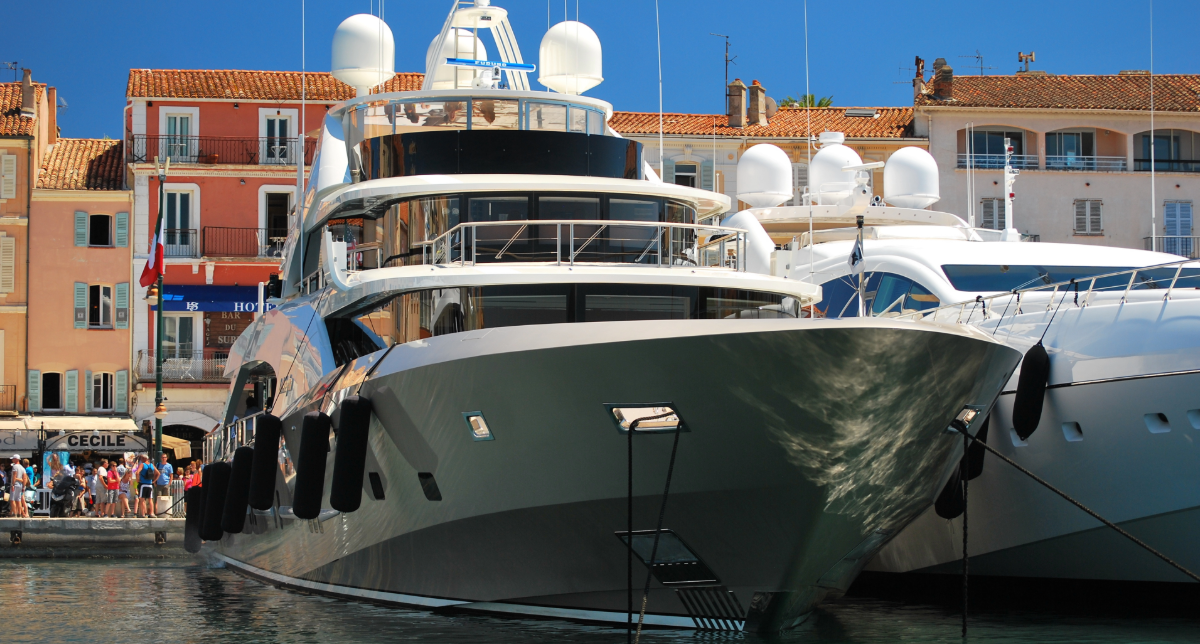
Tropezian luxury is spontaneous, festive and paradoxically discreet. You can come across a world star at the Sénéquier café on the terrace without anyone being particularly upset. Wealth is displayed on the yachts in the port - the megayachts moored in Mediterranean style (sideways, bow or stern towards the quay) form each summer a floating exhibition of naval prestige - but at the same time it is hidden behind the walls of the villas of Ramatuelle and Gassin, far from all visibility.
The Pampelonne beaches are the Tropezian institution par excellence: 4.5 km of fine sand facing the Mediterranean, dotted with beach clubs, the most famous of which — Club 55, Nikki Beach, Bagatelle, Tahiti Beach — have become global brands of seaside luxury. To access it, you generally arrive by sea (jet ski from the port, private boat from your yacht) or by the winding roads of the hills of Ramatuelle.
The hotel offering in Saint-Tropez is smaller in volume than that in Cannes, but of remarkable quality and concentration. The Cheval Blanc Saint-Tropez (LVMH) is the most cutting-edge address in the city — 30 contemporary suites and rooms facing the sea on the port, Dior spa, private beach, and above all the restaurant La Vague d'Or by chef Arnaud Donckele, three Michelin stars, which is probably the best restaurant in the Mediterranean accessible from a port. The Airelles Château de la Messardière (former 19th century castle, 117 rooms and suites, park overlooking the bay of Pampelonne) is the reference for families and groups looking for space and calm within walking distance of the center. THEByblos (opened in 1967, institution of the Saint-Tropez nightlife, 90 rooms including 38 suites) is the reference for partygoers and lovers of the most iconic Saint-Tropez spirit. The Mas de Chastelas in Gassin is the most “secret” address — 4.5 hectare estate, 30 rooms only, swimming pool, gastronomy, absolute privacy, two kilometers from the port without the crowds.
The private villa nevertheless remains the standard accommodation for UHNWI customers in Saint-Tropez. The best properties — villas on the heights of Ramatuelle with a view of the gulf, estates of several hectares in Gassin with an infinity pool overlooking the sea, renovated half-timbered houses on the peninsula — rent between €15,000 and €100,000 per week in July-August, and up to €200,000/week for the most exceptional properties. This market is almost entirely off-market — it is our network of partner agencies that provides access.
The point-by-point comparison: Cannes vs Saint-Tropez
Accessibility: Cannes advantage. The city has a direct TGV station from Paris (5h30), is 30 minutes from Nice airport (the main Côte d'Azur hub), and benefits from a complete transfer infrastructure (helicopters, luxury cars). Saint-Tropez does not have an airport and is accessible from Nice in 1h30-2h by road (more in high season with traffic jams) or by helicopter (25 minutes) — which makes the private helicopter the preferred solution for UHNWI customers.
Atmosphere: Cannes is more formal, more international, more event-oriented. Saint-Tropez is more festive, more relaxed in appearance, but also more unpredictable — the crowds of July-August can turn the village into a permanent traffic jam.
Beaches: Saint-Tropez advantage. The beaches of Pampelonne have no equivalent in Cannes — neither in beauty, nor in length, nor in seaside culture. Cannes beaches are honorable but urban and relatively narrow.
Yachting: Tied, for different reasons. Cannes has the best port and service infrastructure. Saint-Tropez has the most beautiful anchorage representation — being anchored opposite the port of Saint-Tropez with a megayacht is a demonstration that Cannes can't quite match.
Gastronomy: Cannes advantage (immediate area). The density of Michelin-starred restaurants in the Cannes-Mougins-Antibes area is higher. But Saint-Tropez has La Vague d’Or — the best restaurant in the Mediterranean — which puts everything into perspective.
Nightlife: Saint-Tropez advantage, without hesitation. Les Caves du Roy (Byblos), the VIP Room, the Opera Beach: the Tropezian night is a world in itself. Cannes has quality clubs but less intensity outside the Festival.
Private villas: advantage Saint-Tropez and its peninsula (Ramatuelle, Gassin, La Croix-Valmer). The park of exceptional villas available for rental in this area is the largest and most varied on the Côte d'Azur.
Shopping: Cannes advantage, clearly. Rue d'Antibes and the Croisette offer a much greater selection than the village of Saint-Tropez can offer (despite some nice boutiques around the port).
Neighboring addresses that deserve to be included in any Côte d’Azur itinerary
The wealth of the Côte d'Azur lies precisely in the density of exceptional destinations within a 100 km radius. Travelers who limit themselves to Cannes or Saint-Tropez are missing out on part of what makes this region one of the most extraordinary in the world for ultra-luxury vacations.