+33 3 56 89 46 53Mon–Sat 9am–7pm
Contact us
Buying a winemaker's house on the Alsace Wine Route: Riquewihr, Ribeauvillé, Eguisheim, Kaysersberg, Turckheim — the complete guide
REAL ESTATE

Buying a winemaker's house on the Alsace Wine Route: Riquewihr, Ribeauvillé, Eguisheim, Kaysersberg, Turckheim — the complete guide

May 6, 20268 min read

There are addresses that resemble no other. Riquewihr with its intact medieval ramparts. Ribeauvillé and its three castles that have dominated the plain for eight centuries. Eguisheim and its half-timbered houses arranged in concentric circles around a square that seems from another era. Kaysersberg, birthplace of Albert Schweitzer, with its fortified bridge and terraced vineyards. These villages are not merely beautiful — they are classified "Most Beautiful Villages of France", a distinction awarded to fewer than 180 communes across the entire national territory. And they are all on the Alsace Wine Route, between Marlenheim and Thann, in that narrow corridor that has produced, since the 8th century, some of Europe's most remarkable wines. Buying a house in one of these villages means buying something rare — in the most literal sense of the word.

Acquisition Guide · Alsace Wine Route · Classified Villages · Winemakers' Houses · 2026

Buying on the Wine Route means entering a living heritage. This guide is for those who want to do it well.

Buying a house on the Alsace Wine Route is not an ordinary real estate decision. It is a long-term patrimonial decision, guided by values that the standard real estate market struggles to measure: the beauty of the setting, the irreplaceability of the location, the historical depth of a built fabric that has survived centuries, and the structural rarity of a land stock constrained by vines, ramparts and heritage classifications.

The five villages — portrait by portrait

Riquewihr, classified "Most Beautiful Villages of France", has intact 13th-century ramparts encircling a village of half-timbered houses seemingly frozen at the Renaissance. Its Grand Crus Schoenenbourg and Sporen produce Rieslings of mineral precision and Gewurztraminers of exceptional aromatic complexity. Real estate prices range from €350,000-600,000 for typical winemaker's houses (150-200 m²), with exceptional properties reaching €800,000-1.2 million.

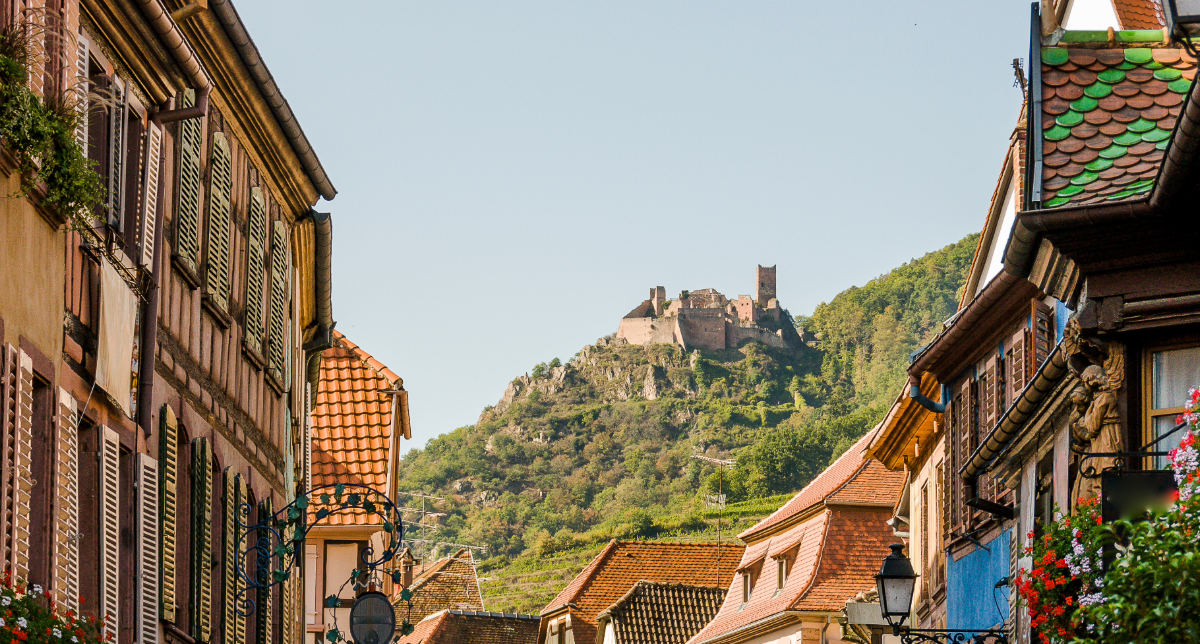
Ribeauvillé, classified "Most Beautiful Villages of France", is the historical capital of the Ribeaupierre lordship, dominated by three ruined castles. Its Grand Crus Geisberg, Kirchberg de Ribeauvillé and Osterberg produce world-reference Rieslings. A 200-250 m² bourgeois house with vineyard and castle views negotiates between €400,000 and €700,000.

Eguisheim, classified "Most Beautiful Villages of France", is organised in concentric circles around its octagonal château. Considered the cradle of Alsatian wine, its Grand Crus Eichberg and Pfersigberg produce celebrated Gewurztraminers. The prime tourist location (under 10 km from Colmar) generates rental yields among the highest on the Wine Route. A restored winemaker's house of 130-180 m² negotiates between €280,000 and €480,000.

Kaysersberg-Vignoble, classified "Most Beautiful Villages of France" and birthplace of Albert Schweitzer, combines a fortified medieval bridge, an imperial 13th-century castle, and the Schlossberg Grand Cru in Kientzheim — one of Alsace's most internationally renowned, its Rieslings featuring in the world's finest cellars. A character winemaker's house in the historic heart ranges from €350,000 to €650,000.

Turckheim, classified "Most Beautiful Villages of France" and uniquely maintaining its medieval night watchman tradition, hosts the Brand Grand Cru — 58 hectares of granite and gneiss producing Rieslings, Gewurztraminers and Pinot Gris of exceptional complexity. The Wine Route's most accessible entry point for classified village buyers, with houses from €220,000-550,000.

The off-market reality on the Wine Route

On the Alsace Wine Route, off-market is not the exception — it is the norm for exceptional properties. Winegrowing families holding houses in the historic hearts of Riquewihr or Kaysersberg for generations do not list them on property portals. They transfer through their notary, through a neighbour who knows an interested buyer, or through a trusted intermediary recommended by someone they have known for years. For an outside buyer, accessing this market requires a territorially-anchored intermediary — someone who knows the winegrowing families, has built relationships with local notaries, and can be informed of sale intentions before they materialise. This is precisely what Adopte une Conciergerie does, with years of direct relationships in Grand Est's notarial and viticultural networks.

Eight essential questions on buying a winemaker's house on the Wine Route

What is the difference between a winemaker's house and an ordinary Alsatian house — and why does it matter for purchase?

A winemaker's house was conceived and built for a viticultural operation: it typically includes a vaulted cellar on one or more levels (for winemaking and storage), working spaces on the ground floor (press room, vat room), living quarters on the upper floor, and often outbuildings (barn, agricultural shed, wine storage building). For the buyer, these characteristics create both an opportunity (living volumes superior to what the price suggests, valorisation potential through renovation) and specific constraints (cellars may require significant structural works, working spaces must be converted to living spaces within rules respecting their original character). The distinction between a winemaker's house and a bourgeois Alsatian house is therefore a purchase criterion in its own right.

Have a project in mind?

Our experts are ready to create a bespoke experience for you.

Request a free quote
Are all five villages genuinely classified "Most Beautiful Villages of France" — and what does this concretely imply for a property owner?

Yes — Riquewihr, Ribeauvillé, Eguisheim, Kaysersberg and Turckheim are all members of the "Les Plus Beaux Villages de France" association, a distinction awarded to fewer than 180 French communes according to strict criteria: rural character, architectural and heritage quality, village commitment to preserving and enhancing this heritage. For a property owner, this membership guarantees that the village you buy in cannot be disfigured by incompatible constructions. It creates international tourist notoriety sustaining rental demand. And it implies reinforced architectural preservation constraints — any visible exterior modification must be submitted to the Buildings of France Architect (ABF) and respect applicable heritage protection regulations.

How do prices on the Wine Route compare to Colmar and Strasbourg?

Wine Route classified village prices are generally below central Colmar quality property prices (€3,200-4,500/m²), and significantly below Strasbourg's Orangerie district (€4,500-6,500/m²). In classified wine villages, prices range from €1,800 to €3,500/m² depending on village and property quality — with upside exceptions for exceptional properties in the finest Riquewihr or Kaysersberg addresses. This relative price difference does not reflect inferior value — it reflects liquidity and market differences between a city and villages. In terms of intrinsic value — built fabric rarity, setting quality, international notoriety — winemakers' houses in classified Wine Route villages have no equivalent in France at these price levels.

What are the regulatory constraints on works in classified Wine Route villages?

They are real but predictable. Any visible exterior modification of a building within a PSMV or AVAP perimeter requires prior declaration or planning permission, with binding approval from the Buildings of France Architect. Most constrained works: window and shutter replacement (must respect original materials and proportions); facade colour (governed by an ABF-validated colour chart); roof covering (must use traditional materials — flat tiles, canal tiles by zone); solar panel installation (often prohibited on street-visible slopes). In contrast, interior works — floor restructuring, interior thermal insulation, technical system modernisation — are free insofar as they do not affect exterior appearance. Anticipating these constraints in the renovation budget is fundamental.

Can a foreign buyer freely purchase in these villages — are there restrictions?

No restrictions — any nationality can freely purchase residential real estate in France. The only specific checks concern anti-money laundering compliance — the notary must verify the source of funds for any purchase regardless of nationality. Physical presence at signing is not mandatory — a notarial power of attorney allows all deeds to be signed remotely, particularly useful for abroad-based buyers. The fiscal implications of the purchase (IFI, capital gains on resale) depend on the buyer's resident or non-resident status — a point to analyse with a tax advisor before acquisition.

What is the rental potential of a well-restored winemaker's house on the Wine Route?

Among the highest in all rural Alsace for well-positioned properties. Wine Route tourist demand is international, regular and seasonally very pronounced — with peaks during the harvest (September-October), Alsatian Christmas markets (November-December) and spring weekends. A 4-6 person character gîte in a classified village, well-restored, with accessible cellar and decor harmonious with the original built fabric, can generate €180-300 per night in high season with 65-75% annual occupancy. On a basis of 250 rented nights at an average €200, annual gross turnover exceeds €50,000 — for a property acquired between €280,000-450,000. Gross rental yield ranges from 6-9% depending on village, property and management quality.

How does Grand Cru proximity valorise a winemaker's house — and should one target a specific Grand Cru?

Grand Cru proximity is an undeniable valorisation factor — both for residential value and rental potential. A Grand Cru represents a classified soil whose reputation is linked to centuries of documented viticultural practice. A window onto Schlossberg, Brand or Schoenenbourg vineyards is not an ordinary landscape amenity — it is a view onto a world heritage of precision agriculture. For UHNWI buyers who understand wine culture, it is a decisive argument justifying a price premium. For premium tenants — wine-passionate couples, American and Japanese "wine travel" clients — it is often the primary reason for choosing the property. The question is not to target one Grand Cru over another — each has its specific personality and reputation — but to understand that the vineyard view is an asset as real as the living area, and deserves to be treated as such in property valuation.

How does Adopte une Conciergerie accompany an acquirer on the Wine Route, from first search to post-purchase management?

Our Wine Route accompaniment covers the complete project life cycle. Pre-purchase: personalised search brief construction, off-market candidate identification through relationships with local notaries, winemakers and property owners, concentrated viewing visits during an Alsace stay, architectural and legal due diligence, renovation estimate coordination. At purchase: negotiation accompaniment in the buyer's exclusive interest, Alsatian-Mosellan notary coordination, deadline and suspensive condition management. Post-purchase: renovation works coordination if desired, seasonal rental management implementation with dynamic revenue management and premium platform distribution, regular patrimonial follow-up for non-resident owners. A single interlocutor, from the first call to the first night in your winemaker's house.

A winemaker's house on the Wine Route is not a real estate investment like any other. It is a civilisation decision. The decision to own or live in one of the most accomplished landscapes that man and nature have built together — and that no-one will ever be able to reproduce.

Alsace Wine Route · Winemakers' Houses · Most Beautiful Villages France · Riquewihr · Ribeauvillé · Eguisheim · Kaysersberg · Turckheim

Adopte une Conciergerie — First Private Luxury Concierge of Grand-Est · First Corporate Concierge

Related Services

Discover our services related to this article

Real Estate ConsultingAudit, portfolio management and bespoke advisoryDiscoverPrivate ConciergePremium property management servicesDiscover
Learn more

Related Articles

Ready to take action?

Contact our team for personalized, no-commitment guidance.