+33 3 56 89 46 53Mon–Sat 9am–7pm
Contact us
Buying a home in Strasbourg as an expat, Eurocrat or international executive: the complete guide by Adopte une Conciergerie
REAL ESTATE

Buying a home in Strasbourg as an expat, Eurocrat or international executive: the complete guide by Adopte une Conciergerie

May 5, 202612 min read

You have just been posted to Strasbourg. Or you have been there for two years renting and are beginning to wonder whether now is the moment to buy. Or you are leaving in eighteen months but wish to keep a foothold in the European capital. In all three cases, you face a real estate market you do not know — with your specific non-resident constraints, your earnings in euros but potentially subject to a derogatory tax regime, a packed agenda and an uncertain holding horizon. This guide is written for you, by a concierge that has accompanied this clientele for several years and has learned what no-one else says clearly: buying in Strasbourg as an expat or European official is a different decision — and it deserves different accompaniment.

Complete Guide · Real Estate Purchase Strasbourg · Expats · European Officials · 2026

Buying in Strasbourg as an expat, Eurocrat or international executive

The guide that says what others leave unsaid — by professionals who accompany this clientele daily.

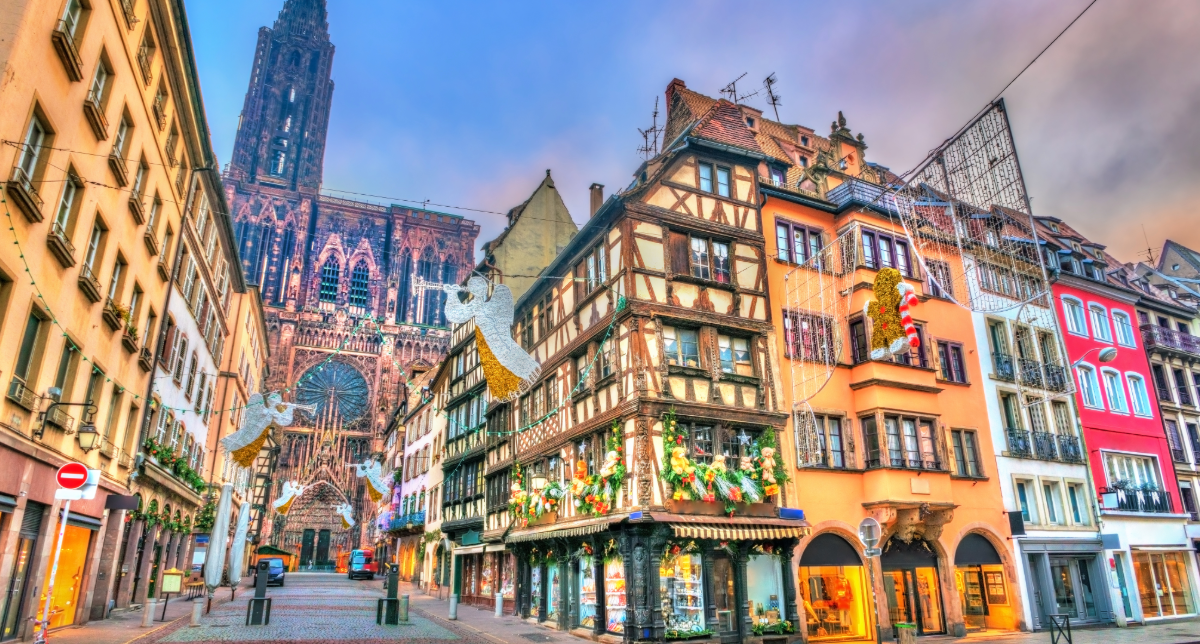
Most real estate purchase guides for expats treat Strasbourg like any mid-sized French city. They are wrong. Strasbourg is a city whose real estate market is structured by a variable that virtually no other French city has: permanent international institutional demand. The European Parliament, the Council of Europe, the European Court of Human Rights, Eurocorps and over twenty other international bodies generate in Strasbourg a permanent presence of several thousand officials, diplomats, lawyers and international experts whose incomes, mobility horizons and housing expectations are fundamentally different from those of the standard French residential market.

This difference translates into prices — the Orangerie, the reference institutional neighbourhood, averages €5,070/m² in April 2026 with peaks at €6,491/m² for the finest apartments — but above all into demand structure. In Strasbourg's institutional neighbourhoods, competition for the finest properties does not come only from local clientele. It comes from Belgian, Dutch, Polish, Ukrainian, British and American officials, some of whom can buy in cash because their net institutional income allows savings that private sector executives cannot achieve at comparable gross income.

The five institutional buyer profiles and their logics

The long-posted European official (3-7 years). This is the profile for which purchase is most clearly economically justified. With a mission of three to seven years, the purchase break-even versus renting in Strasbourg — accounting for acquisition costs (approximately 8% for an older property), loan interest if applicable, service charges, property tax and possible works — is generally reached between year three and year five. European officials benefit from significant net incomes — institutional remuneration packages include expatriation allowances, family and education allowances, and a specific tax regime (Community tax) that is generally lower than national tax. This combination of high income, net of national taxes, often generates a saving and borrowing capacity above what their grade might suggest to an outside observer.

The MEP. The MEP is in a singular patrimonial situation: elected for five years with no guaranteed renewal, they benefit from apartment or accommodation cost reimbursement during plenary sessions. Buying their own Strasbourg property is often a patrimonial choice in its own right — some MEPs buy an apartment they use during sessions and let the rest of the time to a quality tenant: institutional official, international lawyer, accredited journalist. This model generates an asset that largely self-finances and that appreciates in a market structurally sustained by institutional demand.

The Council of Europe diplomat. Permanent representatives of the 47 member states to the Council of Europe are accredited for missions typically lasting two to four years. Most choose to rent during their mission — their government covers all or part of housing costs — but a growing proportion choose to buy, either for their own comfort during the mission or as a pure investment, keeping the property after their posting. These buyers' characteristic is their familiarity with international real estate markets and their capacity to make purchase decisions quickly and without the hesitation often characterising first-time buyers.

The international lawyer and lobbyist. Law firms with active ECHR practices or EU regulatory advisory activities sometimes seek to acquire a Strasbourg foothold — either for personal use during frequent missions, or as a rental investment for their team. These buyers often have fine technical knowledge of real estate markets and are sensitive to build quality, precise location and property liquidity potential — they are already thinking about resale at the moment of purchase.

The international executive and INSP alumni. The ENA — now Institut national du service public since 2021 — is historically Strasbourg-based, and several cohorts of senior French officials have kept a strong personal connection to the city. INSP alumni in international careers represent a sophisticated buyer clientele whose Strasbourg knowledge is often real and whose purchase logic combines personal anchoring and patrimonial rationality.

Neighbourhoods according to your situation

Orangerie — maximum proximity choice. The Orangerie neighbourhood is the first choice of the large majority of European officials buying in Strasbourg. Immediate proximity to the European Parliament (five minutes on foot), Council of Europe (eight minutes) and ECHR (ten minutes), a 26-hectare park, quiet streets of quality Haussmannian buildings, and a deep rental market. Average price: €5,070/m², range €3,573-6,491/m².

Contades — bourgeois residential quiet. Often compared in spirit to Paris's 16th arrondissement — residential, quiet, well-served by schools and commerce. Attracts officials preferring a residential setting to maximum institutional proximity, and families for whom school and play space quality is paramount. Prices: €4,500-5,500/m².

UNESCO Neustadt — the heritage bet. Built 1871-1918 under German administration, listed UNESCO World Heritage in 2017. Generous volumes, ornate facades, 3.20-3.80m ceilings, double reception rooms — a built fabric that the contemporary market cannot reproduce. Prices: €3,500-5,000/m², with appreciation potential sustained by UNESCO listing. Recommended for buyers with a ten-year-plus holding horizon.

Robertsau — houses with gardens in the city. Happy Strasbourg anomaly — individual houses with gardens, forests and ponds, fifteen minutes' walk from the Council of Europe. The choice of families with children wanting space and nature without leaving the city, and diplomats for whom the house-with-garden format is the comfort standard they have known in previous postings. Prices: €3,200-4,800/m².

Twelve fundamental questions for the expat buying in Strasbourg

Can a non-resident European official obtain a French mortgage to buy in Strasbourg?

Yes — but not from any institution and not in any conditions. High-street banks often process non-resident files with higher deposit requirements (20-30%) and longer instruction timelines. Private specialist banks — BNP Paribas Banque Privée, Crédit Agricole Banque Privée, HSBC Private Banking — have teams dedicated to non-residents and international officials, with better understanding of institutional incomes (which can appear atypical in a standard file) and adapted financing solutions. A mortgage broker specialising in non-resident files is often indispensable. We work with several partners in this specialty and can facilitate introduction.

Have a project in mind?

Our experts are ready to create a bespoke experience for you.

Request a free quote
What is the applicable taxation for a European official who buys in Strasbourg and lets the property during their absence?

The fiscal situation of European officials acquiring property in France is complex and must be analysed case by case with a specialist tax lawyer. In summary of principle: rental income generated by a French property is taxable in France according to ordinary French rules (property income under real or simplified regime), even if the owner benefits from the European institutional tax regime for their institutional remuneration. Capital gains on sale are also taxable in France, with a specific withholding rate for EEA non-residents. Bilateral tax conventions between France and the official's country of fiscal residence may modify these rules. This complexity should not discourage purchase — it must simply be anticipated with proper advice, which we systematically coordinate within our accompaniment.

Which Strasbourg neighbourhood do you recommend for an official with school-age children?

The Orangerie neighbourhood is our first recommendation for families with children, for a decisive reason: it is immediately adjacent to the European School of Strasbourg (less than ten minutes on foot), which considerably simplifies daily family logistics. Contades is the second option — well-served by tramway and school lines, with a family-friendly residential atmosphere appreciated by families with young children. Robertsau is the best choice for families prioritising space and houses with gardens — with quality schools and easy access to the Council of Europe.

How does one buy in Strasbourg from Brussels, Geneva or another European city without multiplying return trips?

This is the use case for which our representation service is most valuable. Our process for remote buyers includes: in-depth video briefing to understand your criteria and priorities, pre-selection of matching properties in public and off-market, in-person visit of each property with detailed video report (precise dimensions, light quality, real installation condition, immediate environment), complete due diligence before any offer recommendation, and the possibility of signing the preliminary contract by proxy if your schedule does not allow Strasbourg presence at that stage. We have accompanied complete acquisitions with clients who made only a single Strasbourg trip — for the final notarial signature.

What is the liquidity of a property in Orangerie or Neustadt if I must leave quickly?

Liquidity in both neighbourhoods is significantly above the Strasbourg market average — precisely because permanent international institutional demand means potential buyers (officials taking a post, arriving diplomats) generally need to act quickly. A quality Orangerie apartment, well presented and correctly valued, typically finds a buyer in four to twelve weeks in normal market conditions. UNESCO Neustadt benefits from comparable liquidity for well-maintained properties, with a heritage buyer market (long-term investors sensitive to UNESCO listing) complementing institutional demand. The sine qua non of rapid liquidity is correct valuation — not overestimation relative to market comparables.

Does the European School of Strasbourg accept all children of Strasbourg institution officials?

The European School of Strasbourg — offering multilingual education from nursery to secondary with the European Baccalaureate — gives priority to children of staff of the institutions that directly finance it: essentially the Council of Europe, the European Parliament and associated bodies. Children of officials from other institutions may be admitted according to available places, in an order of priority accounting for institutional affiliation and requested language section. We strongly recommend families arriving in Strasbourg to treat the school registration question as an absolute priority — ideally several months before taking up the post — to avoid finding themselves on a waiting list for a school year that does not wait.

Is it better to buy in personal name or through an SCI structure as a non-resident buying in Strasbourg?

This structural question must be resolved with a notary or specialist tax lawyer before acquisition — the implications are too important to simplify in a general guide. In summary of principle: the SCI (Société Civile Immobilière) can present advantages for a purchase aimed at patrimonial transmission, or for a purchase by several co-investors. It presents disadvantages for a purchase intended as primary residence or for a property to be resold rapidly. For a non-resident European official, the fiscal implications of the SCI — particularly for rental income and capital gains — must be analysed accounting for their fiscal residence and applicable institutional tax regime. We systematically coordinate this reflection with our specialist notary and tax lawyer partners.

Is there a reliable institutional rental market to let one's apartment during absences between postings?

Yes — and this is one of Strasbourg's major advantages for institutional buyers. Premium rental demand in institutional neighbourhoods is permanent and emanates from very solvent profiles: officials on temporary posting, international lawyers on multi-week missions, official delegations in residence, research associates linked to institutions. Rents in these neighbourhoods for quality apartments vary between €18 and €25/m² for quality institutional tenants — levels that often allow coverage of running costs and loan repayments, and sometimes yield a small surplus. We manage this type of rental within our premium rental management service — with careful tenant selection, comprehensive condition reports, and regular property monitoring during the rental period.

What pitfalls should one avoid when buying in Strasbourg from abroad?

Five pitfalls we regularly observe in our practice. First: underestimating the cost of energy compliance works — a property rated D or E may require significant works to remain rentable under evolving regulation (G ban from 2025, F in progress, E from 2028). Second: not reading co-ownership assembly minutes from the last five years, which may reveal major upcoming works. Third: confusing displayed price and real value — in institutional neighbourhoods, some vendors exploit external buyers' unfamiliarity to display significantly overvalued prices. Fourth: overlooking the co-ownership regulations before planning rental — some older Strasbourg co-ownership regulations limit short-stay rental possibilities. Fifth: neglecting the fiscal aspect of the transaction — the fiscal implications of a property purchase by a non-resident are real and must be anticipated, not discovered after signature.

How does Adopte une Conciergerie protect the non-resident buyer during negotiation?

Our buyer protection during negotiation rests on four pillars. Independent property value assessment first — we cross-reference comparable transaction prices in the neighbourhood, the property's real condition and its possible value deductions (energy rating, works, co-ownership) to give an honest opinion on the justifiable price, independent of the asking price. Identification of negotiation arguments second — degraded energy rating, upcoming works signalled in assembly minutes, length of time on market — which we use to negotiate in your interest. Timeline management — we avoid creating artificial urgency that disadvantages the buyer, while being sufficiently reactive not to lose a property you wish to acquire. And freedom of counsel finally — we can recommend not buying a property, something no estate agent can do without acting against their own economic interests.

What post-purchase services does Adopte une Conciergerie offer for a non-resident property owner in Strasbourg?

Our post-purchase accompaniment for non-resident owners covers three main dimensions. Premium rental management if you wish to let the property during absences: selection of quality institutional tenants, entry and exit condition reports, property monitoring, incident management, monthly financial reporting. Residential concierge for your own stays: property preparation before your arrival, provisions according to your preferences, activity or reservation organisation during your stay. And works supervision if your property requires renovation: trusted tradesperson selection, delegated project management site monitoring, regular photographic reporting. These services function together or separately according to your needs — there is no obligatory formula.

Why choose Adopte une Conciergerie over a conventional estate agency to buy in Strasbourg as an expat?

The answer rests on a structural difference: an estate agency has a vendor mandate — its remuneration depends on the sale of the property, not on advice quality to the buyer. Adopte une Conciergerie has no vendor mandate — our sole commitment is to you. We can tell you that a property is overvalued, that its energy rating is a problem, that its co-ownership minutes reveal upcoming works, or simply that it does not match your real criteria. We accompany you before, during and after purchase — which an estate agency does not do. And we specifically know the constraints of non-resident and European official buyers — their taxation, their mobility horizons, their remote representation needs — where a generalist agency will treat you like any buyer.

Buying in Strasbourg as a European official or international executive is not buying like everyone else. It is buying with specific constraints, particular opportunities, and the necessity of accompaniment that understands both. This guide is the beginning of that conversation — not its end.

Real Estate Purchase · Strasbourg · Expats · European Officials · Patrimonial Consulting · 2026

Adopte une Conciergerie — First Private Luxury Concierge of Grand-Est · First Corporate Concierge

Related Services

Discover our services related to this article

Real Estate ConsultingAudit, portfolio management and bespoke advisoryDiscoverPrivate ConciergePremium property management servicesDiscover
Learn more

Related Articles

Ready to take action?

Contact our team for personalized, no-commitment guidance.