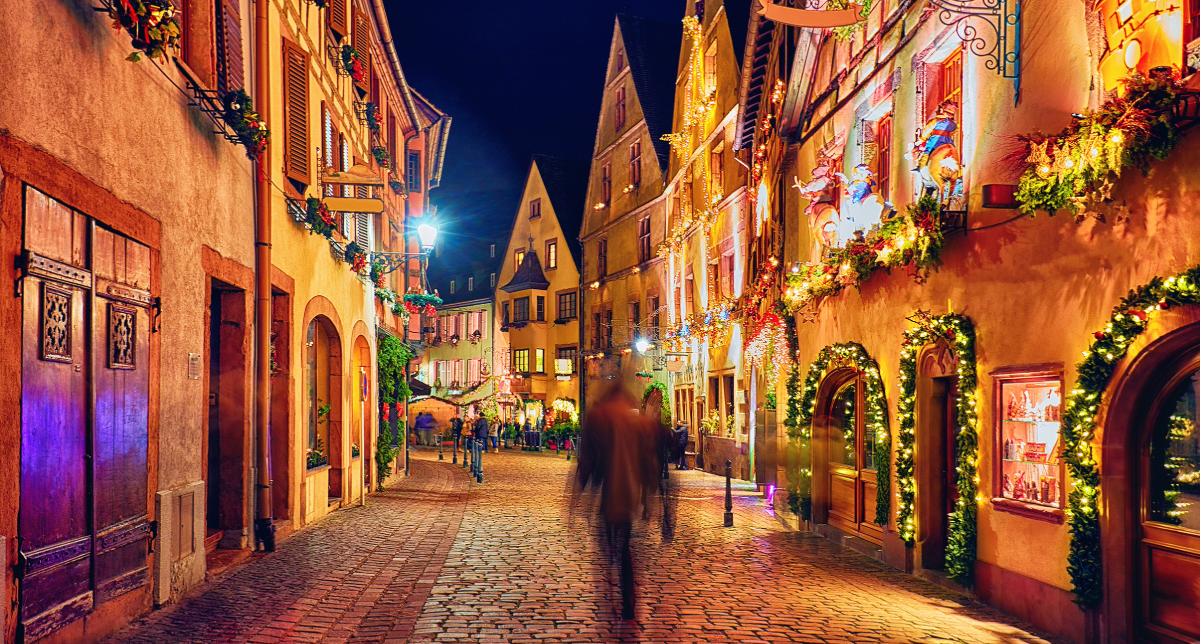
A discreet but measurable phenomenon has occurred in recent years in the map of French luxury travel: UHNW clients — those who have already seen everything, who return from Saint-Tropez and Cannes with a fatigue of demonstration — are turning to Alsace. Not by default. By deliberate choice. Because Alsace offers what the French Mediterranean has progressively lost: peace, cultural density without saturation, and what the sector now calls quiet luxury — the luxury that does not need to show itself to exist. This article deconstructs the arbitrage.
Quiet Luxury · Alsace vs Côte d'Azur · Premium Arbitrage · 2026
When UHNW clients stop following the crowd and choose depth over surface.
Quiet Luxury
Luxury without demonstration — heritage, gastronomy, viticulture, civic peace
Cultural density
Unterlinden Museum · 51 Grands Crus · Starred gastronomy · Intact architecture
Arbitrage
Superior experience · Lower entry cost · Zero human saturation
Until recently, placing Alsace in the same conversation as the Côte d'Azur for a UHNW clientele would have seemed incongruous. Saint-Tropez, Cannes, Monaco, Cap Ferrat — that was where French luxury travel was written. Alsace was beautiful, certainly, but it was a "regional" destination, a prettier Germany, a half-timbered circuit for cultivated tourists.
This reading is outdated. And this is not an opinion — it is what we observe in the requests we receive, in the profiles of clients who choose Alsace, and in the way those clients explain their choice to us. What we hear, invariably, is a variation on the same theme: "We have already done the Côte d'Azur. We want something real."
What the Côte d'Azur has lost — and what Alsace has not yet lost
The Côte d'Azur remains magnificent. The light, the sea, the Belle Époque architecture, the gardens of the Villa Ephrussi de Rothschild, the Fondation Maeght in Saint-Paul-de-Vence — none of this has disappeared. What has changed is the background noise. The human saturation of July and August, the densification of the hotel offer that has transformed certain areas into showcases of ostentatious luxury, the inflation of accommodation and restaurant prices no longer correlated with experience quality, the permanent sense of being in a setting frequented by too many people for the experience to remain intimate.
What the Côte d'Azur offers a UHNW client in high season is the confirmation that they have the means to be there. What it can no longer guarantee is peace. And for a clientele that has reached UHNW level precisely because it is able to distinguish real value from apparent value, this distinction is fundamental.
Alsace has not been subjected to this pressure. Its premium tourism has remained at a human scale. Its villages — Kaysersberg, Eguisheim, Riquewihr, Hunawihr — have not been urbanised to absorb mass tourist flows. Its starred restaurants have not multiplied their covers at the expense of quality. Its wine estates still receive by appointment, not in packaged "tasting experiences" formatted for groups. The cultural and gastronomic density there is real, not constructed to appear so.
The heritage argument: what Alsace has that the Riviera does not
The Côte d'Azur has a recent history — principally 19th and 20th century, built on British and then international aristocratic and bourgeois tourism. It is a beautiful and documented history, but it is a history of consuming the territory, not of organic accumulation over several centuries.
Alsace has a different temporality. Its villages are medieval and often intact since the 15th century. Its wine culture is millennial — certain Alsatian clos were cultivated by Benedictine monks before the year 1000. The Unterlinden Museum, with Mathias Grünewald's Isenheim Altarpiece (1512–1516), houses one of the major works of European painting — in a setting renovated by Herzog & de Meuron that rivals the world's great museum institutions. This temporal stratification, rare in Western France, is precisely what culturally sophisticated UHNWI clients come to find when they have stopped looking only for sun.
For an American art collector who has visited MoMA, Gagosian and Art Basel Miami, the possibility of seeing the Isenheim Altarpiece in optimal conditions, then lunching in a starred restaurant whose cuisine integrates regional heritage, then spending the afternoon in a private appointment at an Alsatian Grand Cru estate — this is a culturally denser day than any possible on the Côte d'Azur in high season.
The gastronomic argument: an underestimated density
The Côte d'Azur has its Michelin stars. Provence too. But Alsace has a star density per capita that is one of the highest in France — a fact that few international prescribers have yet integrated into their mental map. The Auberge de l'Ill at Illhaeusern has been, for several decades, one of Europe's most recognised tables. JY's by Jean-Yves Schillinger in Colmar has built a reputation that extends well beyond regional borders. Around these references, a constellation of starred tables within thirty to forty minutes composes a gastronomic ecosystem that few French regions, outside Lyon and the Paris area, can match.
What distinguishes Alsatian gastronomy from Mediterranean gastronomy is not only quality — it is register. Alsatian tables work with a territory — cereals, charcuterie, game, Vosges mushrooms, river fish, kitchen garden vegetables — that has nothing in common with the olive oil, tomato and lavender of Provence. For a client who has exhausted the Mediterranean register, Alsace opens an entirely unexplored gustatory territory.
The wine argument: Alsatian Grands Crus versus Provençal rosé
The Côte d'Azur has Provençal rosé — Bandol, Cassis, the Provence rosés that have colonised the world's terraces over the past decade. This is a real market phenomenon, supported by remarkable communication. It is not a terroir phenomenon in the sense that Alsace understands it.
Alsace has 51 classified Grands Crus. It produces Rieslings — Trimbach's Clos Sainte-Hune, Zind-Humbrecht's Brand, Domaine Weinbach's Schlossberg — that feature in the collections of the world's greatest enthusiasts and in the cellars of the planet's best starred restaurants. It produces Gewurztraminers and Pinots Gris in late harvests and selected berry harvests that are, in their register, among the world's most complex and long-lasting wines. This viticultural depth is radically different from what the Mediterranean can offer, and for a serious enthusiast, it constitutes a stay-driver in its own right.
The geographic argument: Alsace as European arbitrage destination
The Côte d'Azur is accessible from everywhere — one of its assets. But this accessibility is also its limitation: everyone comes, creating the saturation that UHNWI clients are precisely trying to avoid.
Alsace benefits from a European accessibility that few destinations at its level of calm possess. Direct TGV from Paris (two hours fifty). Two hours' drive from Zurich. Two hours thirty from Frankfurt. Basel-Mulhouse-EuroAirport, with its operational business terminal for private jets, fifty minutes from Colmar. This position at the crossroads of four major UHNWI markets — France, Switzerland, Germany, Benelux — without the mass tourist flows that paralyse the Mediterranean in summer, is precisely what makes Alsace a rational arbitrage for the most discerning clientele.
For a Swiss client from Zurich or Geneva seeking a prestige weekend in France, Alsace is two hours away versus five for the Côte d'Azur. And the experience found there — intact heritage, concentrated gastronomy, world-class viticulture, human-scale five-star hospitality — is objectively superior to what can be expected in Saint-Tropez in July, for a comparable or lower budget.
The quiet luxury paradigm: why Alsace arrives at the right moment
The concept of quiet luxury — discreet, non-ostentatious luxury, centred on intrinsic quality rather than social signalling — has emerged as the dominant paradigm in the luxury sector since 2022–2023. This is not a passing trend; it is a profound requalification of what the most affluent clients seek in their travel.
Alsace is, structurally, a quiet luxury destination. It has never sought to be the Riviera. It has never bet on volume or demonstration. It has built, over several centuries, a quiet excellence — in its wines, its gastronomy, its architecture, its manner of welcoming. Today, when UHNWI clients have a term for what they seek, Alsace appears on their map with a clarity it lacked ten years ago.
Ten questions on Alsace as a premium alternative to the Côte d'Azur
Can Alsace genuinely compete with the Côte d'Azur for UHNW clientele?
For UHNW clients seeking quiet luxury, yes — and in several dimensions it surpasses the Côte d'Azur. In terms of heritage density: Alsace has no Mediterranean equivalent for the temporal depth of its architectural and viticultural fabric. In terms of calm: Alsatian villages and even Colmar offer a tranquility that the Riviera in high season can no longer guarantee. In terms of serious gastronomy: the Michelin star density of Haut-Rhin per capita is among France's highest. In terms of viticulture: Alsatian Grands Crus have nothing to envy Provençal rosé for a serious enthusiast. Alsace does not compete with the Côte d'Azur on sun and sea — it offers something else, and that is precisely what the most discerning clients seek today.
Why do American UHNW clients choose Alsace over Paris or the Riviera?
Three converging reasons. First, density: a four to five-day stay in Alsace offers a concentration of experiences — intact medieval heritage, starred gastronomy, grand cru viticulture, remarkable architecture — that a week in Paris or on the Riviera does not match in intensity per day. Second, absence of saturation: for an American client arriving in Europe in high season wanting to avoid crowds, Alsace is one of the rare French destinations offering fluid access to the best experiences. Third, novelty: an American UHNW client who has already done Paris, Nice and Saint-Tropez several times is looking for something new in their European itinerary. Alsace is still, for many of them, a discovery.
What is quiet luxury, and why is Alsace an illustration of it?
Quiet luxury describes an approach to luxury centred on intrinsic quality — craftsmanship, know-how, authenticity, durability — rather than on social signalling and visible demonstration. This paradigm has progressively established itself as the hallmark of the most affluent clients, in reaction to the oversaturation of ostentatious luxury. Alsace is a structural illustration of it: its wines are great not because they are presented in sophisticated marketing, but because the terroir and the work of generations of winemakers have made them world references. Its heritage is beautiful not because it was restored to please, but because it is intact. Its gastronomy is excellent not because it is fashionable, but because it is deeply rooted in a territory. This is the very definition of quiet luxury.
How does Adopte une Conciergerie organise a quiet luxury Alsace stay for UHNW clients?
Our approach is to build stays around an experience logic, not a checklist logic. For UHNW clientele coming to Alsace for quiet luxury, this means: accommodation selected for the aesthetic sought (historic character house, private villa in the vineyards, human-scale five-star), tastings organised as private appointments at estates that only receive by recommendation, tables that deliver the gastronomic experience of Alsace — not necessarily the most famous, but the most fitting for the client's profile, days built with unstructured time that is often the best part, and invisible transfer logistics from EuroAirport, Zurich, Frankfurt or Paris. The goal is for the client to return having lived something authentically exceptional — and wanting to come back.
Alsace is not the Côte d'Azur. That is precisely why the most discerning UHNWI clients choose it. Quiet luxury is not a positioning — it is a field truth. And this truth, Alsace has carried for centuries, long before the luxury sector invented the term to describe it.
Quiet Luxury France · Discreet Luxury Alsace · Premium Destination · Colmar · Wine Route · May 2026
Adopte une Conciergerie — Premier Private Luxury Concierge of Grand-Est · Paris · Côte d'Azur · Prague presence