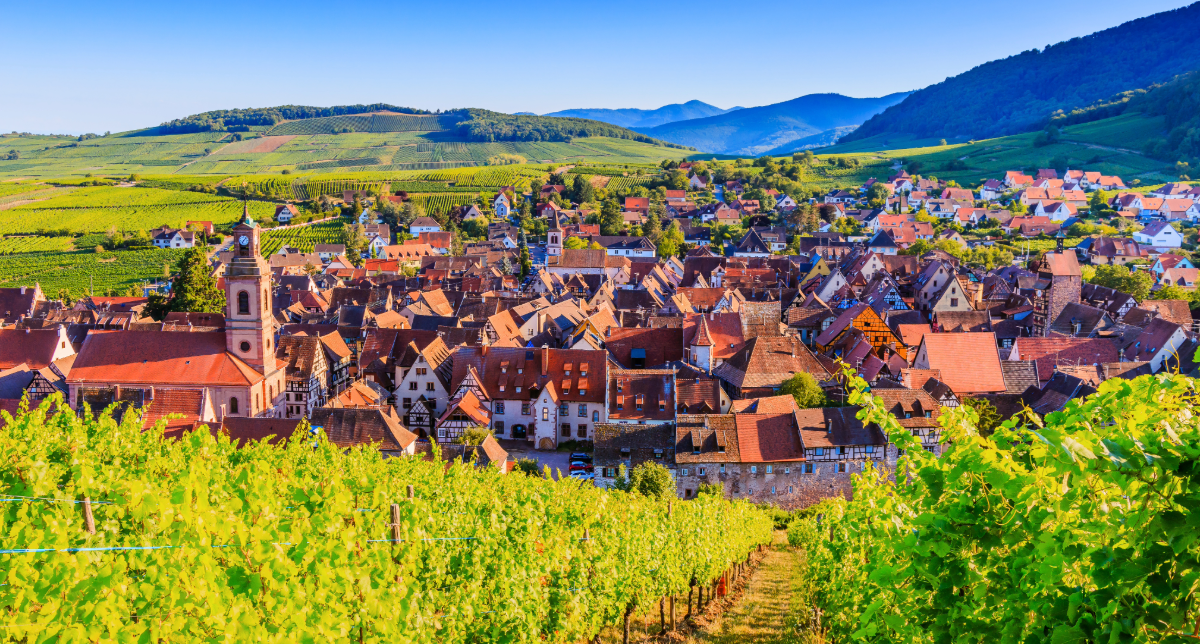
This guide exists because no equivalent existed. Owning a property in Alsace — a secondary residence on the Wine Route, a prestige apartment in Strasbourg or Colmar, a wine estate between Marlenheim and Thann — requires field knowledge that cannot be learned online. Local taxation and the particularities of Alsatian-Mosellian law. The craftsmen who know how to work on half-timbered houses. The restaurateurs who accept last-minute tables for the right clients. The winemakers who open their cellar on a Sunday morning for people properly introduced to them. This guide centralises everything a discerning property owner needs to know — and what a quality concierge naturally does for them.
Reference Guide · Alsace · 2026 · Adopte une Conciergerie · First Private Luxury Concierge Grand-Est
The ultimate guide to stewardship and concierge services in Alsace 2026
Strasbourg · Colmar · Wine Route · Local Taxation · Alsatian-Mosellian Law · Craftsmen · Restaurateurs · Winemakers · Bespoke Services
Owning a property in Alsace is an experience that has no equivalent in France. The region concentrates within a few dozen kilometres vineyard and forest landscapes, a half-timbered architecture unique in Europe, a gastronomy of inexhaustible depth, and a history of multiple strata — French, German, Alsatian — that gives every stone a particular density. But this richness comes with a complexity that owners from outside the region systematically underestimate: a legal framework partially distinct from common French law, an artisanal and relational fabric that operates on recommendation more than advertising, and social codes that value discretion and loyalty as much as excellence.
This guide was written by Adopte une Conciergerie, the first private luxury concierge of Grand-Est, based on several years of experience serving discerning property owners and residents in the region.
I. Property taxation in Alsace: what is identical, what is different
1.1 The general tax framework — identical to the rest of France
For the most part, property taxation in Alsace follows French common law. Property tax (taxe foncière) is calculated on the same basis as everywhere — rental value multiplied by rates voted by local authorities. In 2025, property tax in Alsace was stable in almost all municipalities according to the UNPI annual observatory — stability linked to the March 2026 municipal elections. Over ten years, however, cumulative increases reach 48.9% in Alsace, with some municipalities having doubled their rate. IFI (Impôt sur la Fortune Immobilière) applies to Alsatian properties in the same way as other French assets for a French tax resident.
1.2 Alsatian-Mosellian law — what every property owner must know
This is where Alsace fundamentally diverges from the rest of France. The Land Registry (Livre Foncier / Grundbuch) — inherited from German law during the annexation period (1871-1918) — is the central institution of property publicity in Alsace and Moselle. Unlike the rest of France where mortgage registration falls under the Ministry of Finance, the Land Registry in Alsace-Moselle falls under the Ministry of Justice and is maintained by a specialist judge: the Land Registry judge. Registration confers a presumption of ownership — a stronger legal guarantee. Every property transaction in Alsace requires registration in the Land Registry under a procedure distinct from the rest of France. A notary unfamiliar with Alsatian-Mosellian local law may miss particularities that create complications in the ownership chain. The practical consequence: every Alsace property owner needs a notary who masters local Alsatian-Mosellian law.
II. Property stewardship in Alsace — the fundamentals
2.1 Half-timbered houses — the golden rules
A half-timbered house on the Wine Route is one of the most admirable and demanding real estate assets in existence. Its maintenance obeys rules that novice owners often ignore — with costly consequences. The timber framework breathes: the oak structure lives with humidity and temperature variations. Infill renders must be vapour-permeable — impermeable renders or insulants create moisture pockets that rot the timber from within, invisibly for years. Joinery must be painted wood in the region's historical colours. Properties in AVAP perimeters or under ABF (Architectes des Bâtiments de France) oversight — the case for the vast majority of prestige properties on the Wine Route — require prior authorisation for any exterior modification.
III. Strasbourg — practical guide for the discerning owner
Strasbourg presents a real estate geography in which each neighbourhood has its own logic. Orangerie and Contades — Strasbourg's "little Neuilly" — concentrate the most sought-after properties, with prices reaching €5,070/m² in April 2026 according to MeilleursAgents, and up to €6,491/m² for the finest addresses. The UNESCO Neustadt — the Wilhelmian district listed as World Heritage — offers apartment proportions (high ceilings, original parquet, double reception rooms) that new-build will never reproduce.
IV. Colmar — the underrated prestige city
Colmar is perhaps Alsace's most misunderstood city by those who do not live there. Immobilièrement, it is the Grand-Est's strongest performing market at Easter 2026 — 71% booking rate according to the Tourism Observatory, with a RevPAR of €172, up 11%. Owning a property in Colmar's historic districts implies understanding that the city is under strong heritage protection. ABF constraints are even more present than in Strasbourg for the oldest properties. In return, the value of these properties is structurally sustained by their irreplaceable character.
V. The Wine Route — France's most singular property market
From Marlenheim to Thann, the 170 kilometres of the Alsace Wine Route constitute a property market with no equivalent in France. New construction is prohibited or strictly regulated in most classified villages — meaning the stock of quality properties cannot increase. The most emblematic villages — Eguisheim (classified "Most Beautiful Village of France"), Ribeauvillé, Riquewihr, Kaysersberg — have extremely tight property markets where the best opportunities are accessed through local networks, not platforms.
VI. The address book — a selection by Adopte une Conciergerie
Auberge de l'Ill, Illhaeusern — Three Michelin stars since 1967, held by the Haeberlin family for generations. Alsace's reference table, requiring advance booking several weeks ahead for weekends.
Le Chambard, Kaysersberg — Olivier Nasti's two-starred table with associated hotel: Alsace's finest gastronomic stay in the wine country.
Domaine Marcel Deiss, Bergheim — Jean-Michel Deiss, one of Alsace's most singular winemakers. A private cellar visit organised by Adopte une Conciergerie, with the winemaker himself as guide, is an experience beyond simple wine tasting.
Domaine Weinbach, Kaysersberg — The Faller family's estate, whose wines rank among Alsace's most internationally recognised.
Eight essential questions on stewardship and concierge services in Alsace
What is Alsatian-Mosellian law and how does it concretely affect a property owner in Alsace?
Alsatian-Mosellian local law is a set of legal rules inherited from the German annexation period (1871-1918), maintained after Alsace and Moselle's return to France in 1918. The most significant for a property owner is the Land Registry (Livre Foncier / Grundbuch) — Alsace's equivalent of the mortgage registry, but maintained by a judicial magistrate (the Land Registry judge) rather than the Ministry of Finance. Registration confers a presumption of ownership — a superior guarantee. Every property transaction must be registered in the Land Registry under a specific procedure. A notary who does not master Alsatian-Mosellian local law may miss particularities that create complications in the ownership chain. The practical consequence: every Alsace property owner needs a notary and, in case of dispute, a lawyer who masters local law.
What rules must be known before undertaking works on a half-timbered house in Alsace?
Half-timbered houses in AVAP perimeters or under ABF oversight — the case for most prestige properties on the Wine Route and in Alsatian historic centres — are subject to strict intervention rules. Any visible exterior modification requires prior declaration or planning permission subject to the ABF's binding opinion. Infill renders must be vapour-permeable — any impermeable render is prohibited both regulatorily and for structural durability reasons. Joinery must be painted wood in historical tones. Roofing materials are generally imposed by local regulations. The first step before any works is a consultation with the competent ABF — which Adopte une Conciergerie coordinates for its clients.
How does Adopte une Conciergerie manage an Alsace property for an absent owner?
Our property management service for absent owners covers the full life cycle of the property. Monthly basis: complete inspection visit (installation checks, access verification, infiltration/damage detection, photographic report transmitted to the owner). Before each owner stay: full airing, heating and temperature control, equipment checks, food and product stocking, welcome preparation. After each departure: secured closing, frost-prevention heating in winter, condition report. For emergencies — water damage, installation failure, security issue — we intervene immediately with our local service providers and inform the owner in real time.
Does the Alsace Wine Route offer specific real estate investment opportunities in 2026?
Yes — fundamentally different from urban market opportunities. Two distinct categories: prestige residence in a classified village (a half-timbered house in Eguisheim, Ribeauvillé or Riquewihr — structurally undervalued relative to comparable assets in other French wine regions) and wine domains with classified appellations (a domain with Alsace AOC production, particularly with Grand Cru parcels, is a patrimonial asset whose deep logic is that of a "refuge" asset: absolute rarity, financial market decoupling, real use value). Neither category is accessible through public platforms. Adopte une Conciergerie is positioned in the networks that provide access.
What is the best way to organise a prestige gastronomic stay in Alsace for foreign guests?
A successful prestige gastronomic stay articulates several dimensions coherently rather than stacking starred tables without a thread. Our approach: one or two nights at Le Chambard in Kaysersberg. A lunch or dinner at Auberge de l'Ill in Illhaeusern — to be booked several weeks ahead for weekends. A private cellar visit with a great winemaker (Weinbach, Deiss, Ostertag depending on the guests' profile) with commented tasting. A meal in an authentic winstub — no stars, a choucroute prepared the day before, a Pinot Noir served in a carafe — for the other facet of Alsatian cuisine. And a free exploration of one or two Wine Route villages, away from the usual tourist circuits. Adopte une Conciergerie builds this type of programme, manages the bookings and coordinates transfers.
How can one access Adopte une Conciergerie's artisan network for works on an Alsatian property?
Our artisan network is not a public directory — it is a network built over time through successful interventions and client rigour. We work with craftsmen specialised in old Alsatian buildings: timber carpenters trained in traditional half-timbered techniques, joiners competent in historical joinery, masons specialised in lime renders on timber frames, painters knowing the historical Alsatian colour palette and ABF constraints. This network is accessible to our clients within an active concierge relationship — we coordinate interventions, are present during significant works, and act as the link between craftsman and absent owner.
Can Adopte une Conciergerie organise private events in an Alsatian property?
Yes — one of our most appreciated services. A private dinner in a half-timbered house on the Wine Route, prepared by an engaged Alsatian chef, with wines from the neighbouring estate served by the winemaker himself — this is the type of experience Adopte une Conciergerie organises for its clients. We coordinate everything: chef selection, winemaker agreement for the wines (and their possible presence), dining room set-up, floral decoration, table service, music if desired, and guest logistics. These events range from an intimate dinner for six to a prestige reception for thirty, in the client's property or in a venue we select for them — a winemaker's cellar privatised for the evening, a winstub dining room closed to the public, a Vosges château.
Why is Adopte une Conciergerie the reference for concierge and stewardship in Alsace rather than a national platform?
One principle: the quality of a concierge in Alsace is measured first by its knowledge of Alsatian territory — not by its presence in 60 cities worldwide. A global operator based in Paris or London can book a starred table in Strasbourg — because that information is public. But it does not know which craftsman can intervene on a half-timbered render within constraints and deadlines. It does not know the Ribeauvillé winemaker who opens his cellar on Sunday mornings for properly introduced guests. It does not know that the region's finest winstub is not on booking platforms. Adopte une Conciergerie inhabits Alsace. We know its property owners, craftsmen, restaurateurs, winemakers — and their constraints, habits, real availability. This knowledge — impossible to buy, possible only to build over time — is what makes our clients obtain what others cannot.
Alsace is not visited — it is inhabited. And inhabiting it truly requires someone who knows it from the inside. Not a catalogue. A relationship.
First Private Luxury Concierge Grand-Est · Stewardship · Real Estate Consulting · Exclusive Address Book
Adopte une Conciergerie — Private Stewardship & Concierge · Strasbourg · Colmar · Wine Route · 2026