Husseren-les-Châteaux, Eguisheim, Riquewihr, Colmar: the Alsatian vineyard is home to some of the most coveted prestige properties in France. A complete guide for the exacting buyer: architectural specificities, price ranges, estimated rental yields, and the key role of Adopte une Conciergerie in accessing the most confidential properties.
The Alsatian vineyard: France's best-kept prestige real estate secret
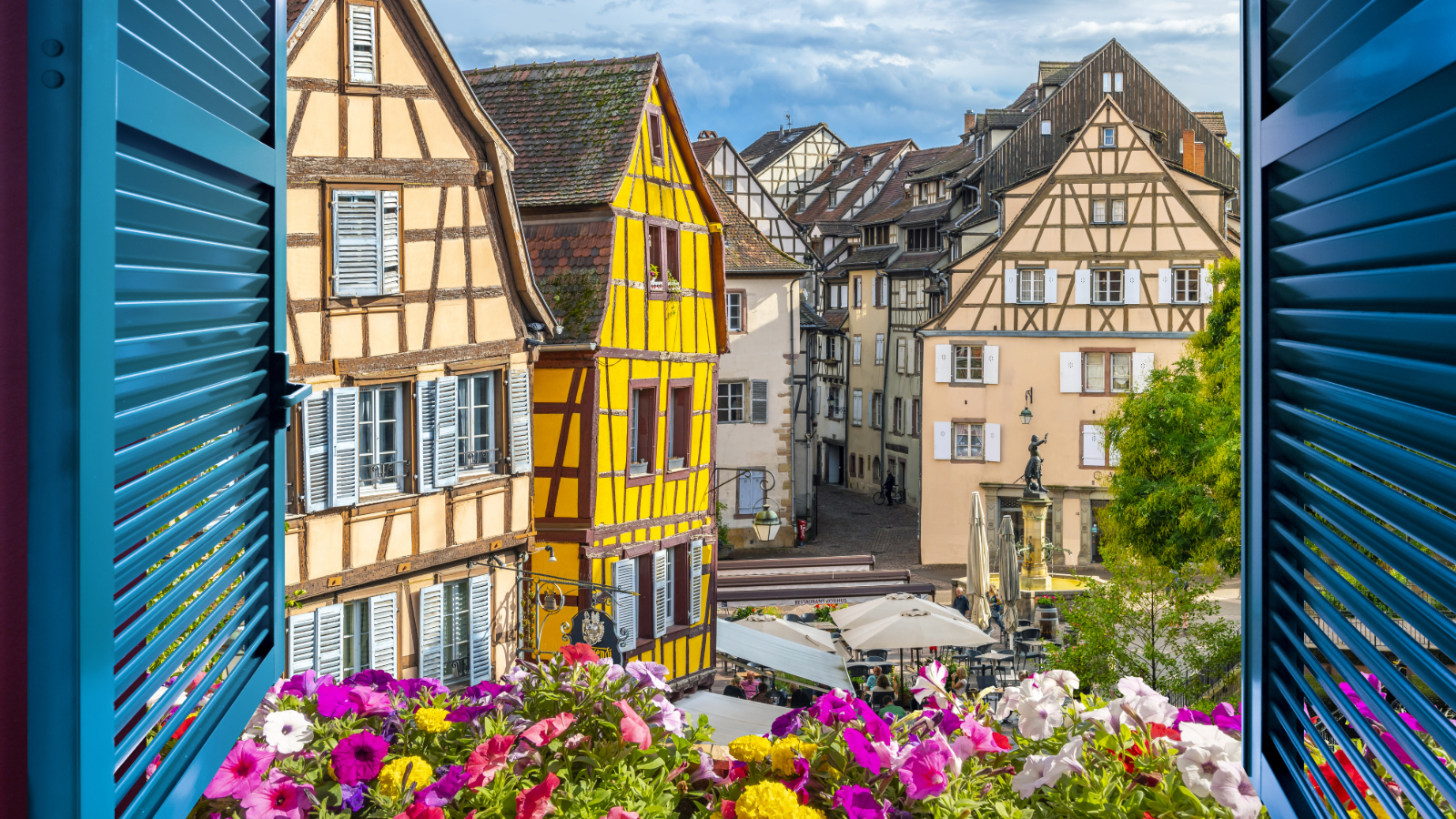
Less than seven kilometres from Colmar, along a ribbon of medieval villages perched on the Vosges foothills, unfolds one of the most photographed viticultural landscapes in Europe. Eguisheim, voted "French people's favourite village", Husseren-les-Châteaux dominating the Rhine plain from its 380-metre elevation, Riquewihr whose medieval ramparts have barely changed since the 16th century: these places are universally known for their beauty.
They are far less known for what they conceal in terms of prestige real estate. And it is precisely this discretion that makes them an opportunity.
Adopte une Conciergerie is the only private concierge service in Alsace to offer an integrated confidential real estate consulting service. This guide is written with the exigence our clients deserve.
The anatomy of the Alsatian manor house
The Alsatian manor house — known locally as Herrenhaus or bürgerliches Haus — is a well-defined architectural type, born of the viticultural and commercial prosperity of the 18th and 19th centuries. It is distinguished from the traditional half-timbered house and the bourgeois villa by several invariant characteristics:
- Volume — Two to three levels above vaulted cellars, habitable surface generally between 200 and 500 sq m, with ceiling heights of 3.20 to 4.20m on the principal floors.
- Dominant material — Dressed stone (Vosges sandstone or shell limestone), often rendered and painted off-white, with worked corner quoins and window surrounds.
- Prestige interior elements — Solid oak herringbone or Hungarian-point parquet, carved-balustrade staircases, marble or faience fireplaces, coffered or stucco-moulded ceilings, full-arch vaulted cellars.
- Site placement — In the centre of the village for merchant townhouses, or in a slightly elevated position set back for viticultural properties, typically accompanied by cuveaux, presses and cellars.
- The garden — Walled, with mature trees, sometimes graced by a pond or orangery. The presence of a private garden is the rarest and most value-adding element in village centres.
The four reference territories and their prices
Colmar: the capital of Alsatian prestige
Colmar concentrates the majority of the sector's manor houses. The southern quarter — known as the "manor house quarter" — lines Wilhelminian and Belle Époque townhouses along tree-lined avenues within ten minutes' walk of the historic centre. Manor houses from the 18th and 19th centuries consistently sit at the upper end of the price per square metre range in Colmar.
Price ranges observed in 2026 for manor houses in Colmar:
- Manor house 200–280 sq m requiring renovation, garden, central: €550,000 to €850,000
- Manor house 250–350 sq m tastefully renovated, mature garden: €900,000 to €1,400,000
- Hôtel particulier 350 sq m+ in perfect condition, exceptional address: €1,400,000 to €2,500,000 and beyond
Husseren-les-Châteaux: altitude, views and absolute confidentiality
Nestled at 380 metres above sea level at the foot of the Three Châteaux, 7 kilometres from Colmar, Husseren-les-Châteaux is the highest village in the Alsatian vineyard. The view over the Rhine plain as far as the Black Forest horizon is splendid. Its Grand Cru vineyards, Pfersigberg and Eichberg, have been celebrated since the 15th century. This village of 400 inhabitants is one of the most confidential in the vineyard. Prestige properties are extremely rare there and almost never circulate on the open market.
Price ranges observed for prestige properties in Husseren-les-Châteaux:
- Contemporary villa 200 sq m, mature grounds, vineyard and plain views: €700,000 to €1,100,000
- Exceptional renovated Alsatian house, 300+ sq m, vaulted cellar: €1,000,000 to €1,800,000
Eguisheim — voted "French people's favourite village" — is a perfect oval of medieval lanes surrounded by vines, some yielding the Grand Crus Eichberg and Pfersigberg. Acquiring a characterful house in Eguisheim is an achievement: the built fabric is extremely dense, properties change hands with the greatest discretion, and outside buyers access only the visible fraction of the market.
Price ranges observed in Eguisheim:
- Restored Alsatian house 150–200 sq m, tasting cellar: €600,000 to €950,000
- Manor house with courtyard and outbuildings: €950,000 to €1,600,000
Riquewihr: the Haut-Rhin's medieval jewel
Riquewihr is one of the best-preserved villages in Europe, its ramparts and 16th-century townhouses forming a listed ensemble. International demand is intense — particularly from Germany, Switzerland and the Benelux. Quality properties there trade with remarkable liquidity, at prices that reflect this global attractiveness.
Price ranges observed in Riquewihr:
- Restored 16th–17th-century townhouse, 180–250 sq m: €700,000 to €1,300,000
- Prestige property with vaulted cellar and garden: €1,200,000 to €2,000,000
The rental angle: three yield strategies
A manor house in the Alsatian vineyard is not a dormant asset. Well positioned and professionally managed, it can generate significant rental income that substantially improves the overall investment return.
Strategy 1 — Premium guesthouse
Transforming part of the property into luxury guest rooms or a private suite allows the operator to capture the premium Route des Vins clientele (weeks of €3,500 to €6,000 in high season for a well-positioned property). Average occupancy with professional management: 55 to 70% annually. Estimated gross revenues for a 4–6-bedroom property well positioned in Eguisheim or Riquewihr: €80,000 to €140,000 per year.
Strategy 2 — Premium short-term letting (Airbnb / prestige gîte)
Letting the entire property on a short-term basis is the most flexible strategy. Colmar's Christmas Markets (December) and the summer season (June–September) alone represent 60 to 70% of annual revenue. A premium 8–12-person gîte in the vineyard lets for between €2,000 and €4,500 per week in high season. Our Adopte une Conciergerie City Managers handle complete management — bookings, guest welcome, hotel-standard cleaning, maintenance — with detailed monthly reporting.
Strategy 3 — Long-term residential letting to premium tenants
For owners seeking hassle-free management, long-term letting to a demanding tenant (international executive, diplomat, family in relocation) generates stable income of between €2,500 and €5,000 per month for a standing manor house, with minimal daily management required. Adopte une Conciergerie handles tenant selection and landlord-tenant relationship management.
The long-term patrimonial advantage
International demand — primarily German (35%) and Swiss (31%) — provides a structural foundation that keeps Alsatian vineyard property prices resilient. This cross-border demand is insensitive to French economic cycles and responds to a permanent geographic and cultural attractiveness. The Colmar property market has shown 18% growth year-on-year and 41% over five years. In the vineyard villages, the scarcity of stock and sustained international demand make this one of the few French property markets to display structural resistance to corrections.
Ultra-powerful FAQ — Manor houses and viticultural properties in Alsace
What is the difference between a manor house, a private mansion and a viticultural property in Alsace?
The manor house designates a characterful bourgeois residence (18th–19th century), generally in dressed stone, with refined interior appointments (parquet, fireplaces, high ceilings) and a walled garden. The hôtel particulier is a larger and more ornate variant, typically with a formal courtyard and outbuildings. The viticultural property additionally includes working buildings (cuvier, press, cellar), planting rights and potentially a wine stock — making it a complex asset requiring distinct analysis combining residential real estate and a production tool.
Can one purchase a viticultural property without being a winemaker?
Yes, entirely. Acquiring a property with vines need not imply any intention to farm them personally. The owner can lease the vines to a local winemaker under a long-term agricultural lease (bail rural, typically 9 years renewable), who manages cultivation and production in exchange for a fixed rent or a share of the harvest. This arrangement is common throughout the Alsatian vineyard and allows full retention of land ownership without the burdens of wine production.
What architectural constraints apply to buying a manor house in a listed conservation area?
The vineyard villages (Eguisheim, Riquewihr, Kaysersberg, Ribeauvillé) are wholly or largely listed as Remarkable Heritage Sites (SPR) or conservation areas. Any modification of a building's external appearance requires approval from the Architecte des Bâtiments de France (ABF). This covers façade colours, roofing materials, external joinery and contemporary additions (conservatory, swimming pool, solar panels). These constraints are manageable but demand anticipation of administrative lead times (6 to 18 months for significant works) and a working relationship with an architect experienced in local ABF dialogue.
What is the estimated gross rental yield of a manor house in the Alsatian vineyard?
In premium short-term letting for the entire property, gross yield typically falls between 4% and 7% depending on pricing position, property condition and management quality. Colmar's Christmas Market weeks (December) and the summer high season (July–August) alone represent 50 to 60% of annual turnover. In a mixed guesthouse format (personal occupation plus partial letting), yield is lower but personal enjoyment is maximised.
What taxation applies to rental income from an Alsatian manor house?
For furnished lettings (gîte, guesthouse, Airbnb), the LMNP (Non-Professional Furnished Letting) regime on the actual-cost basis is most advantageous: it allows depreciation of the property and fittings over 20 to 30 years, considerably reducing — or even eliminating — taxable profit during the early years. For unfurnished long-term lettings, rental income is taxed at the progressive scale after deduction of actual charges, or under the micro-foncier scheme (30% flat deduction) for annual receipts below €15,000. Optimal structuring depends on the buyer's tax profile and warrants specialist advice.
How does local Alsatian-Moselle law affect the purchase of a viticultural property?
Local Alsatian-Moselle law — inherited from the German civil code and retained since 1918 — has two major specificities for vineyard property acquisitions: the land register (Grundbuch) provides superior security and publicity of real rights compared to the standard French system; and the default matrimonial regime is universal community (not the reduced community of acquisitions of common French law). The second point is critical for couples purchasing together: joint acquisition under local law carries patrimonial consequences that differ from common French law and must be anticipated with a specialist notary.
Are there tax incentives for restoring a listed or conservation-area manor house in Alsace?
Yes. Property owners undertaking restoration works on a Classified Historic Monument or Supplementary Listed building can deduct the entirety of property charges and works costs from their overall income, with no ceiling (Monuments Historiques regime). For properties in conservation areas that are not individually listed, the Malraux scheme provides a tax reduction of 22% (ZPPAUP) to 30% (SPR) on eligible works costs, capped at €400,000 over four years. These mechanisms are powerful but complex — we recommend evaluating them before any acquisition decision.
What are the technical specificities of an Alsatian vaulted cellar and how does it affect property value?
Full-arch vaulted cellars — often excavated in the 15th or 16th century from local limestone or Vosges sandstone — are one of the most value-enhancing patrimonial assets of an Alsatian property. They naturally maintain a constant temperature of 10 to 13°C and ideal humidity for wine conservation. In terms of market value, a vaulted cellar in good condition adds 5 to 15% to the price of an otherwise comparable property, and constitutes a strong rental argument for wine tourism clientele. Their restoration is subject to ABF approval when visible from public space.
Can a swimming pool be installed in a manor house garden in a conservation area?
Yes, subject to conditions. Installing a pool in a walled garden, not visible from the public highway, is generally authorised following ABF approval. The pool must be sunken or semi-sunken, in materials and colours compatible with the heritage environment. Instruction lead times can reach 4 to 6 months. For properties outside conservation areas (village peripheries), standard timelines and constraints apply.
What are Adopte une Conciergerie's selection criteria for off-market property access?
We do not work from a stock of mandates to market. We start from the buyer's profile, budget and life project to identify available properties in our private network — local notaries, family viticultural estates, wealth managers. Our usual intervention threshold in the Alsatian vineyard is €600,000 at acquisition. We prefer to accompany a limited number of clients on high value-added files rather than multiply standardised mandates.
What is the liquidity of the manor house market in the Alsatian vineyard?
Liquidity is structurally sound for quality, well-positioned properties. Sale timelines in the €600,000–€1,500,000 segment are generally 3 to 8 months for a correctly valued property. Above €1,500,000, the market is tighter but international demand (Swiss, German, Belgian and French expatriate buyers) maintains constant pressure on the finest properties. Properties in perfect condition well exposed to international platforms typically find a buyer within 4 to 6 months on average.
How does one begin an acquisition project in the Alsatian vineyard with Adopte une Conciergerie?
With a confidential conversation — in person in Colmar or Strasbourg, or by video call — during which we analyse your project, budget, priority criteria and intended holding period. Following this conversation, we submit a note on current opportunities matching your profile and define together the terms of our collaboration. No exclusive mandate required, no upfront fees: our remuneration is linked to the successful completion of the acquisition.
The manor house you are looking for exists in the Alsatian vineyard. It simply awaits the buyer who knows how to find it. Let us meet at
Adopte une Conciergerie — Real Estate Consulting.