A wine estate in Alsace is not an ordinary real estate investment. It is a fully distinct asset class — irreplaceable by definition, uncorrelated with financial markets, carried by a controlled designation of origin whose global reputation has been built over centuries. This panorama decodes the Alsatian wine estate market in 2026: who sells, who buys, at what prices, in what logic — and how Adopte une Conciergerie supports patrimonial buyers in this structurally opaque market.
Market Analysis · Wine Estates · Alsace · Grand Est · 2026
An off-cycle asset. Structural rarity. An invisible market.
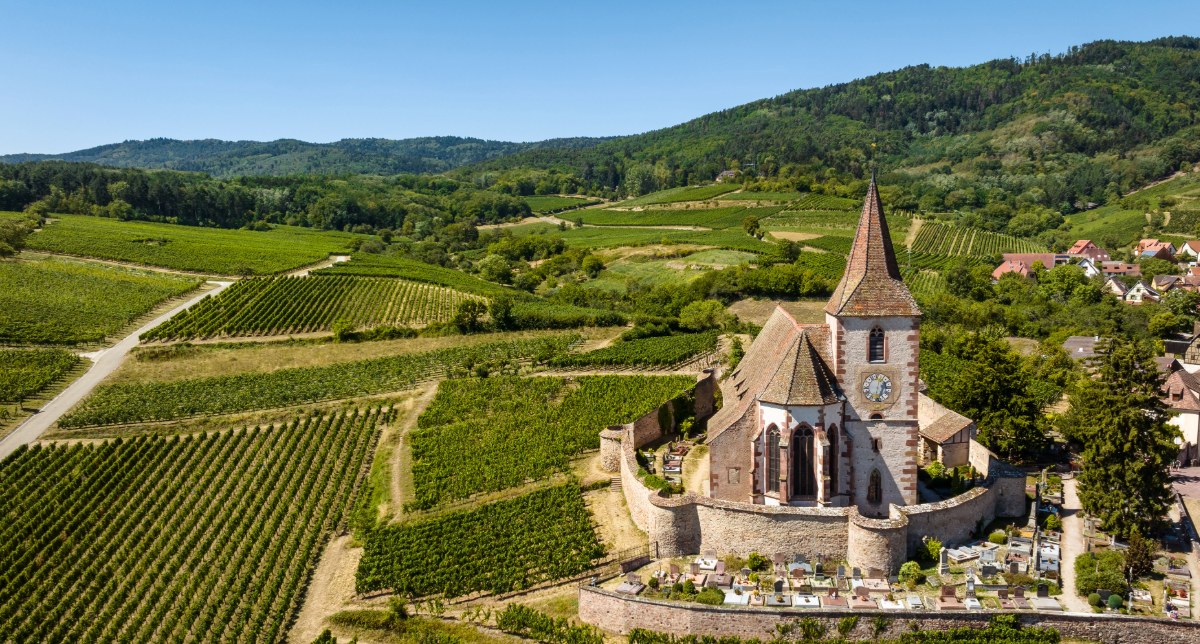
There are assets the market cannot create — it can only redistribute them. A hectare of Grand Cru Schlossberg vineyard at Kaysersberg, an estate on the Rangen de Thann, parcels on the Brand at Turckheim — these properties exist in fixed, definitive quantities, delimited by decrees dating in some cases to the Middle Ages and modifiable by no-one. This absolute irreplaceability is what makes an Alsatian Grand Cru vineyard a fully distinct asset class within a sophisticated patrimonial strategy.
Understanding this market first requires accepting its profound singularity: it is not real estate in the conventional sense, not financial, not quite agricultural either. It is a market of living heritage — a combination of land, expertise, controlled designations and family history that is transmitted, transferred and acquired according to logics that few intermediaries genuinely master. Adopte une Conciergerie is among those who do.
Eight questions on investment in Alsatian wine estates
What is the price of a wine estate in Alsace in 2026?
Prices in the Alsatian wine estate market vary considerably according to the nature of the assets. For a regional designation vineyard parcel (Alsace AOC), the price is generally between €50,000 and €150,000 per hectare depending on exposure, condition and location. For Grand Cru classified parcels, prices start around €500,000 per hectare for lesser-known Grand Crus, and can exceed €1 to €2 million per hectare for the most reputed — Schlossberg, Rangen, Brand, Sommerberg. For a complete operating estate — with buildings, equipment, stock and clientele — prices depend closely on the estate's scale, the Grand Cru proportion of the vineyard, and commercial reputation. Modest estates transfer from a few hundred thousand euros; the finest reach several million. The rarity of transactions makes any range inherently indicative.
Is it possible to buy a wine estate in Alsace without being a winemaker?
Yes — but with regulatory conditions to respect. Acquiring an operating wine estate falls under rural law, particularly the SAFER's (Société d'Aménagement Foncier et d'Établissement Rural) pre-emption right on certain agricultural land transactions. However, the vast majority of transactions between private parties — including non-winemaker buyers — conclude without SAFER intervention, provided the project is coherent and legally well-prepared. The non-winemaker buyer can operate the estate via a salaried technical director, a sharecropper, or by entrusting operations to a winemaker contractor under contract. These structures are common and legal.
Which Alsatian Grand Crus are most sought by patrimonial investors?
The most sought-after are those with the oldest and most solidly established international reputations. Schlossberg at Kaysersberg — Alsace's largest Grand Cru at 80 hectares — enjoys worldwide renown for its age-worthy Rieslings. Rangen de Thann — the southernmost Grand Cru with unique volcanic soils — produces wines of exceptional concentration and longevity. Brand at Turckheim, Sommerberg at Niedermorschwihr, Goldert at Gueberschwihr — all these terroirs have international reputations that extend beyond specialised oenophilia. The rarity of transfers on these Grand Crus is such that opportunities, when they arise, always find a buyer.
Can a non-resident investor manage an Alsatian wine estate remotely?
Yes — and this is an increasingly common management model. Several structures exist: direct management with a salaried technical director (the investor owns the estate, employs a qualified technical director who manages all viticultural and commercial operations); sharecropping (a winemaker operates the estate under contract, sharing the harvest with the owner on agreed terms); total delegation to a wine contractor (the owner entrusts all operations to a winemaker-contractor who sells the wine under their own or the estate's label). In all cases, administrative, fiscal and patrimonial management can be delegated to a trusted intermediary — one of the patrimonial concierge dimensions Adopte une Conciergerie offers to estate-owning clients.
What are the fiscal advantages of wine property ownership in Alsace?
Wine property ownership in France benefits from several favourable fiscal provisions. Partial exemption from the Wealth Tax on Real Estate (IFI): agricultural and viticultural properties professionally operated can be IFI-exempt under certain conditions. Transmission provisions: wine estate transfer can benefit from abatements within the agricultural Dutreil Pact framework, allowing family transmissions with substantial reductions in gift or inheritance tax. Agricultural income taxation: revenues from wine operations are subject to the agricultural profits regime, with lump-sum or actual-basis options optimisable according to the buyer's structure. These provisions are complex and must be analysed case by case with a specialist in agricultural and viticultural taxation.
How does Adopte une Conciergerie support wine estate acquisition in Alsace?
Our support is structured around four phases. Project qualification: we begin with a deep conversation on the buyer's objectives — use (production, residence, pure investment), budget, holding horizon, desired personal involvement. Market search and access: we mobilise our network of rural law notaries, patrimonial lawyers and contacts in the Alsatian wine world to identify matching opportunities, including off-market. Due diligence: we coordinate agronomic analysis (vineyard condition, yields, organic certification if applicable), legal analysis (property title, rural leases, pre-emption rights), fiscal analysis and buildings assessment. Post-acquisition: administrative management, coordination with the estate director or winemaker contractor, patrimonial concierge for residential components.
Is the Alsatian wine estate market liquid?
No — and this is precisely one of the characteristics defining this asset class. Once acquired, an Alsatian wine estate is not transferable in a few weeks like an apartment. The transfer process — buyer search, due diligence, negotiation, exercise of pre-emption rights if applicable, notarial deed — typically takes six months to two years for a significant-scale estate. This relative illiquidity is the counterpart of the rarity premium: an asset that cannot be created ex nihilo cannot be rapidly liquidated either. For a patrimonial investor with a fifteen to twenty year horizon, this illiquidity is not an obstacle — it is the very condition of the value.
What is the difference between buying vineyards in Alsace and a wine estate in Burgundy or Bordeaux?
The difference is significant on several planes. Prices first: an Alsatian Grand Cru hectare costs on average ten to twenty times less than a Burgundian premier cru hectare, and two to three times less than a Bordeaux Grand Cru left-bank hectare — for comparable terroir quality and international reputation. Estate size: Alsace, like Burgundy, is a small and medium structures vineyard, often family-operated. Estates of less than 10 hectares are the norm, making entry tickets accessible to individual investors. Regulation: the Alsatian Grand Cru system is distinct from Burgundian grand crus or Bordeaux classifications in precise terms, but rests on the same logic of regulatory geographic delimitation and controlled designation. On liquidity, all three vineyard regions are comparably illiquid.
An Alsatian Grand Cru is not a portfolio line. It is an address on a hillside that existed before nation states and will persist beyond stock market cycles. It is the type of asset one chooses when thinking for the next generation.
Wine Estates · Alsace · Wine Route · Patrimonial Investment · Grand Est
Adopte une Conciergerie — First Private Luxury Concierge of Grand-Est · First Corporate Concierge