Tribune · Brand Strategy · May 2026
"Luxury is dead. Long live wellness." The phrase, coined by Dr. Dheeraj Dogra (MRICS), captures a quiet but radical shift in how the world's wealthiest now define their relationship to riches.
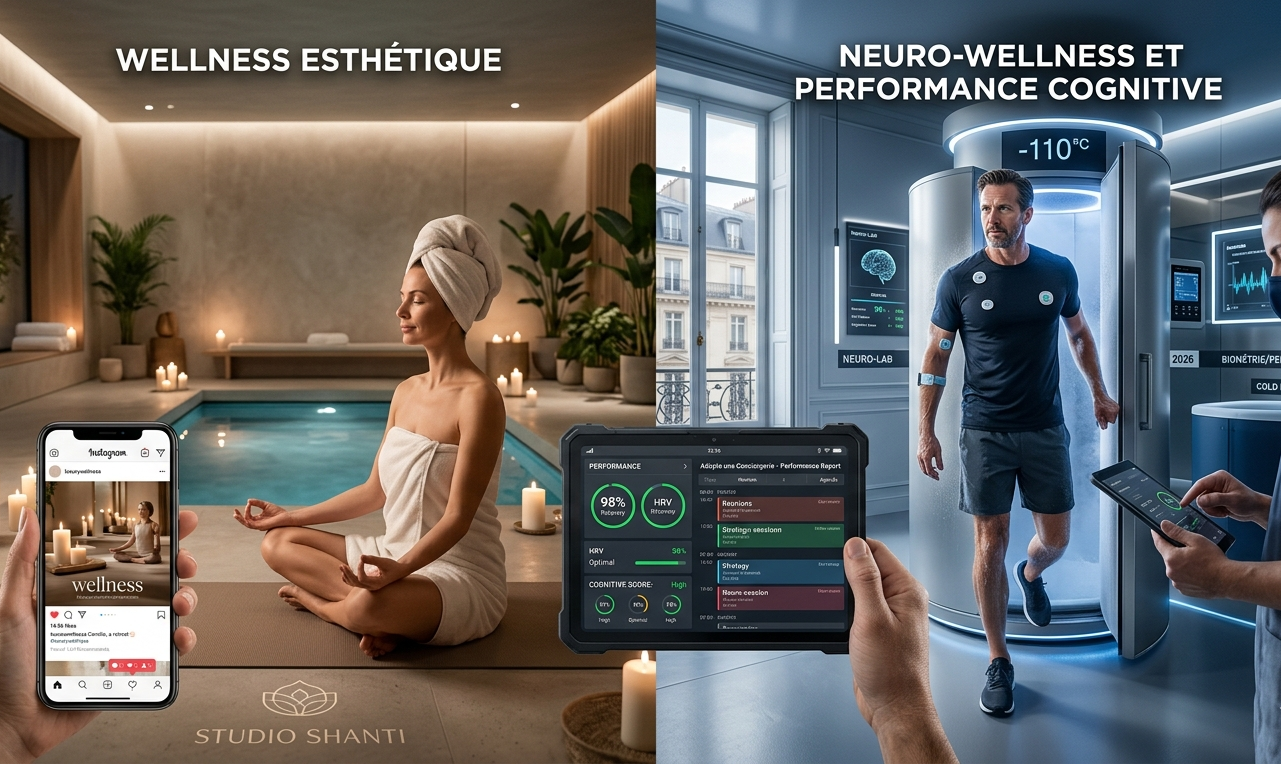
For two decades, luxury was measured in objects: a Hermès bag, a Patek watch, a Pagani car. Then came the pandemic. And suddenly, what mattered was no longer the bag on your arm. It was the quality of the air you breathed, the depth of sleep you could find, the immune resilience you had built. Luxury had moved from the visible to the invisible, from having to being, from object to time.
This shift is not intuition. It is documented, quantified, measured. And it is reshaping in depth what it means to serve an ultra-wealthy clientele in 2026.
The numbers behind a silent revolution
According to the Global Wellness Institute, the global wellness economy reached $6.8 trillion in 2024, and is forecast to surpass $9.8 trillion by 2029. To put that in perspective: it is nearly four times the size of the pharmaceutical industry, and larger than global tourism. Wellness is no longer a niche. It has become a pillar of the real economy.
Global economy
$6.8T
Wellness economy 2024 — toward $9.8T by 2029 (GWI)
UHNW spending
49%
Of UHNWIs place wellness ahead of watches and automotive (Brandteliers)
Wellness real estate
+19.5%
Annual growth 2019-2024 — fastest-growing wellness sector
Luxury wellness clubs
$68.4B
Global market 2025 — toward $138.7B by 2034
More telling still: according to recent UHNW behavioral research by Brandteliers, 49% of the world's wealthiest now place wellness at the top of their investment priorities — ahead of prestige watchmaking (42%) and exceptional automotive (32%). Only travel ranks higher, at 83% — and even there, the majority of high-end travel today is driven by a wellness dimension.
Why traditional luxury is faltering
Bain & Company's 2026 luxury report is unequivocal: for the first time in fifteen years (excluding the COVID period), personal luxury has contracted. The customer base shrank by roughly 20 million consumers. Leather goods and footwear declined sharply. Even the top 1% — historically immune to cycles — stabilized its product spending.
But what Bain documents most strikingly is this fundamental sentence: "Luxury experiences continue to grow faster than the broader market, driven by a lasting shift toward wellness, self-reward and social connection."
In other words: the money has not disappeared. It has moved. From the bag to the wellness retreat. From the jewel to the longevity programme. From the car to the personal transformation experience.
The UHNWI triangle: longevity, serenity, meaning
Read the McKinsey 2025 and Bain 2026 reports closely, and three words keep recurring in UHNWI interviews:
- Longevity — not living longer, but living better for longer. The English concept of healthspan is supplanting that of lifespan.
- Serenity — the ability to disconnect, to sleep, to regulate one's nervous system. Deep sleep has become a luxury product.
- Meaning — the alignment between what one owns, what one consumes and the values one stands for. Wellness now embraces an ethical dimension: sourced products, chosen providers, measured impact.
This triangle is no longer optional. It has become the lens through which any ultra-wealthy clientele born after 1975 reads the world. And it radically transforms the expectations placed upon a private concierge house.
What this changes for Adopte une Conciergerie
At Adopte une Conciergerie, this shift is not a trend we are adapting to. It is the very foundation of our offer strategy. Our clients no longer ask us merely to manage their residence in Strasbourg, their chalet in Megève or their apartment in Monaco. They ask us to orchestrate a way of life consistent with this new paradigm.
Pillar 1
Máte projekt na mysli?
Naši odborníci jsou připraveni vytvořit pro vás zážitek na míru.
Požádat o bezplatnou nabídkuWellness-calibrated residences
Rigorous selection of properties integrating air quality, natural light, controlled acoustics, and dedicated spaces for yoga, meditation and recovery. Wellness real estate is no longer a marketing argument — it is a requirement.
Pillar 2
Longevity and integrative medicine network
Privileged access to longevity clinics (genomics, biomarkers, personalised protocols), integrative physicians and Europe's leading recovery centres — Switzerland, Austria, Italy, France.
Pillar 3
A sourced and discreet daily life
From private chefs trained in functional nutrition to sleep coaches, from mineral-water sommeliers to cardiac coherence practitioners, we orchestrate a daily rhythm that is not spectacular — but profoundly regenerative.
Pillar 4
Transformation journeys
Stays at Lanserhof, Clinique La Prairie, Palace Merano or Six Senses Douro Valley — not to tick another luxury experience off a list, but to engage in a true protocol of transformation, measured and followed over time.
Wellness is not the absence of luxury — it is its highest form
There is a simplistic reading of this movement that we reject. No, wellness is not a return to austerity. No, it is not a passing millennial fad. No, it is not a sub-segment of luxury.
Wellness is the most demanding form of contemporary luxury. It requires more resources, more time, more expertise and more discretion than any form of conspicuous consumption before it. A four-week stay at Lanserhof costs more than a haute couture bag. A personalised longevity protocol with a leading Zurich physician runs into six figures annually. A residence with a true wellness environment — filtered air, structured water, circadian lighting, considered acoustics — demands specific investments that few real estate agencies yet understand.
"For a long time, luxury was about showing. Now, it is about protecting. Protecting health, time, attention, loved ones. It is a quieter, more intelligent, more lasting definition. And it is exactly what our clients now expect of us."
A strategy that changes everything, internally
This repositioning is not merely a marketing story. It transforms our craft in depth:
- Our account managers are trained in functional nutrition, sleep medicine and longevity principles.
- Our provider network now includes physicians, naturopaths, osteopaths, breath coaches and recovery specialists.
- Our property selection charter includes a wellness evaluation grid (air quality, light exposure, acoustic levels, presence of regenerative spaces).
- Our premium concierge offer integrates, on demand, a lifestyle audit and a 12-month transformation programme.
Tomorrow?
The McKinsey report on the future of wellness identifies two clear directions: personalised longevity (genomics, biomarkers, predictive AI) and mental well-being. Two axes we follow closely. Tomorrow's clients will not just be more demanding. They will be more informed, more measured, more precise in their requests. They will no longer say, "I want to live well." They will say: "I want to gain five years of healthy life by 2035, and I want you to help me build the daily life that makes it possible."
That precision is what we are preparing for.
Our conviction
Dr. Dogra's title was deliberately provocative. Luxury is not dead. It has moved. It has left the storefront window for the inner sanctuary. It has left the object for time. It has left possession for regeneration.
Adopte une Conciergerie did not follow this trend. We anticipated it — because that is the meaning the word concierge has always held for us: not to serve a conspicuous lifestyle, but to protect human capital. Health, time, attention, relationships. What money cannot buy, but what care, over time, can preserve and grow.
Frequently Asked Questions
Why speak of "the death of luxury" when the market still stands at €1.44 trillion?
The luxury market is not disappearing — it is recomposing. Personal goods (bags, footwear, leather) are receding, while experiences — and particularly wellness, longevity and transformation travel — capture most of the growth. It is a mutation of perceived value, not a market collapse.
What defines a wellness residence according to Adopte une Conciergerie?
A wellness residence natively integrates filtered air quality, optimised circadian lighting, controlled acoustics, direct access to nature and dedicated spaces for movement, meditation and recovery. Beyond equipment (sauna, pool, gym), it is the entire environment that is calibrated to support health.
Which are the leading longevity centres in Europe?
Among the international references: Lanserhof (Germany, Austria, UK), Clinique La Prairie (Montreux, Switzerland), Palace Merano (Italy), SHA Wellness Clinic (Spain), VIVAMAYR (Austria), Six Senses (multiple destinations). Adopte une Conciergerie guides the choice of centre adapted to each profile and coordinates the entire stay.
How does Adopte une Conciergerie integrate wellness into its daily offer?
Beyond punctual wellness stays, we orchestrate a regenerative daily life: private chef trained in functional nutrition, sleep coach, recovery practitioners at home, personalised movement programme, lifestyle audit. The aim is not the event — it is consistency.
Has wellness become more expensive than traditional luxury?
Often, yes. A four-week stay at a leading centre easily exceeds the price of a haute couture bag. A personalised longevity protocol can reach six-figure annual sums. A residence designed for well-being demands specific investments. Wellness has become the most demanding — and least conspicuous — form of contemporary luxury.