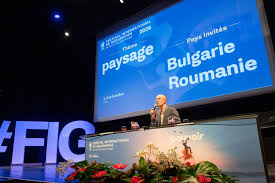
From 2 to 4 October 2026, Saint-Dié-des-Vosges hosts the 37th International Festival of Geography — one of Europe's most singular intellectual and cultural events. Theme: Landscape. Countries of honour: Bulgaria and Romania. A complete guide to attending and making the most of it.
Saint-Dié-des-Vosges: the city that named America
There is a little-known fact that gives Saint-Dié-des-Vosges a singular place in human history: it was here, in 1507, that the word "America" first appeared on a map. The Vosgien Gymnasium — a circle of humanist scholars gathered around canon Vautrin Lud — produced that year a revolutionary world map, baptising the new continent with the Latinised name of Amerigo Vespucci. This small Vosgien provincial town thus carried, long before it was known for anything else, the mark of a cartographic gesture that changed the world's representation of itself.
It is on this exceptional foundation of identity that the International Festival of Geography rests — founded in 1990 by Christian Pierret. Over thirty-five years, the FIG has become one of the most important intellectual, cultural and gastronomic events in Grand-Est, and one of the rare festivals in the world to make geography a popular celebration open to all.
The FIG by the numbers: a festival unlike any other
Every year, for three days at the first weekend of October, Saint-Dié-des-Vosges transforms itself entirely:
- Over 40,000 festival-goers welcomed each edition, from across France and abroad
- Over 300 speakers — geographers, writers, philosophers, artists, cartoonists, journalists — occupying the town's spaces
- Over 200 encounters in all forms: panel debates, round tables, geography cafés, screenings, exhibitions, live performances
- Entirely free admission for the whole programme — an absolute singularity for a festival of this international standing
- 35 editions since 1990, a continuity that speaks to the festival's deep roots in French intellectual life
FIG 2026: Landscape, Bulgaria and Romania
The 37th edition of the FIG takes place on 2, 3 and 4 October 2026 in Saint-Dié-des-Vosges, around a particularly rich double programme.
The theme: "Landscape"
The word "landscape" is deceptively familiar. The moment it is pronounced, each person can immediately project themselves far away in space and time — or, conversely, into the space immediately around them. This ambivalence — between the intimate and the collective, between the idealised postcard and a living, political space — is precisely what FIG 2026 intends to explore. Behind any landscape's apparent role as scenery lies a set of choices, tensions, environmental and social crises. In the context of the Anthropocene, the geography of landscape compels us to rethink our relationship with territory, vulnerability and the shared future.
Countries of honour: Bulgaria and Romania
The choice of Bulgaria and Romania for 2026 is not incidental. In October 2026, we stand on the eve of the twentieth anniversary of their accession to the European Union — the largest enlargement in EU history. Both countries, having entered the Schengen area together on 1 January 2025, share a geopolitical interface position on the Black Sea and a common border along the Danube, with its major environmental stakes. Twenty years of European integration seen from these two territories: a geopolitical prism of rare richness.
A programme in four dimensions
The scientific dimension
At the festival's heart, researchers and geographers from across the world debate within a unique framework: that of a passionate and heterogeneous public, which compels scientists to communicate clearly on pointed subjects. The Vautrin-Lud Prize — often described as the "Nobel Prize of Geography" — is awarded each year at the FIG to a geographer honoured for their life's work, on the basis of a consultation of over one hundred researchers worldwide, by a five-member specialist jury modelled on the 1507 Vosgien Gymnasium.
The literary dimension
The Book Fair is a centrepiece of the festival. Hundreds of titles linked to geography, travel, cartography and the human sciences are presented. Several literary prizes are awarded, including the Amerigo Vespucci Prize (adult geographical work), the Amerigo Vespucci Youth Prize, the Geographic Comics Prize and the Geography Book Prize for Secondary and Post-Secondary Students. These prizes make the FIG one of the most complete geographical literary events in France.
The cultural dimension
Photographic and cartographic exhibitions, thematic film screenings, live performances: the FIG is also a festival of the arts that tell the world's story. Each edition weaves connections between geography and contemporary creation, between science and sensibility, between objective data and subjective perspectives.
The gastronomic dimension
The FIG has the unique characteristic of placing gastronomy on an equal footing with intellectual life. The Place de la Gastronomie, the Allée des Saveurs and the Éco-Resto allow visitors to discover the cuisines of the invited countries and the terroirs of France in a spirit of total curiosity. Vosgien gastronomy itself — quiche, meat tart, Munster cheese, mirabelle plum — is presented in its finest expressions.
How to experience the FIG in the best possible conditions
Saint-Dié-des-Vosges is a city of 20,000 inhabitants that finds itself, over one weekend, welcoming twice its population. The organisation is well-oiled and the welcome genuinely warm — but logistical planning is essential for visitors who wish to experience the festival fully.
Accommodation
Hotels in Saint-Dié-des-Vosges and its immediate surroundings fill up several weeks before the festival weekend. Alternatives within a 30 to 40km radius are plentiful: Gérardmer (30 min), Épinal (40 min), Sélestat (40 min on the Alsatian side). For a premium experience — a Vosges chalet, a characterful guesthouse, a prestige apartment in Strasbourg with shuttle transfer — Adopte une Conciergerie can source and book the ideal lodging well in advance.
Getting there
Saint-Dié-des-Vosges is accessible from Strasbourg in 1h15 by road (D392 via Sainte-Marie-aux-Mines) or 1h30 by train (TER with connection). From Paris, allow 3h30 by car or 3h by train via Nancy or Strasbourg. A dedicated Train for Secondary School Students is organised each year by the festival from several major cities in Grand-Est.
Programme and free admission
The entire FIG programme is free and open to all — conferences, debates, exhibitions, performances. The detailed programme is published on the festival's official website and updated regularly in the weeks before the event.
The FIG and the Vosgien territory: an invitation to extend the experience
For many of its visitors, the FIG is a unique opportunity to (re)discover the Vosges. The Vosgien massif offers, within a few kilometres of Saint-Dié, a range of landscapes — fir forests, upland meadows, Alsatian villages on the eastern slope, glacial lakes — that echo the very theme of the 2026 festival. Extending the visit by one or two nights in the region is an obvious choice.
For visitors wishing to combine the FIG with a prestige stay in the Vosges or Alsace — premium accommodation, gastronomic dining, confidential cultural experiences — Adopte une Conciergerie organises the complete bespoke programme.
FAQ — International Festival of Geography 2026
Is the FIG genuinely free?
Yes, in its overwhelming majority. All conferences, debates, round tables, geography cafés, exhibitions and performances are free and open to all. Certain specific activities (workshops, gastronomic meals, private partner events) may be charged. This is a remarkable singularity for a festival of this international standing.
What are the exact dates of FIG 2026?
The 37th edition of the FIG takes place on Friday 2, Saturday 3 and Sunday 4 October 2026 in Saint-Dié-des-Vosges (Vosges, Grand-Est, France).
What is the theme of FIG 2026 and which countries are being honoured?
The 2026 theme is "Landscape" — explored across all its dimensions: scientific, political, environmental, sensory and artistic. The countries of honour are Bulgaria and Romania, whose EU accession marks its twentieth anniversary in 2027.
What is the Vautrin-Lud Prize?
The Vautrin-Lud Prize is the highest distinction in world geography, often described as the "Nobel Prize of Geography." It is awarded each year at the FIG to a geographer honoured for their life's work, following a consultation of over one hundred researchers worldwide, by a five-member specialist jury. Its name honours Vautrin Lud, the Déodatian canon whose circle of scholars inscribed the word "America" on a map for the first time in 1507.
Is the FIG suitable for children and families?
Yes, entirely so. FIG Junior offers programming specifically designed for children and families. The Train for Secondary School Students organises annual journeys from the main cities of Grand-Est to bring pupils to the festival in excellent conditions. School outreach sessions are also offered in educational establishments ahead of the festival.
Why was Saint-Dié-des-Vosges chosen to host a geography festival?
Saint-Dié-des-Vosges holds a unique historical legitimacy: in 1507, the Vosgien Gymnasium published the first map bearing the name "America" — a foundational cartographic act in the history of world representation. This town is, literally, the godmother of America. It was upon this singular identity that Christian Pierret built the FIG in 1990.
How does one secure accommodation for the FIG without being caught out?
Hotels in Saint-Dié-des-Vosges and the immediate vicinity fill up several weeks before the festival. Early planning and a broader search radius are essential: Gérardmer, Épinal, Sélestat, Colmar and even Strasbourg are all reachable within an hour. For a prestige stay in the region — a Vosges chalet, a characterful guesthouse, an Alsatian Haussmannian apartment — Adopte une Conciergerie manages the complete accommodation logistics.
Is there a gastronomic programme at the FIG?
Yes — and it is one of the festival's great singularities. The Place de la Gastronomie hosts chefs and producers from the invited countries, offering tastings and culinary demonstrations. The Allée des Saveurs brings together regional artisans and producers. The Éco-Resto offers environmentally committed catering. At the FIG, gastronomy is a full academic discipline in its own right — alongside cartography and geopolitics.
Can the FIG be combined with a touring stay in the Vosges or Alsace?
Absolutely — and it is warmly recommended. The FIG takes place at the first weekend of October, when the Vosges are at their most beautiful autumn colours. The Alsatian Route des Vins, the Vosges highlands, the classified villages of Riquewihr or Kaysersberg, the region's gastronomic tables: everything is within easy reach. Adopte une Conciergerie can orchestrate a complete premium stay combining the FIG with a discovery of the Alsatian-Vosgien territory.
FIG 2026 is approaching. To experience these three days in the best possible conditions — prestige accommodation, premium transport, a personalised programme across the Vosges and Alsace — entrust the organisation to Adopte une Conciergerie.