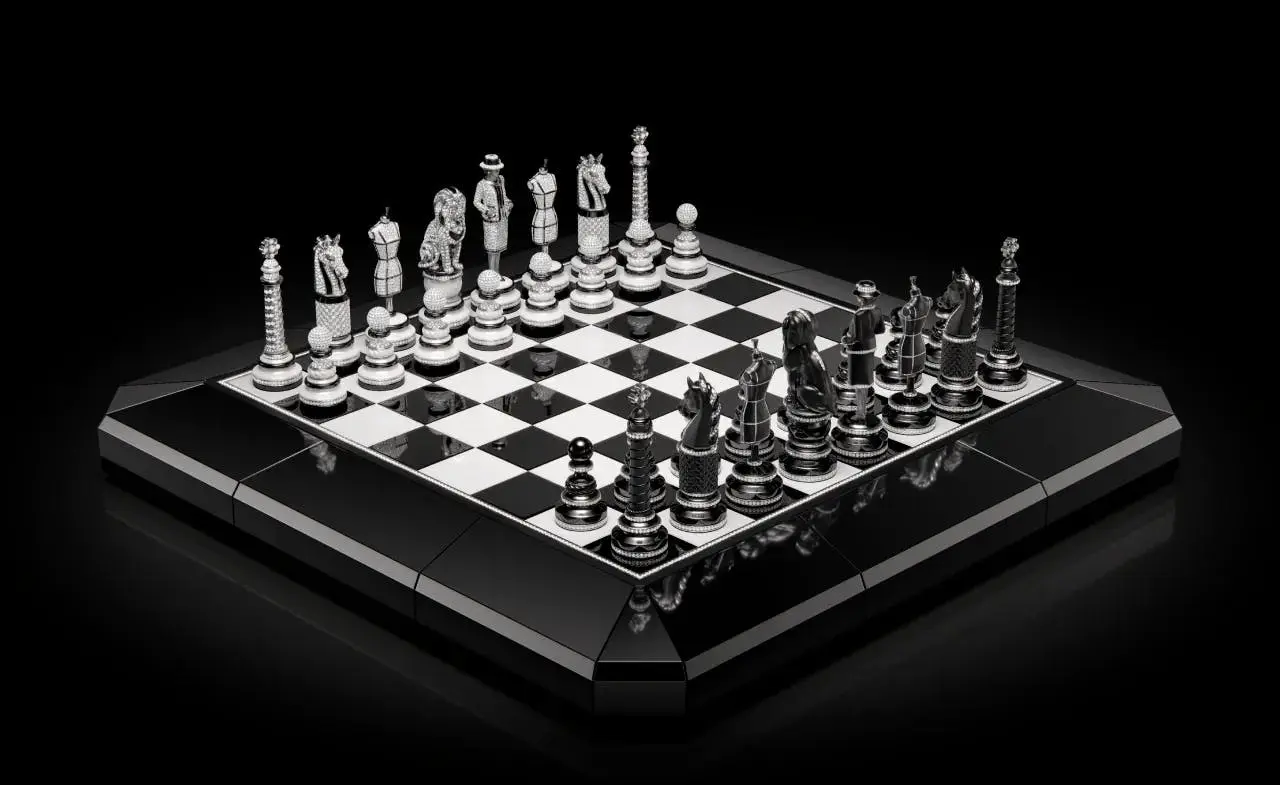
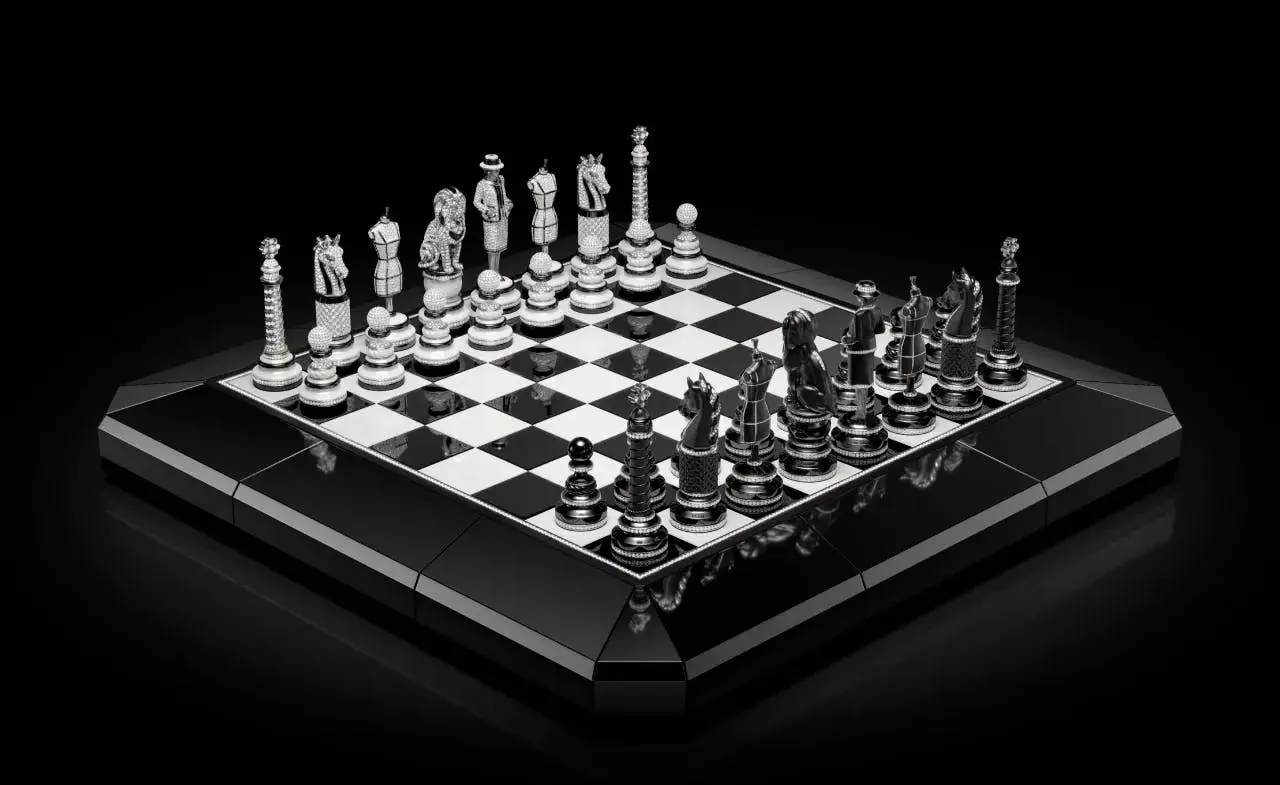
In 2024, Chanel committed $1.755 billion in investments — a 43% increase. But this figure alone says nothing. What says everything is the geography of these investments: Avenue Montaigne in Paris, 5th Avenue in New York, Biarritz, London, Tokyo, Nanjing, Chengdu, Pudong. And in parallel, an itinerant cultural network — Le19M — which has already landed in Dakar and Tokyo, and is preparing to occupy the Museum of Art Pudong in Shanghai from September to November 2026. This is not an ordinary growth strategy. It is a chessboard.
Strategic Analysis · Luxury Market · Chanel · 2025-2026
Chanel has built a luxury chessboard — and every piece has its logic.
There are corporate strategies one can read in figures. And there are others one must read in geography. Chanel's strategy since 2023 belongs firmly to the second category. When the house acquires the building at 42 Avenue Montaigne — after already securing addresses in Biarritz, London and New York — then deploys in parallel an itinerant cultural network across three continents, these are not independent decisions. It is a system. A chessboard where each piece plays a precise role, and whose overall movement says something fundamental about where global luxury is heading.
First axis: securing irreplaceable addresses before they become inaccessible
Chanel's real estate logic is crystal clear once stated plainly: rents on the world's prime luxury streets increase structurally — 3% on major European luxury streets in the past year alone. A brand that rents its flagships depends on its landlord, exposes its margins at every lease renewal, and lacks the freedom to fundamentally transform the space. Chanel has decided to no longer accept this dependency. The acquisition of 42 Avenue Montaigne inscribes itself in a sequence — several purchases made "in recent months in Paris, London and Biarritz" according to the house's statement. These addresses are not ordinary financial assets. They are presence infrastructure. Owning the building means having the freedom to reinvent the client experience without lease constraints, to invest in immersive spaces, and to secure patrimonial value that, at these locations, does not correct.
Le19M is the most interesting piece on the chessboard. Founded by Chanel in 2021, it brings together eleven Maisons d'art — including embroiderer Lesage (celebrating its centenary in 2026), silversmith Goossens and hatmaker Maison Michel — and over 700 artisans under one roof in Paris. But Le19M is not merely a production site. It is a deployable cultural asset. Its Galerie du 19M has already travelled to Dakar (2023) and Tokyo (2025), and will occupy the entire third floor of the Museum of Art Pudong in Shanghai from September to November 2026 — a retrospective celebrating the centenary of the Lesage embroidery house, participatory workshops, a dialogue between French savoir-faire and Chinese contemporary craftsmanship. This cultural deployment is not philanthropy. It is a brand resilience strategy.
Third axis: creative renaissance with Matthieu Blazy
Appointed artistic director in December 2024, Matthieu Blazy — former creative director of Bottega Veneta — represents the third chessboard dimension. According to Bernstein's brand momentum tracker, Chanel has climbed 11 positions in the Western tracker and 5 in China since his nomination, "supported by continued buzz around the spring 2026 collection." This creative momentum arrives at a pivotal moment: Chanel's 2024 results weighed on the entire luxury sector at the Paris Bourse, acting as a "warning signal on the profitability of the growth model of the sector's major names." The Blazy bet, combined with real estate strategy and Le19M's cultural deployment, says Chanel is responding not through rationalisation — but through reaffirmation.
Eight questions on Chanel's strategy and what it reveals about the luxury market
What is Chanel's Le19M and why is it strategically important?
Le19M is a hub founded by Chanel in 2021 bringing together eleven Maisons d'art — including embroiderer Lesage (centenary in 2026), silversmith Goossens and hatmaker Maison Michel — and over 700 artisans under one roof in Paris. Its Galerie du 19M, open to the public, constitutes Chanel's itinerant cultural arm: it has been deployed in Dakar (2023) and Tokyo (2025), and occupies the Museum of Art Pudong in Shanghai from September to November 2026. Strategically, Le19M is Chanel's answer to luxury's most fundamental question: how to prove irreplaceability in an era where everything can be copied, duplicated or AI-generated? By making savoir-faire visible, experiential and global.
Why are luxury houses buying their boutiques rather than renting them?
Three converging reasons. Protection from prime rent increases: rents on global luxury streets increase structurally — 3% on major European luxury streets in the past year. An owner-brand escapes this pressure. Freedom of transformation: a property owner can invest in immersive experiential spaces, VIC salons, dining areas without lease constraints. Patrimonial value finally: a building on Avenue Montaigne, Via Monte Napoleone or 5th Avenue does not depreciate — it is an asset whose long-term value is structurally sustained by the scarcity of these addresses. LVMH, Kering and Chanel have all adopted this logic, transforming luxury houses into first-rank global real estate investors.
What are the implications for prestige real estate of luxury groups buying their own flagships?
Multiple implications. Additional tension on the finest addresses: when Chanel, LVMH and Kering buy entire buildings on prime streets, they withdraw stock from the rental market and mechanically raise the value of adjacent retail units. A long-term confidence signal in these addresses: when groups of several tens of billions in market capitalisation make these acquisitions, it signals these locations are considered structurally protected. And a validation of the irreplaceability principle for exceptional addresses — the same principle supporting the value of top-floor apartments in Strasbourg's Orangerie, Nancy private mansions or Alsatian Grand Cru wine estates.
Who is Matthieu Blazy and what does he bring to Chanel?
Matthieu Blazy is one of his generation's most respected designers. Before arriving at Chanel in December 2024, he was artistic director of Bottega Veneta — where he radically transformed the house's image, giving it a sophistication and creative depth that made it one of the luxury success stories of the 2020s. His first Chanel collection is awaited for Spring-Summer 2026. Early signals are very positive: according to Bernstein, Chanel has climbed 11 positions in the Western brand momentum tracker and 5 in China since his appointment. His ability to combine artisanal mastery and contemporary vision is precisely what Chanel needs in this moment of reaffirmation.
Why is Chanel investing in markets like Dakar, Tokyo and Shanghai with Le19M rather than traditional luxury markets?
Because the geography of luxury has fundamentally shifted. Global UHNWI clientele is no longer concentrated only in Western Europe and the United States — it is present in Shanghai, in Dakar (representing French-speaking sub-Saharan Africa), in Tokyo. But more fundamentally, Chanel is betting that in a market saturated with brands, what differentiates is no longer products alone — it is the depth of the culture the brand carries. Le19M in Shanghai sells nothing. It creates an emotional and intellectual anchor that precedes and extends the act of purchase. This is luxury that thinks in terms of twenty-year brand building rather than quarterly revenue.
How does Chanel's strategy compare to LVMH's or Hermès'?
Each house plays a different chessboard. LVMH plays diversification and scale — a portfolio of brands across all luxury segments with deep vertical integration (wines, hotels, cosmetics, fashion, jewellery). Hermès plays absolute scarcity — products with multi-year waiting lists, ultra-controlled distribution, pricing strategy that defies economic cycles. Chanel, an unlisted family house, plays depth and resilience — massive investment in artisanal savoir-faire (Le19M), securing strategic physical addresses, and betting on creative longevity with Matthieu Blazy. These three strategies share one thing: emphasis on irreplaceability rather than short-term growth.
What does Chanel's strategy tell patrimonial investors about luxury assets in 2026?
Several clear lessons. Irreplaceable addresses command a growing premium — when the greatest luxury houses invest massively in their strategic locations, they signal these positions are structurally protected. Irreplaceable savoir-faire and authenticity create durable value — whether a Lesage embroiderer or an Alsatian Grand Cru vineyard, what cannot be reproduced will always be sought. And assets combining physical heritage and intangible reputation — Alsatian wine estates, Neustadt Wilhelmian apartments, Nancy private mansions — benefit from exactly the same structural movement on which Chanel is betting.
How does Adopte une Conciergerie inscribe itself in this logic of irreplaceable luxury?
By being exactly what Chanel's strategy illustrates: an actor anchored in a specific territory — Grand Est — whose value rests on the depth of local relationships, precise knowledge of addresses and networks, and the irreplaceability of what we offer compared to a platform or generic service. Adopte une Conciergerie is not a service found on an application. It is the result of years of presence and trust built with notaries, winemakers, hoteliers, artisans and property owners who call us because they know who we are. The same logic that makes an Alsatian Grand Cru or an Avenue Montaigne building valuable makes a concierge genuinely anchored in its territory valuable.
Chanel does not play on the same squares as others. It has decided to build its own chessboard — where the rules are duration, savoir-faire and irreplaceability. These are also, precisely, the rules of prestige real estate heritage in Grand Est.
Luxury Analysis · Chanel · Le19M · Real Estate Strategy · Prestige Market · 2026
Adopte une Conciergerie — First Private Luxury Concierge of Grand-Est
Sources: WWD · Hypebeast · FashionNetwork · Club Patrimoine (May 2025) · Journal du Luxe · Luxury Insights · Bernstein Brand Momentum Tracker 2026