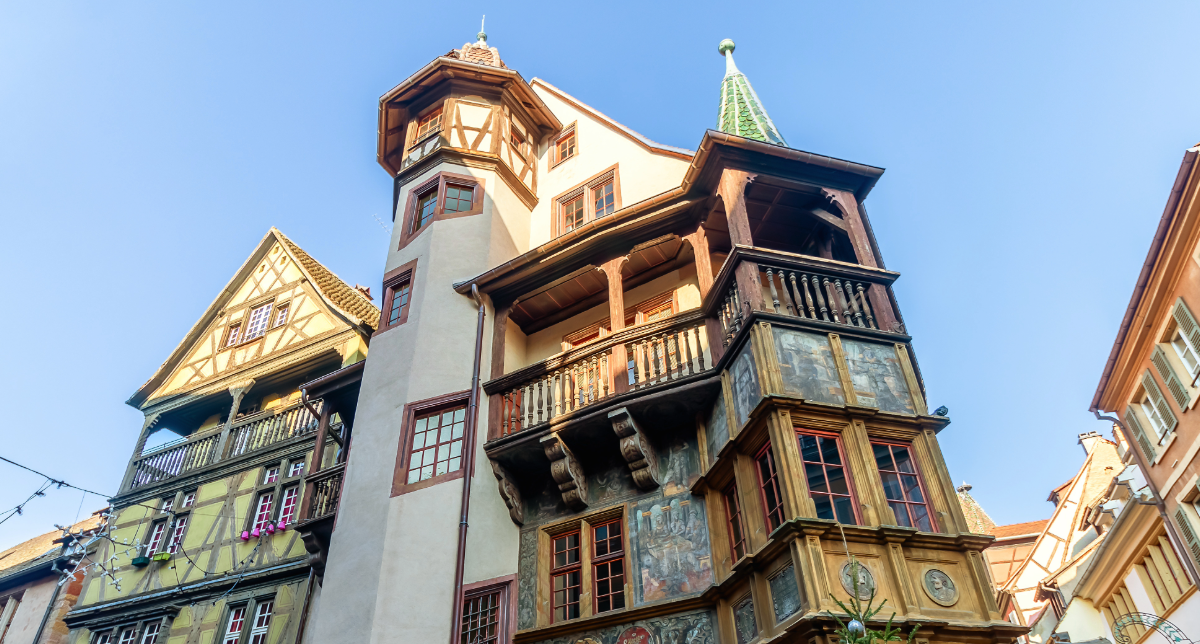
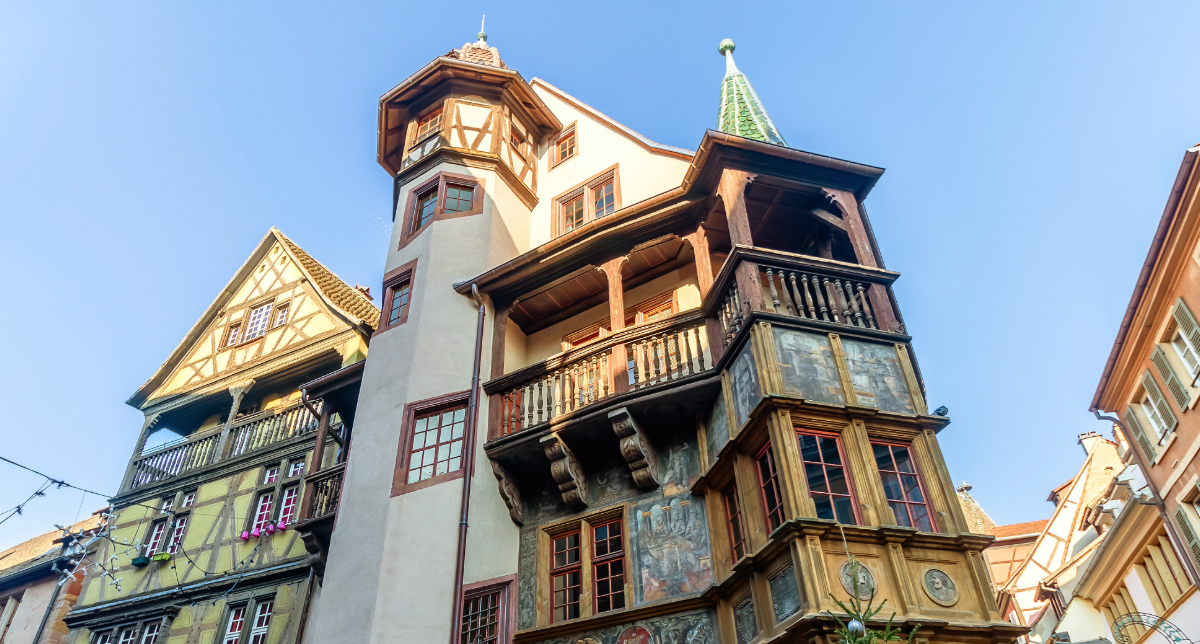
Buying a half-timbered house in Alsace means acquiring one of Europe's most singular built heritages — a timber-frame structure centuries old, a façade that survived the Renaissance, wars and fashions, and a relationship to space and territory that no contemporary construction can reproduce. It also means entering a legal framework of particular complexity that most buyers only discover after the preliminary sale agreement. This guide — produced by Adopte une Conciergerie, the first private luxury concierge and real estate consulting house of Grand-Est — details the entire framework, before you sign.
Legal & Heritage Guide · Alsace · 2026 · Verified Data · Consult a Professional
Half-timbered houses in Alsace — Everything every buyer must know before signing
400
Half-timbered houses disappearing every year in Alsace (ASMA)
€2,000–4,000
Average price/m² half-timbered house Alsace (2025-2026 market)
500m
Protection perimeter around each Historic Monument
1988
UNESCO listing of Strasbourg's Petite France (half-timbering untouchable)
In the lanes of Riquewihr, Kaysersberg, Obernai or Eguisheim, there is something found nowhere else in France — and which has no equivalent in western Europe. These multicoloured timber-frame façades, these jetted upper floors, these interior courtyards, these geraniums at sculpted wooden windows — none of this is a postcard reconstruction. It is the real Alsace, built from the 14th to the 18th century and resistant to everything. Including indifference. Because every year in Alsace, according to the Association pour la Sauvegarde des Maisons Alsaciennes (ASMA), over 400 half-timbered houses disappear from the Alsatian landscape — demolished, transformed beyond recognition, or simply left to deterioration until irreparable.
Buying a half-timbered house is therefore also taking a position in this silent battle for the preservation of an irreplaceable heritage. It is a patrimonial decision in the fullest sense — and one that deserves rigorous legal preparation that too many buyers discover too late.
Understanding the legal protection framework — the map before the terrain
Historic Monuments. A property can be classified or listed under the Historic Monuments Act of 31 December 1913. A classified property carries the highest protection level — any transformation, repair or restoration work is subject to Ministère de la Culture authorisation. A listed property requires prior declaration for any works modifying the exterior appearance. In both cases, the DRAC (Regional Directorate of Cultural Affairs), represented by the Departmental Architecture and Heritage Units (UDAP) of Bas-Rhin and Haut-Rhin, is the mandatory interlocutor before any works project.
The 500-metre perimeter. If the property is not itself classified or listed but is within 500 metres of a Historic Monument, it is nevertheless subject to the opinion of the Architect of Historic Buildings (ABF) for any exterior works. In Alsace, where historic villages and towns concentrate an exceptional number of Historic Monuments, this rule applies to a considerable proportion of half-timbered houses.
Sites Patrimoniaux Remarquables (SPR). Since the LCAP Act of 7 July 2016 (Law n° 2016-925), all previous protection devices — protected sectors, ZPPAUP and AVAP — were replaced by a single device: the Sites Patrimoniaux Remarquables. In an SPR, all works modifying the exterior appearance — including light works such as facade cleaning or construction of a wall under two metres — are subject to prior authorisation under Article L.632-1 of the Heritage Code.
Plan de Sauvegarde et de Mise en Valeur (PSMV). In SPRs with a PSMV — as is the case in Strasbourg, whose Petite France has been listed UNESCO since 1988 — the rules are even more precise and can descend to centimetre-level definitions of permitted works. The ABF's opinion in this context is binding on the mayor and cannot be circumvented.
It is precisely this global vision — legal, architectural, heritage and economic — that Adopte une Conciergerie brings to its clients wishing to acquire a half-timbered house in Alsace.
Eight questions on buying a half-timbered house in Alsace
What is a Site Patrimonial Remarquable (SPR) and how do I know if a half-timbered house falls within one?
The Site Patrimonial Remarquable (SPR) is the single heritage protection device created by the LCAP Act of 7 July 2016 (Law n° 2016-925), replacing former devices — protected sectors, ZPPAUP and AVAP. An SPR corresponds to a town, village or district whose preservation presents a public interest from a historical, architectural, archaeological, artistic or landscape perspective. In an SPR, all works modifying a building's exterior appearance — even light works such as facade cleaning or construction of a wall under two metres — are subject to prior authorisation under Article L.632-1 of the Heritage Code, with the opinion of the Architect of Historic Buildings (ABF). To determine whether a property is in an SPR, the Ministry of Culture database is available online, and the UDAP of Bas-Rhin and Haut-Rhin can be contacted directly before any purchase offer.
What are the concrete constraints on works for a half-timbered house in a protected zone?
They are substantial and cover a much broader perimeter than buyers anticipate. In an SPR with a PSMV — as in Strasbourg — the regulations can define rules to the centimetre for facades, joinery, timber colours, infill materials, and even tile types. Concretely: replacement of windows with standard double glazing — often refused or highly controlled. External wall insulation — quasi-systematically refused on street façades in protected zones. Modification of shutters or louvred blinds — subject to authorisation with prescribed traditional materials and colours. Solar panel installation on street-visible façades or roofs — generally refused. These constraints are not insurmountable obstacles — they are rules of a patrimonial game with its own logic. But they must be known before purchase, not after.
How do you finance renovation of a classified or listed Historic Monument in Alsace?
Owners of properties protected under Historic Monuments benefit from an exceptional fiscal regime, often little-known. For a classified or listed property, restoration works are deductible at 100% from global income (regardless of amount) if the property is open to the public, or at 50% if not open to the public — without any cap on property deficits. This regime is far more advantageous than the Malraux or standard property deficit regimes. It requires keeping the property for at least three years after works and respecting conventions with the DRAC. For a buyer with a high marginal tax rate, acquiring a classified half-timbered house for restoration can represent one of the few still-pertinent fiscal devices in 2026 for character property. Consultation with a specialist in cultural heritage taxation is imperative.
What is Alsace-Moselle local law and how does it affect a property transaction?
Alsace-Moselle local law is a set of legal provisions specific to the Bas-Rhin, Haut-Rhin and Moselle departments — a legacy of German law maintained when these territories returned to France in 1919 and 1945. It applies in numerous areas of civil law: residential tenancies, co-ownership, local civil companies, funeral law, association law, and certain aspects of succession law. For a property transaction, its implications can be significant: local co-ownership rules present particularities compared to common French law, notably regarding the management of common areas and co-owner rights. A notary specialised in Alsace-Moselle local law — most Alsatian notarial offices hold this expertise — is the indispensable interlocutor for securing a transaction on this type of property.
Can a half-timbered house be thermally insulated while respecting heritage requirements?
Yes — but not with standard methods. External insulation, the most thermally efficient solution for recent constructions, is quasi-systematically refused on main street façades in protected zones as it masks the timber framing. Heritage-compatible solutions include internal insulation with bio-sourced materials respectful of old building fabric (wood wool, hemp, cellulose wadding) avoiding vapour barriers incompatible with timber structure "breathing", replacement of joinery with sash double glazing or small-pane windows respecting original proportions, roof renovation with adapted under-rafter insulation, and heating system optimisation. The UDAP of Bas-Rhin and Haut-Rhin have published specific advisory sheets for typical old Alsatian building types, downloadable from the Grand Est Region website.
Can a half-timbered house be rented as a high-end tourist rental — and what regulations apply?
Yes — and it is one of the most pertinent uses of such a property, given international demand for authentic Alsatian stays. The applicable regulation is that of meublé de tourisme (furnished tourist rental): compulsory municipal declaration, registration number (generalised by mid-2026 via the Le Meur Law n° 2024-1039), compliance with rental duration limits if the property is the primary residence (120 days per year). For a secondary residence or pure rental investment, these duration limits do not apply — but a change of use authorisation may be required in certain municipalities. An authentic, well-restored half-timbered house on the Wine Route or in a listed village generates international desirability that few Alsatian properties can match.
What are the most frequent mistakes of buyers of half-timbered houses in Alsace?
Five mistakes recur systematically. First: discovering the property's heritage status after the preliminary sale agreement — whereas this verification must precede any offer. Second: relying on a standard property survey (mandatory for any sale) without commissioning a structural survey specific to old building stock by a specialist timber-frame carpenter. Third: underestimating the renovation budget — restoration with heritage-compatible materials and techniques costs two to three times more than standard renovation. Fourth: choosing a notary or lawyer without specific expertise in Alsace-Moselle local law and heritage law. Fifth: not consulting the UDAP before formulating the renovation project, which regularly leads to refusals and time-consuming back-and-forth.
How does Adopte une Conciergerie support acquisition and management of a half-timbered house in Alsace?
Our heritage real estate consulting covers the entire cycle. Before purchase: verification of the property's patrimonial and regulatory status (SPR, Historic Monuments, PSMV, 500-metre perimeter), coordination of structural survey by a specialist in old Alsatian building stock, review of title and planning documents, realistic assessment of renovation budget compatible with heritage requirements, introduction to a notary specialised in Alsace-Moselle local law. During renovation: coordination of specialist craftspeople (timber-framers, traditional renders, wood joiners), management of relations with UDAP and ABF, supervision of timeline and budget compliance. After renovation: management of the property as a high-end tourist rental, platform presence optimisation, guest welcome, ongoing maintenance. We are the single point of contact — from preliminary sale agreement to the last night booked.
A half-timbered house in Alsace is not a property. It is a position in time — a way of holding upright something that five centuries have failed to bring down. And that position deserves to be taken with all the expertise it requires.
Heritage Real Estate Consulting · First Private Luxury Concierge of Grand-Est · Alsace · Wine Route
Adopte une Conciergerie — Acquisition, Renovation & Management · Half-Timbered Houses · Grand-Est 2026
This guide is provided for information purposes only and does not constitute legal or tax advice. Always consult a specialist notary, heritage architect and tax advisor before any acquisition decision. Sources: DRAC Grand Est · UDAP Bas-Rhin and Haut-Rhin · LCAP Act n° 2016-925 · Heritage Code Art. L.632-1 · Strasbourg.eu · ASMA · Belambra/Pragma Immobilier 2025.